Dr. Henry H. Davis
Dr. Henry Hill Davis was born at Crosswicks, New Jersey, on August 16, 1848. He began the study of medicine in 1867 in the office of Dr. Alexander Mecray, enrolled at Jefferson Medical College that fall, and graduated in March 1869. At the same time he completed a course in pharmacy at the Philadelphia College of Pharmacy and Science, and then began practicing medicine in Camden. In 1874 he opened a drug store, which he conducted alongside his practice through at least 1886. In 1881 he joined the Camden County and Camden City Medical Societies and the State Medical Society. He ran unsuccessfully for Mayor of Camden in 1883, losing to Claudius W. Bradshaw.
For most of the 1880s Davis made his home and conducted his practice and pharmacy at 299 Kaighn Avenue, at the northwest corner of Third Street and Kaighn Avenue; by the 1890–1891 City Directory he had moved to the southeast corner. He later served as a physician at the Camden City Dispensary. The 1910 census recorded him and his wife residing at 232 North 2nd Street, at the southeast corner of Second and Penn. He later lived with his wife, the former Harriet Blizzard, at 417 Cooper Street.
Over his career Davis served as a school board member and county coroner, and became Camden's first medical inspector and first chief medical inspector. He spent many years on the Board of Health, serving as its president when the Camden Municipal Hospital for Contagious Diseases was planned and built. He was also Chief of the Medical Department of Camden's public schools and the first School Medical Inspector in the State of New Jersey.
Plans for the Municipal Hospital were drawn in 1910, and construction began in 1912 under a building committee of Raymond L. Warren, John A. Mather Jr., and William H. Kensinger, M.D. The 1912 Board of Health comprised Davis as president, Marcus K. Mines, E. Winner Collins, Reuben L. Gaskill, S. G. Bushey, Melbourne F. Middleton, and William I. Kelchner. Bids to equip the hospital were let in 1914, with Dr. David Rhone selecting the medical supplies.
In September 1911 four assistant medical inspectors were appointed in addition to Davis, and five inspectors examined more than 2,700 students in the first full month. A year later Dr. Roscoe L. Moore, of the Camden High School class of 1903, was appointed assistant medical inspector for the colored schools at a salary of $240 a year.
That same September the schools enrolled immigrant pupils from Germany, Italy, England, Prussia, Poland, Romania, and Holland. Inspectors found 81 children malnourished, 16 native-born children with defective vision, and 84 with periodontal problems. Unvaccinated children were refused admittance, and a rule allowed teachers sick leave of up to 30 days.
A scarlet fever epidemic struck in February 1913, followed by measles in March. Davis spoke out about unreported disease and about the risks posed by movie houses.
In September 1913 an open-air class for girls opened at the Bergen School, furnished with Rochester and portable desks, with milk served twice daily and Horlick's malted milk donated. The class was discontinued on February 1, 1925.
Medical cabinets and examination screens were purchased for the schools, and Davis classified some children as “dull or deficient.” He pushed for full-time nurses, citing another New Jersey city that had grown from 8 to 38 nurses, and proposed a ratio of one nurse for every 5,000 students.
Miss Sarah Kroenwetter was hired as the district's first nurse on January 19, 1914, at a salary of $625 a year, and was assigned to the Central School. She visited 101 homes and received a $100 raise beginning in January 1915.
By February 1915 no school reported a child's death from illness, and Davis held a “court” each Wednesday for parents.
In 1915–1916 nurse Rebecca O. Kandle was hired at a salary of $720 a year.
When the Spanish Influenza epidemic arrived in September 1918, average daily attendance dropped by about 2,000, and Davis was given authority to close the schools. He closed the day and evening schools from October 1 to November 6, 1918. A second wave followed from January to March, and influenza returned in February 1920, this time with no fatalities.
The Camden Municipal Hospital for Contagious Diseases opened in 1916 under Davis, who by then held the title of Health Director. Dr. Rhone treated more than 100 polio patients that year, and Dr. Jungman served as full-time Medical Director.
In 1917 Dr. Jungman entered military service, and the hospital was run by Davis and Dr. John Leavitt. During the 1918 epidemic, overflow patients were housed in the doctor's bungalow, the nurses' home, and the Haddon Avenue armory, and the New York Shipbuilding Corporation assigned staff. Davis worked alongside Dr. Marcus K. Mines.
Smallpox epidemics before 1910 were reduced by Davis's vaccination campaign; a 1925 outbreak brought 97 cases and 44 deaths, with single fatal cases in 1933 and 1947. In 1923 Davis was succeeded as Health Director by Dr. Arthur L. Stone.
The Henry H. Davis School, the largest elementary school in Camden, was built in 1925 at 3425 Cramer Street in East Camden, designed by architect Benjamin Howell Lackey. Davis Street, adjoining the Municipal Hospital property, was also named in his honor.
Davis served as president of both the Camden County and Camden City Medical Societies, was a member of the American Medical Association, and was an active member of Camden Lodge No. 293, B.P.O.E..
Dr. Henry Hill Davis died in 1929; a later account records that he was killed by an automobile in his eightieth year.
In the Newspapers
The newspaper articles and documents below record Dr. Davis's work as county coroner and, later, as a Camden health official. Each is preserved as its own post.
Tag: dr-henry-h-davis
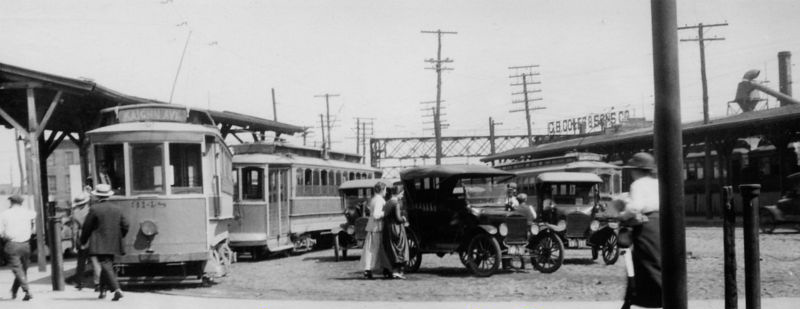
Kaighn Avenue
One of Camden's major east-west streets, running from Kaighn's Point at the Delaware River east to Admiral Wilson Boulevard and the Airport Circle in Pennsauken, with block-by-block address histories from the 1860s through the early 2000s.
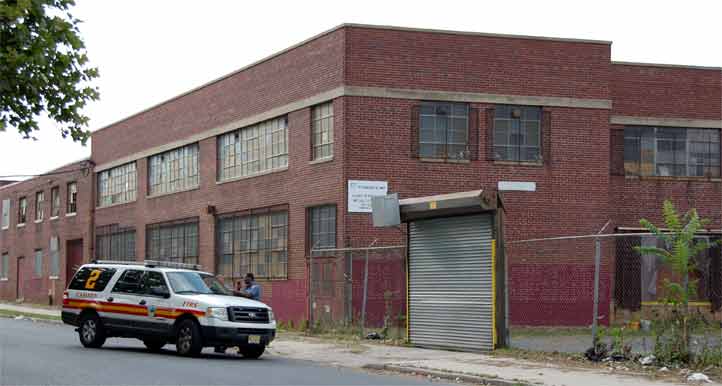
Davis Street
Davis Street runs southeast from north of Sheridan Street to Ferry Avenue in the East Camden/Morgan Village area, named for Dr. Henry Hill Davis — Camden's first medical inspector and School Medical Inspector in New Jersey.

Lincoln School
aka Claudius W. Bradshaw School; aka Challenge Square Academy; aka Met East High School 1151 Kaighn Avenue Camden had become an industrial city by the 1880s, and although the country went into an economic slump in the early 1890s, generally referred to as "the panic of 1893," the city continued to grow and with it the need for new schools.

2nd Street
2nd Street extends north-south between Front Street and 3rd Street, running parallel to the Delaware River until Mechanic Street. In the early 1970s, several buildings were cleared on the east side of North 2nd Street below Mickle Street to make way for the Royal Court townhomes and Mickle Tower senior citizens apartment building.
Four Prominent Physicians
Ben Courter's 1931 Camden Courier-Post reminiscence of four leading South Jersey physicians — Drs. Godfrey, Iszard, Davis and Gross — recalling how Dr. H. H. Davis transformed health care for Camden's schoolchildren.
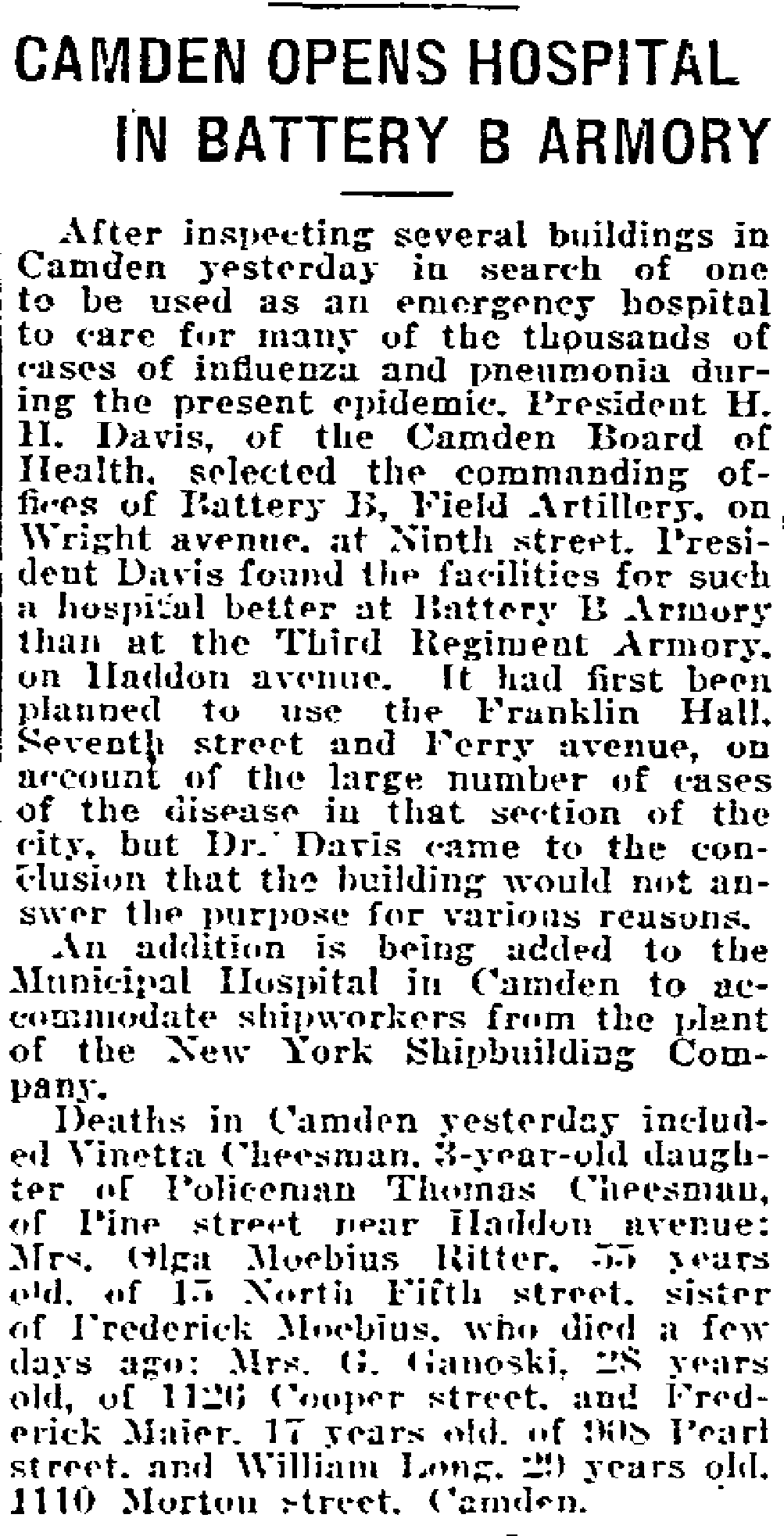
Camden Opens Hospital in Battery B Armory
President H. H. Davis of the Camden Board of Health selected the Battery B Armory as an emergency hospital during the 1918 influenza and pneumonia epidemic.
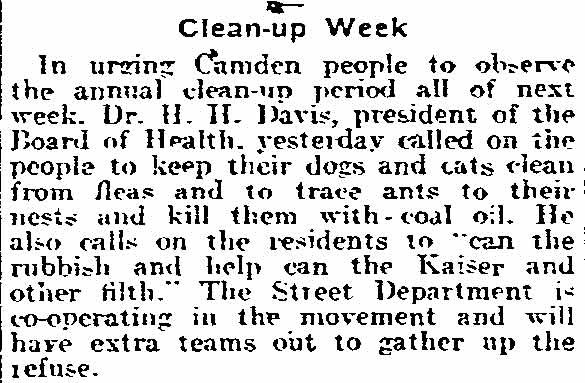
Dr. Davis Urges Annual Clean-Up Week
Dr. H. H. Davis, president of the Board of Health, urged residents to observe the city's annual clean-up week and to “can the rubbish and help can the Kaiser and other filth.”
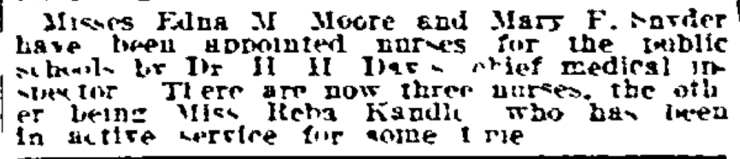
Two School Nurses Appointed
Dr. H. H. Davis, chief medical inspector, appointed Edna M. Moore and Mary F. Snyder as public-school nurses, bringing the district to three.
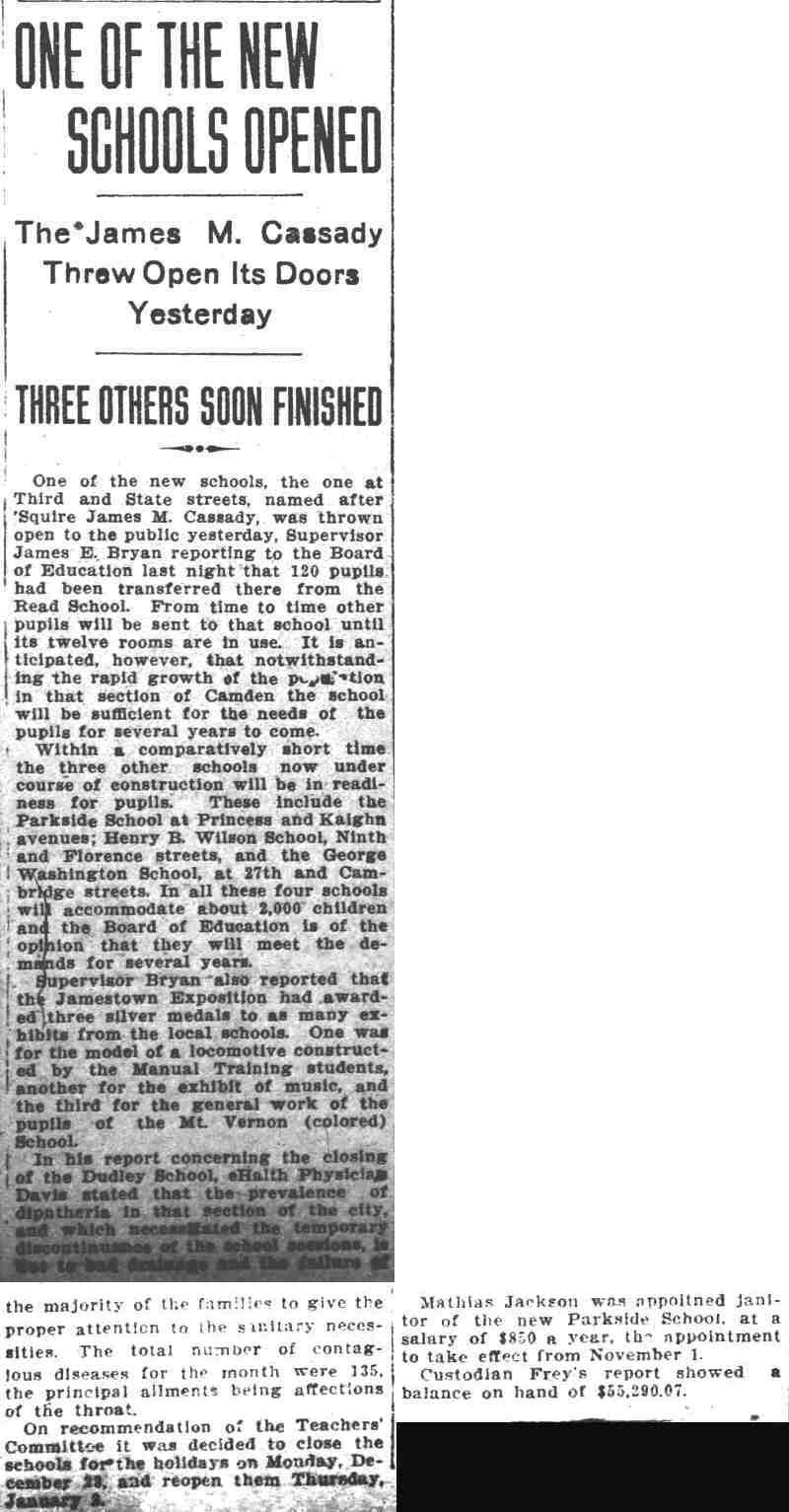
One of the New Schools Opened
The Camden Daily Courier reports the opening of the James M. Cassady School, with Health Physician Davis explaining the closing of the Dudley School during a diphtheria outbreak. (Transcription incomplete.)
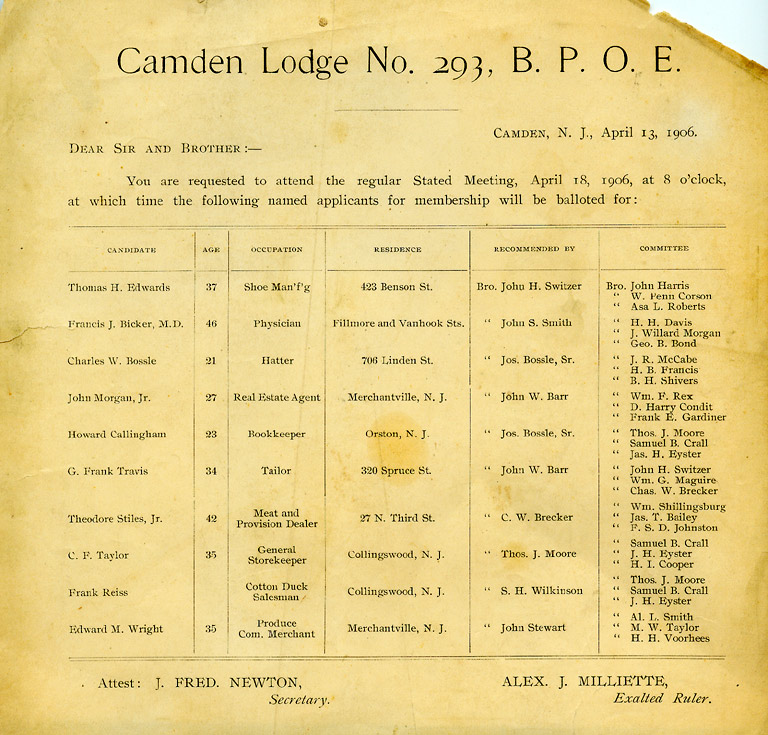
Camden Lodge No. 293, B.P.O.E. — Membership Ballot Notice
A membership ballot notice for Camden Lodge No. 293, B.P.O.E., listing the applicants to be balloted on at the April 18, 1906 stated meeting; Dr. H. H. Davis served on the investigating committee for one candidate.
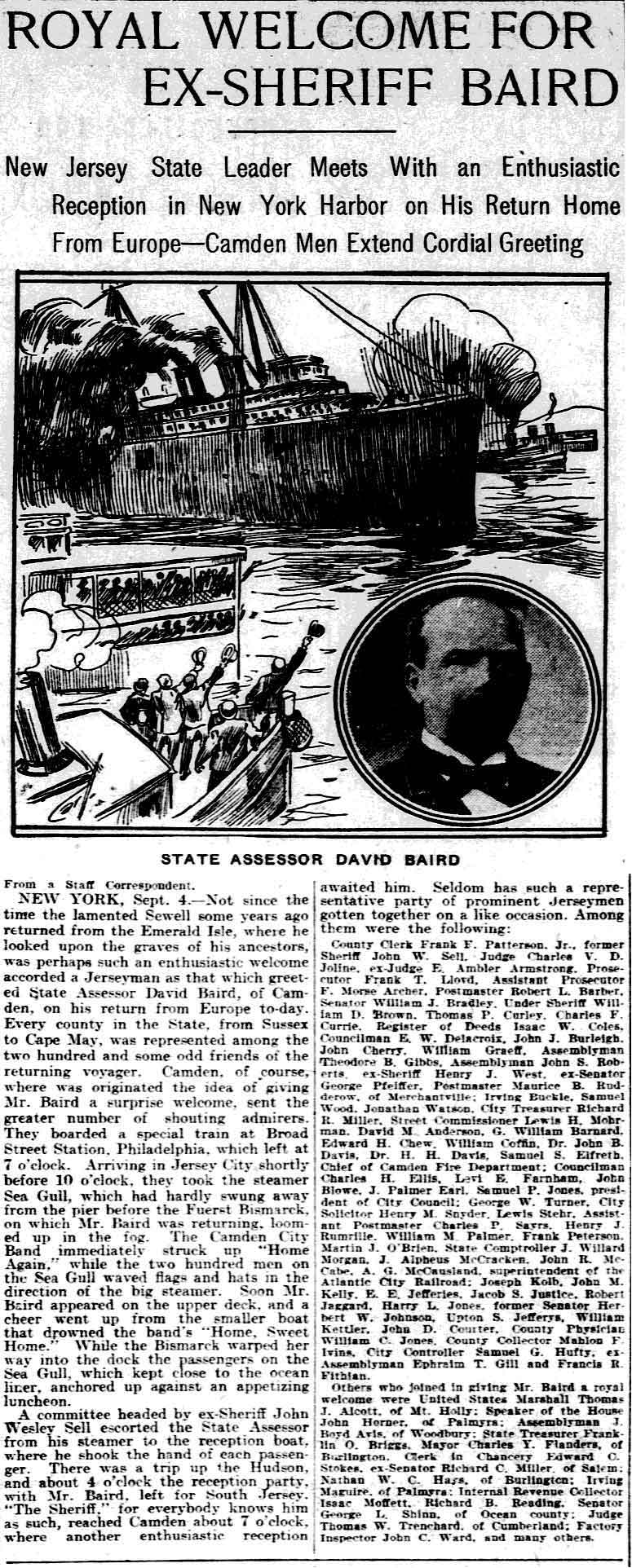
Royal Welcome for Ex-Sheriff Baird
The Philadelphia Inquirer's account of the enthusiastic welcome given State Assessor and former Sheriff David Baird on his return from Europe; Dr. H. H. Davis was among the Camden men in the greeting party.
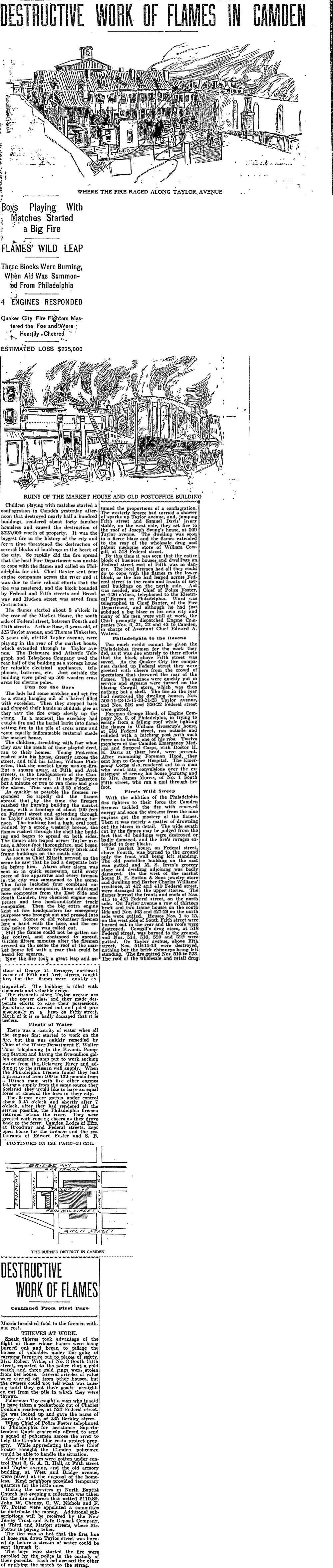
Destructive Work of Flames in Camden
The Philadelphia Inquirer's account of a destructive fire along Taylor Avenue in Camden, started by boys playing with matches, which drew Philadelphia engines across the river.
Obsequies of Henry B. Wilson
An account of the funeral of former Postmaster Henry B. Wilson, at which Dr. H. H. Davis served as one of the pallbearers.

Side-Splitting Farce Goes On
The Camden Daily Telegram's account of the Police Committee's hearings on charges against city policemen, at which Dr. “Mark Hanna” Davis was noted as absent from the Reformers' deliberations.
Boy Attacked by Dog on Spruce Street
A ferocious dog nearly killed six-year-old Walter Vanstavern on Spruce Street near South 7th Street; Coroner H. H. Davis took charge of the case.

Burial Certificate for Charles Blieth
Coroner Davis issued a certificate of burial for Charles Blieth, of No. 22 Oak Street, who died without medical attendance.

Coroner Davis Holds Inquest in Child's Death
Coroner Davis held an inquest on a colored girl believed to have been murdered; the jury found she came to her death from shock at the hands of persons unknown.
Infant's Body Found on Broadway
Coroner Davis took charge of the body of an infant found on Broadway near Branch Street, and of the recovered body of William Knowells, drowned off the Chestnut Street wharf.
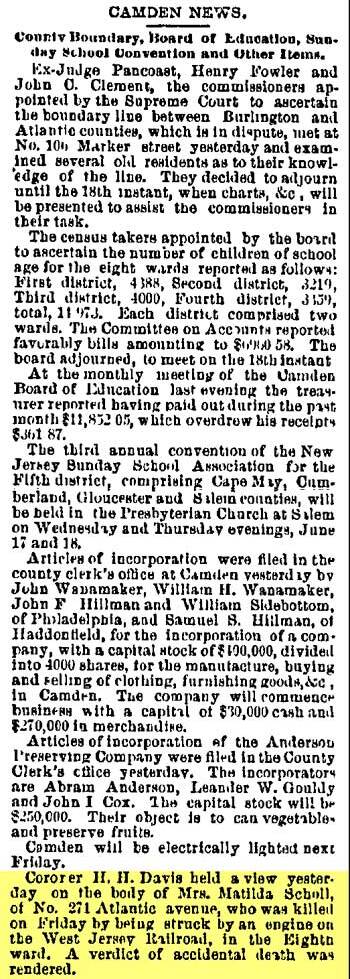
Camden News — June 2, 1885
A Philadelphia Inquirer column of Camden news, closing with Coroner H. H. Davis's inquest verdict of accidental death in the killing of Mrs. Matilda Scholl.
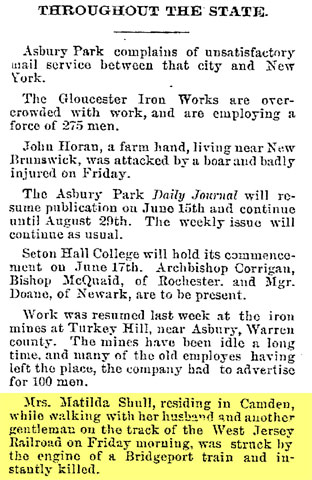
Throughout the State
A Trenton Evening Times statewide news column noting the death of Mrs. Matilda Scholl, struck by a train on the West Jersey Railroad in Camden.
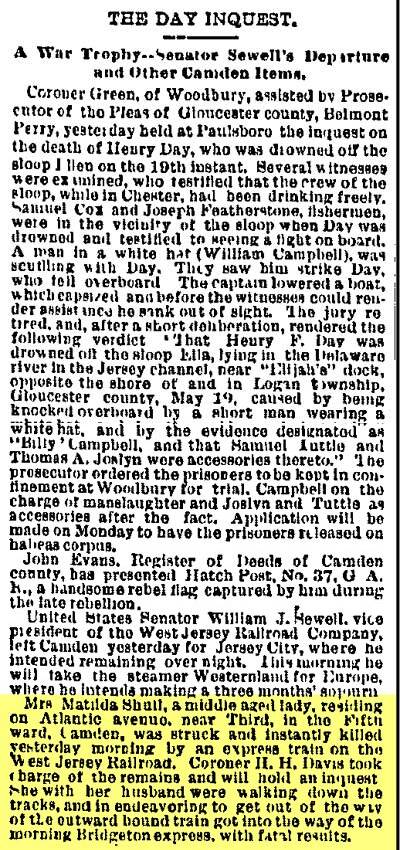
The Day Inquest
A Philadelphia Inquirer column of Camden items, including the death of Mrs. Matilda Scholl on the West Jersey Railroad, of which Coroner H. H. Davis took charge.
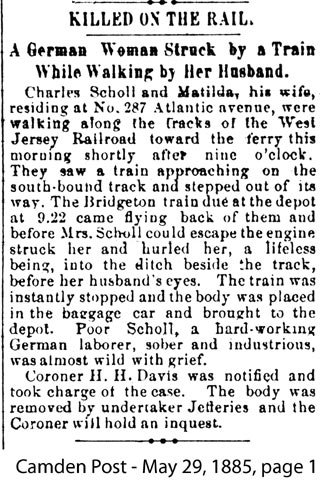
Killed on the Rail
The Camden Post's account of the death of Mrs. Matilda Scholl, struck and killed by a West Jersey Railroad train near the ferry; Coroner H. H. Davis took charge of the case.