People
William E. Jaeckel
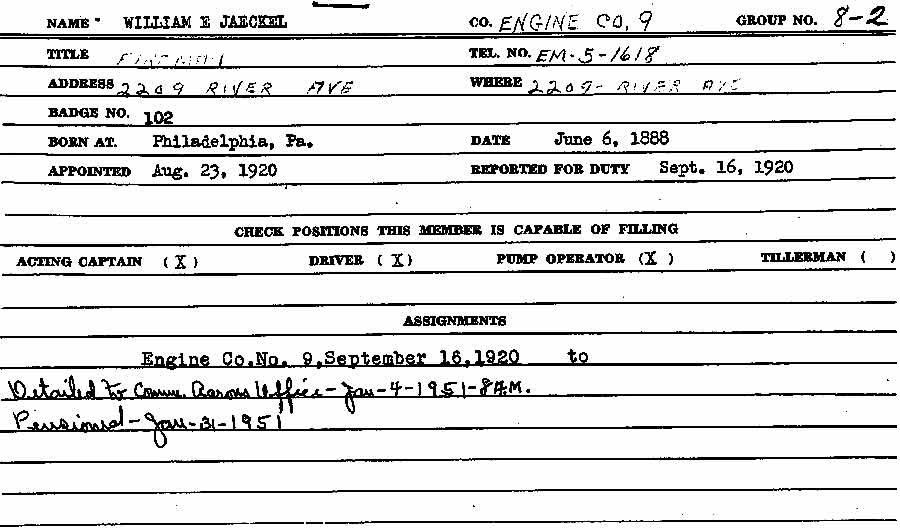
William E. "Pud" Jaeckel (1888–1961) joined the Camden Fire Department in 1920 and served over thirty years with Engine Company 9 at North 27th and Federal Streets in East Camden, retiring on pension in January 1951.
Tag
William E. "Pud" Jaeckel (1888–1961) joined the Camden Fire Department in 1920 and served over thirty years with Engine Company 9 at North 27th and Federal Streets in East Camden, retiring on pension in January 1951.
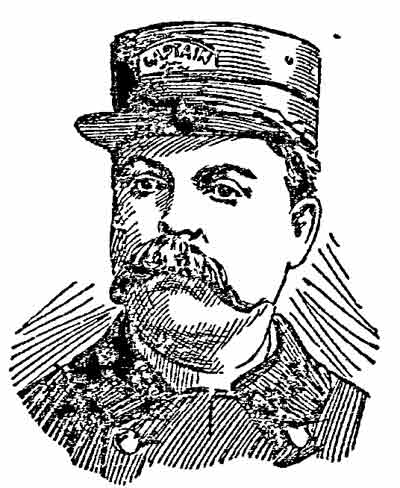
Arthur Stanley (1845–1925), Camden police captain and Civil War veteran. Born in England, he came to America in 1853, served with Company G, 12th New Jersey Infantry at Chancellorsville, Gettysburg and Petersburg, and commanded the Second District of the Camden Police Department from 1898 until his retirement in 1916.
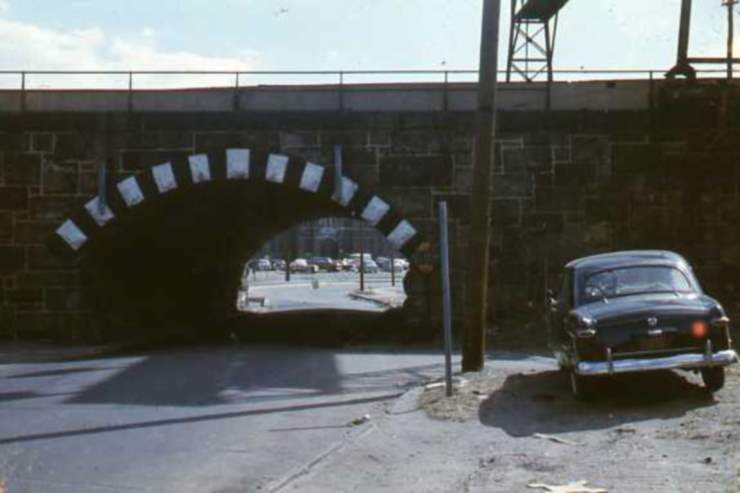
Eleventh Street ran north from Market Street through to Pearl Street. Over time, North 11th Street was erased block by block, until only a short segment between Penn and Linden Streets survives. South 11th Street is a connecting road with no residential addresses.
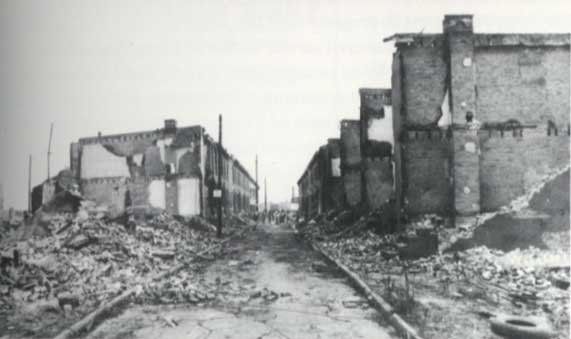
Burns Street was in Camden's Poet's Row neighborhood, named for Robert Burns. Three blocks of row homes built in the 1890s, all destroyed in the catastrophic Poet's Row fire of August 1972.

Cooper Browning Hatch was a prominent citizen of Camden in the late 19th and early 20th centuries. He was born to Joseph and Mary Hatch in a farmhouse that now houses the Camden County Historical Society.

Charles Hobart Corson, commonly known as Hobart Corson , was born in Camden, New Jersey, on July 23, 1902, to W. Penn Corson and his wife, the former Catherine Kronenwetter.
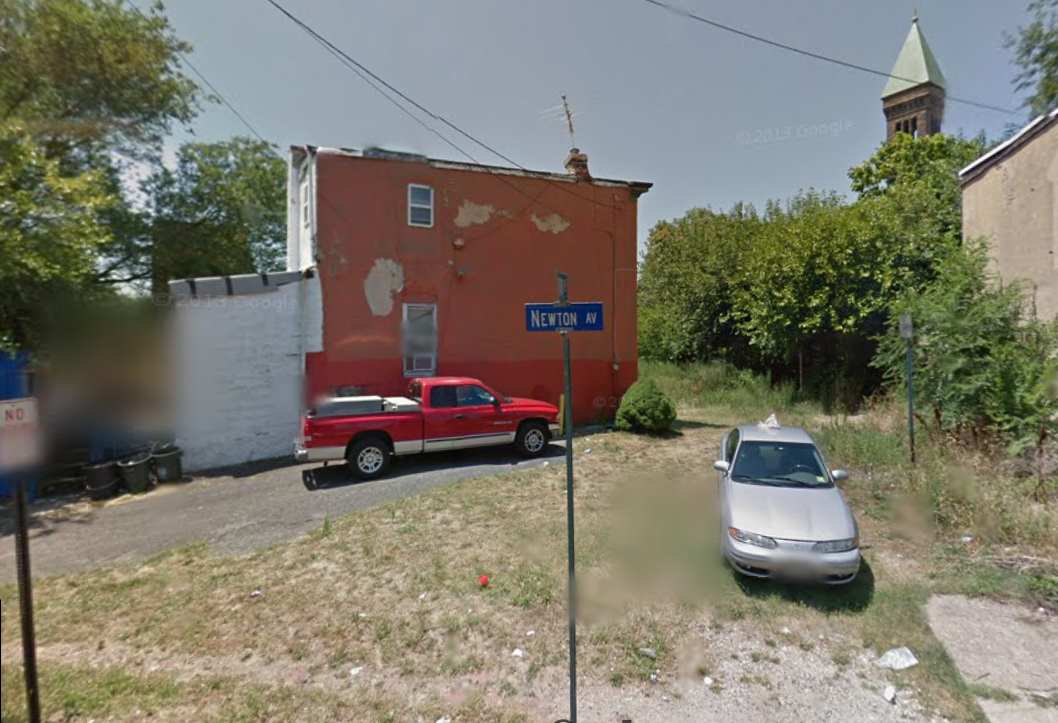
Girard Place was a short, dead-end street running east from 916 St. John Street in Camden, NJ. First appearing in city directories in 1890 with eleven homes, it dwindled to a single occupied house at 570 Girard Place by 1980 before disappearing as a through street.
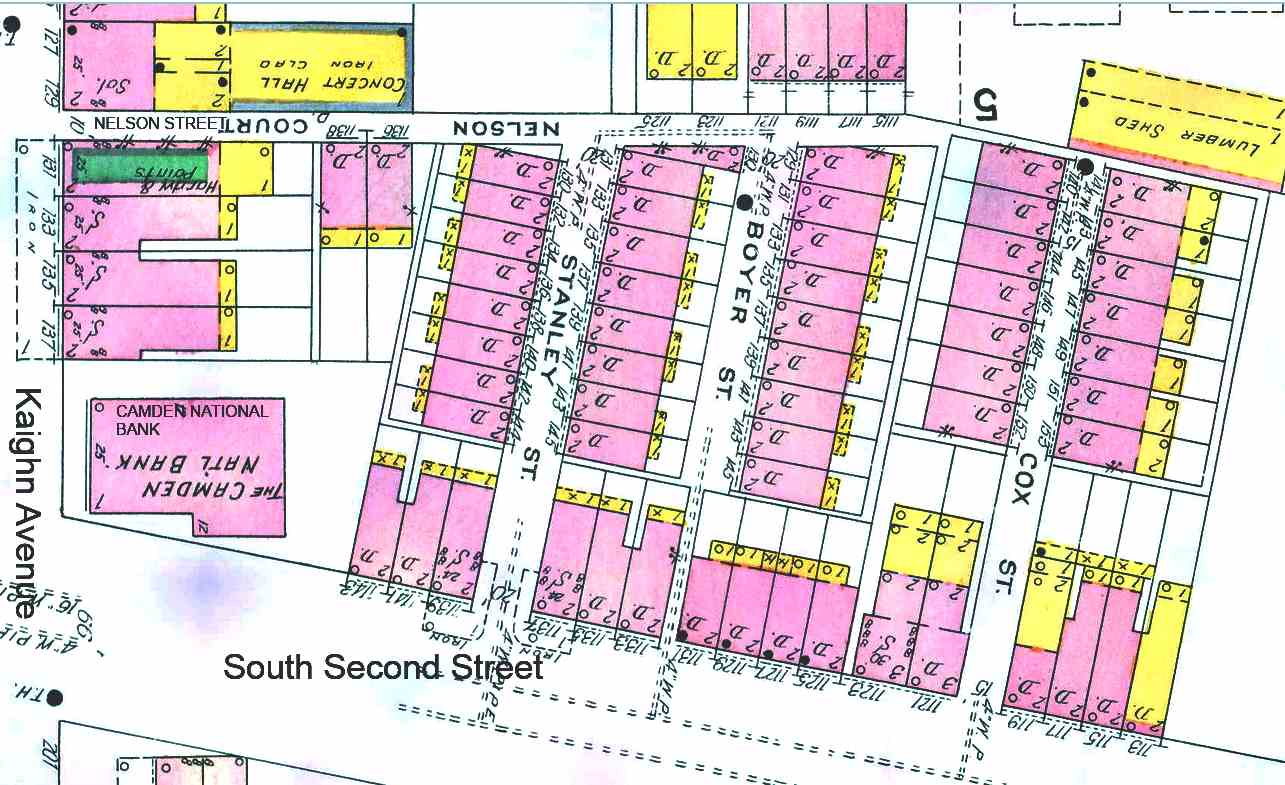
Boyer Street, also known as Boyer Court, was a half-block dead-end street running east from Nelson Street in South Camden. Eight brick homes on the north side were built in the early 1890s and demolished after World War II for industrial development.
Border Street, renamed Mt. Ephraim Avenue in the 2000s, ran from Line Street and Haddon Avenue north along the railroad tracks to Newton Avenue. It remains a convenient shortcut between South Camden and East Camden.

Camden High School opened in 1918 at Park and Baird Boulevards in Camden, NJ, designed by architects Arthur Truscott and Paul A. Davis III.

Mount Ephraim Avenue in Camden, NJ, dates to 1878 as the Mount Ephraim Turnpike toll road and was known as Border Street until the 2000s.

Division Street runs across South Camden. In 1997, a portion of the street was renamed Ramona Gonzalez Street to honor a community leader; the remainder continues to be known as Division Street.

Haddon Avenue is one of Camden's oldest roads, dating to at least 1792 as a bridle path and incorporated as the Haddonfield & Camden Turnpike in 1839. It runs southeast from Federal Street to the city limits toward Collingswood, Haddon Township, and Haddonfield.

EUGENE F. ALSTON was born October 16, 1919 in Camden to Richard Alston and his wife, the former Dolly Robinson. His father had been born in 1891 in Henderson, North Carolina.
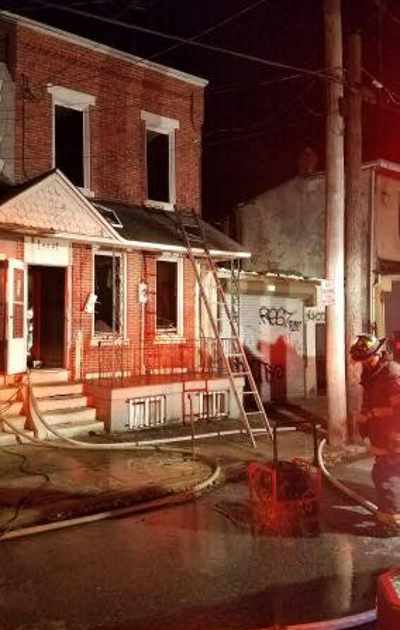
Berkley Street runs through South Camden from Buren Avenue to Haddon Avenue, named for Lord Berkeley, one of the original proprietors of colonial New Jersey. The section east of Broadway was once known as Hamilton Street until 1882.
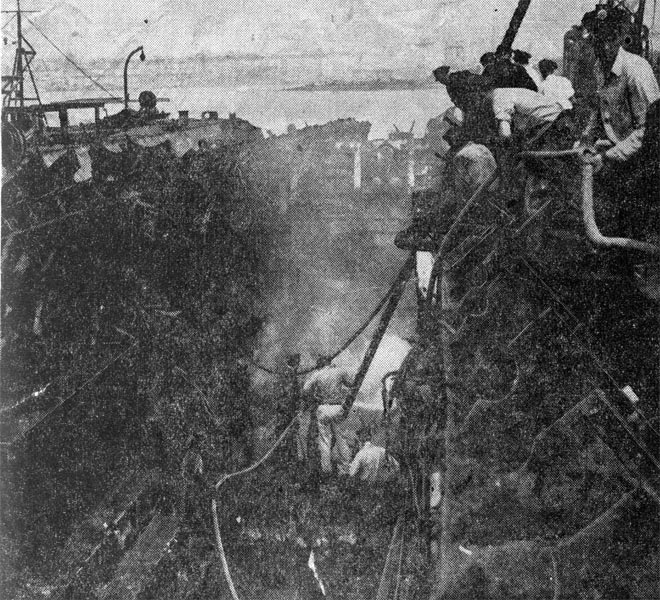
Fifth Street was one of Camden's original streets, running south to north, with a few major interruptions, from Newton Avenue to just west of Pyne Point in North Camden.
Camden Courier-Post - November 25, 2003 By KEVIN RIORDAN, Courier-Post Staff Retired state Superior Court Judge Joseph M. Nardi Jr. , a shoemaker's son who became an attorney, a mayor and a member of the state judiciary, is dead.
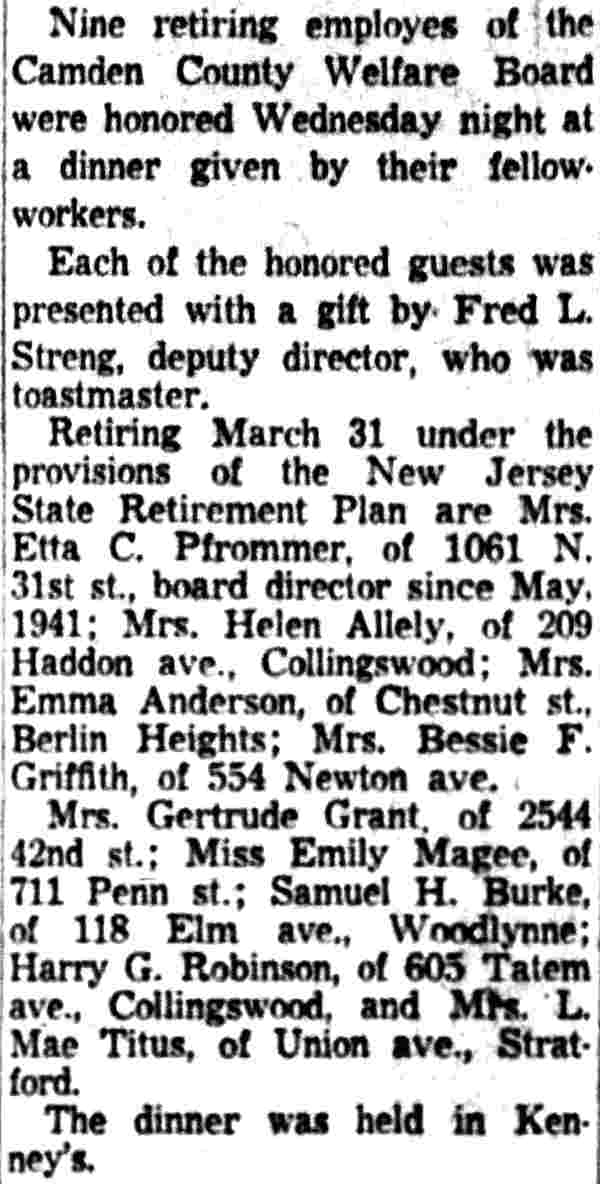
Nine retiring employees of the Camden County Welfare Board were honored at a dinner in February 1956, including board director Mrs. Etta C. Pfrommer of 1061 North 31st Street who had served since 1941.

Kaighn School Razed; Blazes Set in Church, Unoccupied House Police today are investigating the possibility that three fires Wednesday within a quarter-mile area inside of three hours and 46 minutes were the work of a firebug.
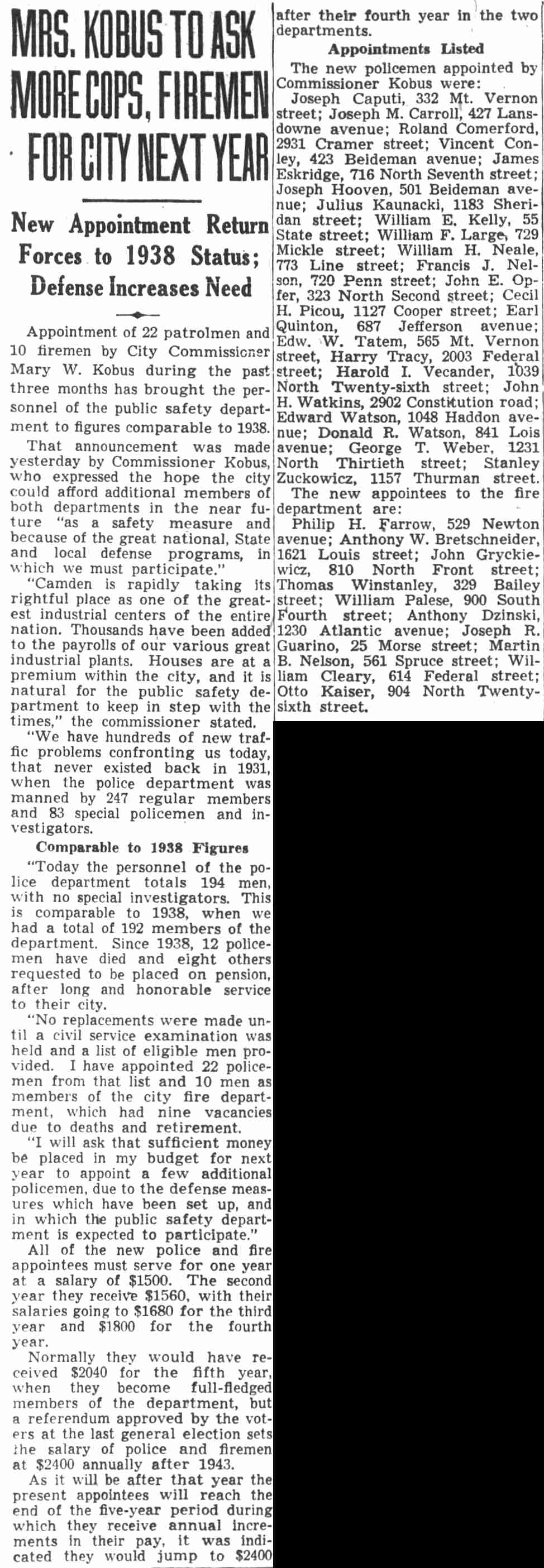
Camden Public Safety Commissioner Mary W. Kobus announced in December 1940 that her appointment of 22 patrolmen and 10 firemen had restored the public safety department to 1938 strength, and said she would seek money for more officers because of defense needs; John Gryckiewicz of 810 North Front Street was among the fire appointees.
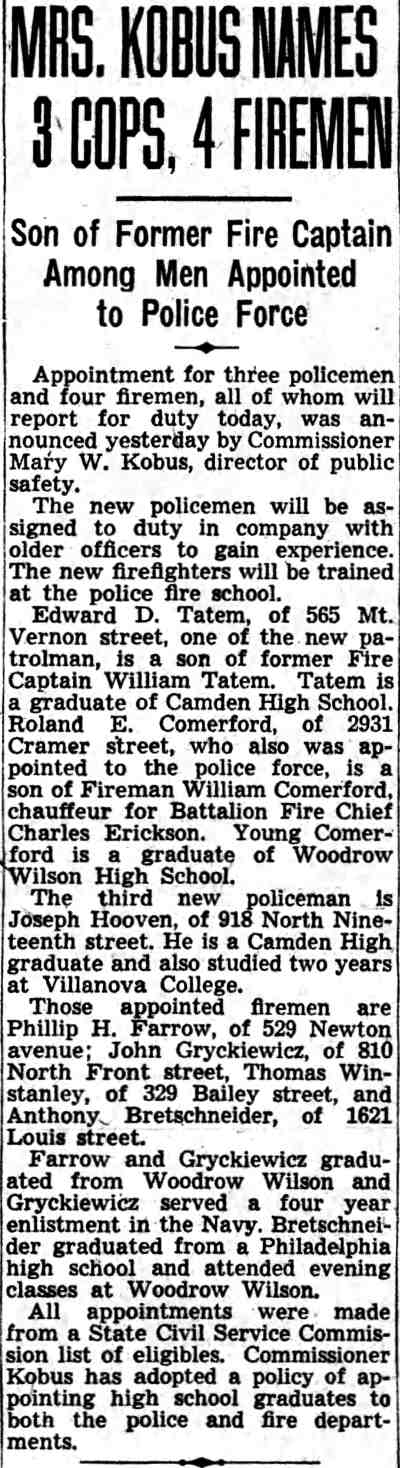
Commissioner Mary W. Kobus announced the appointment of three Camden policemen and four firemen in November 1940; among the new firefighters was John Gryckiewicz of 810 North Front Street.
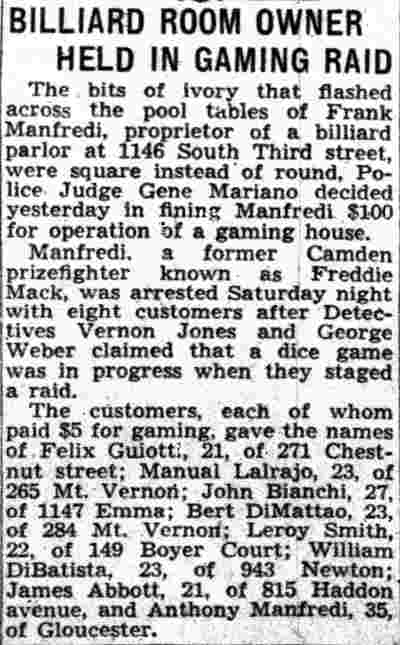
Frank Manfredi, proprietor of a billiard parlor at 1146 South Third Street and a former Camden prizefighter known as Freddie Mack, was fined $100 for operation of a gaming house after a dice-game raid.
Mrs. Elizabeth Holmes of 519 Newton Avenue was fined $25 for allowing disorderly persons to congregate after a woman screamed murder at 3 AM, drawing police to the house.

Man and Woman Struck by Lightning; Mercury Tumbles A violent electric storm, which paralyzed a South Camden woman, accompanied by a driving rain tumbled the mercury last night and ended, temporarily, the six-day heat wave.
Three men who pleaded guilty to stealing gas or electricity from Public Service were sentenced to 30 days in county jail. Among them: John Waldner of 814 North 34th Street, who tapped the main gas line while his wife was ill and their meter was shut off for nonpayment.
Less than 24 hours after the Camden Board of Education had warned school officials of Pennsauken township and Woodlynne borough that 164 pupils from those towns faced dismissal from Camden Senior High School, officials of both communities last night promised that money owed the local board would be transmitted today.

In June 1930 Mrs. Helen Edwards, 36, confessed to police that she stabbed her husband John W. Edwards, a gasoline station manager, during a quarrel over a meal; he died at Cooper Hospital.
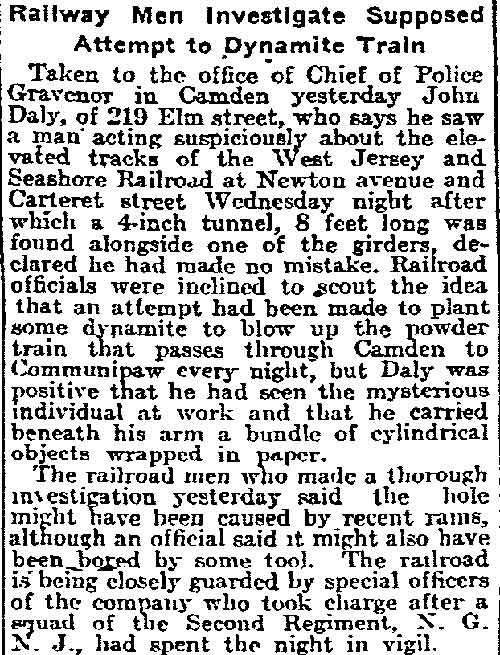
John Daly reported a suspicious man at the elevated West Jersey and Seashore Railroad tracks at Newton Avenue and Carteret Street, where a bored hole was found; railway men investigated a supposed dynamite attempt.
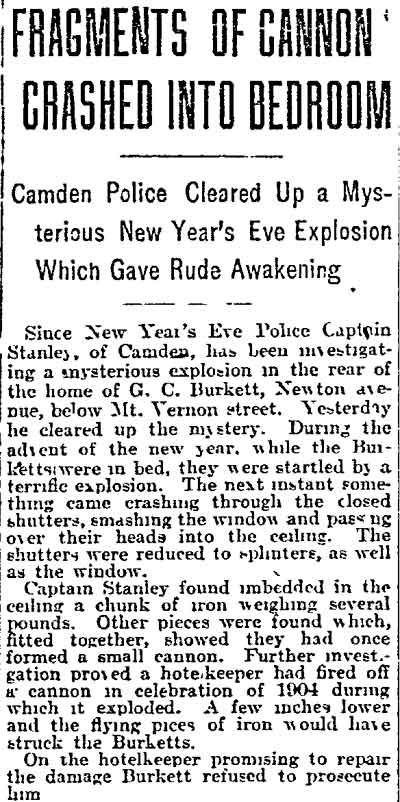
Captain Stanley traced a mysterious New Year's Eve explosion that sent iron fragments through the shutters of G. C. Burkett's Newton Avenue bedroom to a hotelkeeper whose celebratory cannon had burst.
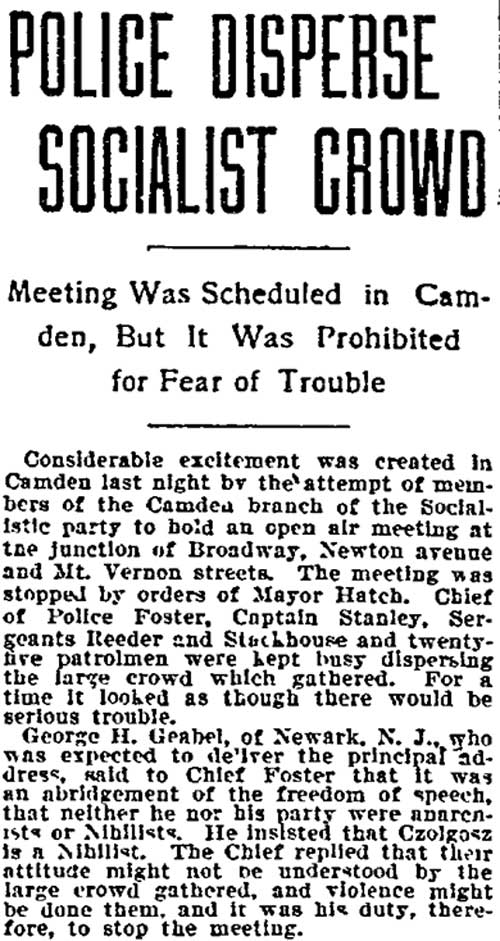
An open-air meeting of the Camden branch of the Socialist party at Broadway, Newton Avenue and Mt. Vernon Street was stopped by order of Mayor Hatch. Chief Foster, Captain Stanley and twenty-five patrolmen dispersed the crowd.
The Camden and Suburban Railway Company's ruse to slip a work gang onto Haddon Avenue failed when a watchful police line intercepted them. Captain Stanley — "the doughty little captain" — ordered the men to disperse, and Mayor Hatch had the street cleared.
Residents and property owners of Camden's Fourth and Sixth wards petition City Council for an under-drainage culvert running from the Line Street culvert at Broadway out to Sixth Street and north to Sixth and Royden. Arthur Stanley, then of 929 Newton Avenue, signed among the petitioners.

The Camden Cemetery, known in modern times as Old Camden Cemetery, adjoining the Newton Friends' burying grounds, through an action of a town meeting of the Township of Camden, was founded on March 10, 1836.