Philadelphia Inquirer, May 24, 1904View transcription
FOUR KILLED WHEN FIREWORKS BLEW UP
Factory on the Outskirts of Camden Wrecked by an Explosion of Mysterious Origin---Ten Received Injuries---Officers of the Company Placed Under Arrest
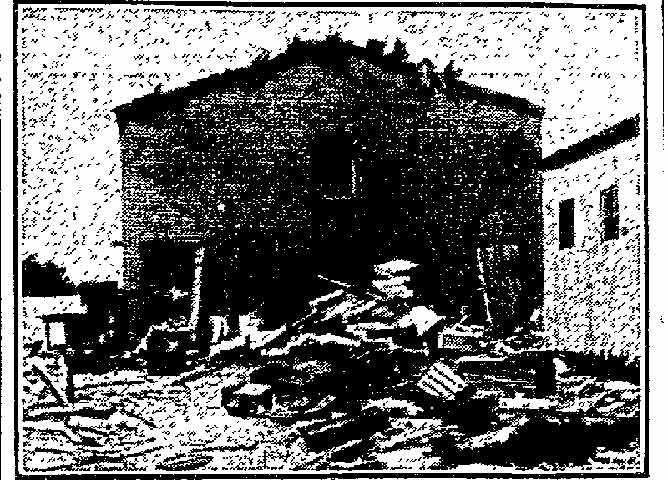
[Photograph, captioned:] MAIN BUILDING WRECKED BY THE EXPLOSION
With a roar and concussion that shook buildings and shattered windows for miles around an explosion occurred at the Independent Fireworks Company, Ferry and Cooper avenues, Camden, yesterday morning about half-past 6 o'clock. Three Italians were blown to fragments, another died in the Cooper Hospital late last night and nine persons were more or less seriously injured.
The Dead Are
SINEONE TIERANTOZODI, aged 17 years, of 248 Division street, Camden.
LEONARDO PINTO, aged 45 years, Tenth and Ferry avenue; expert workman.
UNKNOWN ITALIAN, probably Joseph Logalla, of Philadelphia.
UNKNOWN ITALIAN.
Ten Were Injured
The injured are:
MICHAEL SCALONA, aged 52 years, of 109 Powelton avenue, Woodlynne, foreman of the factory, mangled thigh. Condition serious; Cooper Hospital.
HANNAH PARKER, aged 16 years, 203 Haddon avenue, Stonetown, cut and bruised, concussion of the brain; Cooper Hospital.
STELLA LEWIS, aged 18 years, 203 Haddon avenue, Stonetown, cut about face, head, arms and body by flying glass; Cooper Hospital.
MARY ENGLE, aged 14 years, 1807 South Tenth street, lacerated face and chin and shock; Cooper Hospital.
JULIUS ENGLE, aged 12 years, 1807 South Tenth street, cut, bruised and suffering from shock; Cooper Hospital.
PETER KEARNEY, aged 15 years, of 653 Ferry avenue, contusion of back, head and face; taken home.
JEROSA MONGELLO, aged 41 years, of 246 Division street, burned about legs; Cooper Hospital.
TONY DINIGRO, aged 17 years, 657 Ferry avenue, right hand torn and leg injured; Cooper Hospital.
UNKNOWN YOUNG MAN, cut about hands and face.
The sight was appalling. The body of one of the victims was found a hundred yards from the scene of the explosion. Every thread of clothing had been torn from the body. Morgue Keeper O'Brien removed the remains to the morgue.
A few minutes after the explosion the police were notified by Charles Dubell. A squad of officers under Captain Stanley and Sergeant Hyde were at once sent to the scene to keep the crowd away.
The force of the explosion was terrific. The brick building occupied by the company, 30 by 40 feet, was twisted so badly that it will have to be torn down. A frame structure, known as the labeling building, was shattered as though splintered with an ax.
Many of the packing boxes were broken by the concussion and the splintered wood was hurled hundreds of feet.
Windows Broken
Probably there is not a house in Wood Lynne but what suffered by broken windows. Twenty-one windows were wrecked at the home of R. A. Rockhill, 108 Wood Lynne avenue. The houses occupied by J. A. Diebert, 116 Wood Lynne avenue; Eberhardt Renning, 108 Wood Lynne avenue; Wilson Cunningham, 110 Wood Lynee avenue, and R. A. Raphal Cooper avenue, were shaken so violently that in some instances not only the windows but the sashes as well were knocked out.
Jerosa Mongello probably had one of the narrowest escapes from death. He was working about the place when he suddenly felt himself hurled high in the air. He alighted in a recently plowed field, minus some clothing and suffering from burned legs. He was badly shocked but will recover. He was near the three other Italians who were blown to pieces.
Miss Parker was just entering the labeling house when she was hurled with terrific force a dozen feet away. When found, she was sitting on the ground with a large wooden box resting on her head. She was delirious from fright and severe injuries when discovered.
Hurled Through Doorway
Tony Dinigro said he was working and all he knew there was a big noise. "Then I was hurled through a doorway," said he. "I don't know how I got home, I was so scared."
Peter Kearney said he had just gone into the powder house to get ready for work when the explosion occurred. He was thrown into the street.
According to these men both dynamite and powder were used by the concern, Kearney declaring he was employed to carry the explosive to the mixing plant.
Had the explosion occured a few minutes later the loss of life would have been much greater. Just as the catastrophe occurred a trolley car loaded with female employes was within a block of the place. Inside of five minutes they would have been working in the labeling and storage rooms, which were shattered by the concussion.
Placed Under Arrest
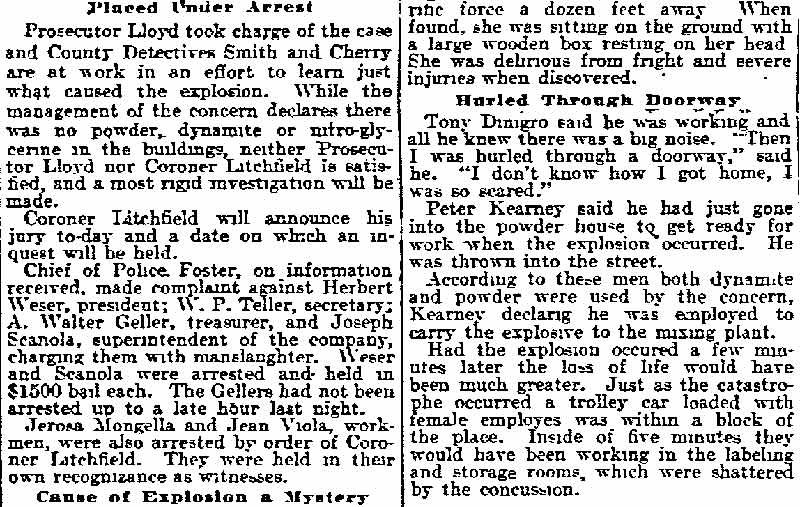
Prosecutor Lloyd took charge of the case and County Detectives Smith and Cherry are at work in an effort to learn just what caused the explosion. While the management of the concern declares there was no powder, dynamite or nitro-glycerine in the buildings, neither Prosecutor Lloyd nor Coroner Litchfield is satisfied, and a most rigid investigation will be made.
Coroner Litchfield will announce his jury to-day and a date on which an inquest will be held.
Chief of Police Foster, on information received, made complaint against Herbert Weser, president; W. P. Teller, secretary; A. Walter Geller, treasurer, and Joseph Scanola, superintendent of the company, charging them with manslaughter. Weser and Scanola were arrested and held in $1500 bail each. The Gellers had not been arrested up to a late hour last night.
Jerosa Mongella and Jean Viola, workmen, were also arrested by order of Coroner Litchfield. They were held in their own recognizance as witnesses.
Cause of Explosion a Mystery
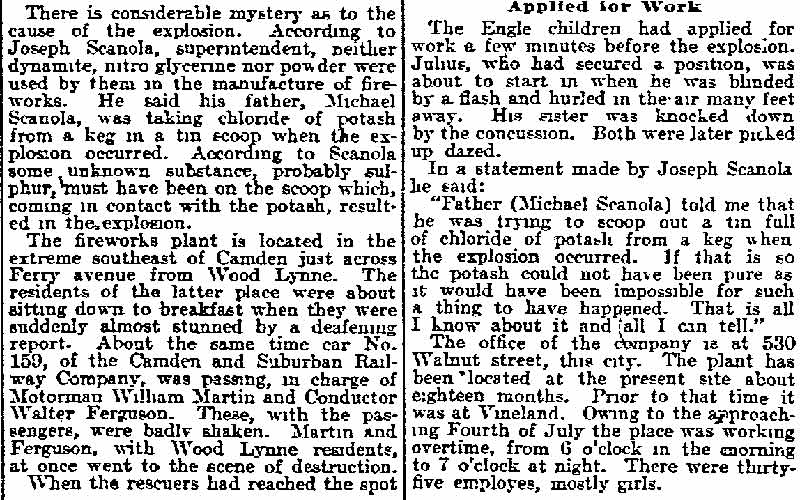
There is considerable mystery as to the cause of the explosion. According to Joseph Scanola, superintendent, neither dynamite, nitro glycerine nor powder were used by them in the manufacture of fireworks. He said his father, Michael Scanola, was taking chloride of potash from a keg in a tin scoop when the explosion occurred. According to Scanola some unknown substance, probably sulphur, must have been on the scoop which, coming in contact with the potash, resulted in the explosion.
The fireworks plant is located in the extreme southeast of Camden just across Ferry avenue from Wood Lynne. The residents of the latter place were about sitting down to breakfast when they were suddenly almost stunned by a deafening report. About the same time car No. 159, of the Camden and Suburban Railway Company, was passing, in charge of Motorman William Martin and Conductor Walter Ferguson. These, with the passengers, were badly shaken. Martin and Ferguson, with Wood Lynne residents, at once went to the scene of destruction.
Applied for Work
The Engle children had applied for work a few minutes before the explosion. Julius, who had secured a position, was about to start in when he was blinded by a flash and hurled in the air many feet away. His sister was knocked down by the concussion. Both were later picked up dazed.
In a statement made by Joseph Scanola he said:
"Father (Michael Scanola) told me that he was trying to scoop out a tin full of chloride of potash from a keg when the explosion occurred. If that is so the potash could not have been pure as it would have been impossible for such a thing to have happened. That is all I know about it and all I can tell."
The office of the company is at 530 Walnut street, this city. The plant has been located at the present site about eighteen months. Prior to that time it was at Vineland. Owing to the approaching Fourth of July the place was working overtime, from 6 o'clock in the morning to 7 o'clock at night. There were thirty-five employes, mostly girls.
Philadelphia Inquirer, May 24, 1904 — page 2Philadelphia Inquirer, May 24, 1904 — page 3Philadelphia Inquirer, May 24, 1904 — page 4Philadelphia Inquirer, May 24, 1904 — page 5Philadelphia Inquirer, May 24, 1904 — page 6
Factory on the Outskirts of Camden Wrecked by an Explosion of Mysterious Origin—Ten Received Injuries—Officers of the Company Placed Under Arrest
[Photograph, captioned:] MAIN BUILDING WRECKED BY THE EXPLOSION
With a roar and concussion that shook buildings and shattered windows for miles around an explosion occurred at the Independent Fireworks Company, Ferry and Cooper avenues, Camden, yesterday morning about half-past 6 o’clock. Three Italians were blown to fragments, another died in the Cooper Hospital late last night and nine persons were more or less seriously injured.
The Dead Are
SINEONE TIERANTOZODI, aged 17 years, of 248 Division street, Camden.
LEONARDO PINTO, aged 45 years, Tenth and Ferry avenue; expert workman.
UNKNOWN ITALIAN, probably Joseph Logalla, of Philadelphia.
UNKNOWN ITALIAN.
Ten Were Injured
The injured are:
MICHAEL SCALONA, aged 52 years, of 109 Powelton avenue, Woodlynne, foreman of the factory, mangled thigh. Condition serious; Cooper Hospital.
HANNAH PARKER, aged 16 years, 203 Haddon avenue, Stonetown, cut and bruised, concussion of the brain; Cooper Hospital.
STELLA LEWIS, aged 18 years, 203 Haddon avenue, Stonetown, cut about face, head, arms and body by flying glass; Cooper Hospital.
MARY ENGLE, aged 14 years, 1807 South Tenth street, lacerated face and chin and shock; Cooper Hospital.
JULIUS ENGLE, aged 12 years, 1807 South Tenth street, cut, bruised and suffering from shock; Cooper Hospital.
PETER KEARNEY, aged 15 years, of 653 Ferry avenue, contusion of back, head and face; taken home.
JEROSA MONGELLO, aged 41 years, of 246 Division street, burned about legs; Cooper Hospital.
TONY DINIGRO, aged 17 years, 657 Ferry avenue, right hand torn and leg injured; Cooper Hospital.
UNKNOWN YOUNG MAN, cut about hands and face.
The sight was appalling. The body of one of the victims was found a hundred yards from the scene of the explosion. Every thread of clothing had been torn from the body. Morgue Keeper O’Brien removed the remains to the morgue.
A few minutes after the explosion the police were notified by Charles Dubell. A squad of officers under Captain Stanley and Sergeant Hyde were at once sent to the scene to keep the crowd away.
The force of the explosion was terrific. The brick building occupied by the company, 30 by 40 feet, was twisted so badly that it will have to be torn down. A frame structure, known as the labeling building, was shattered as though splintered with an ax.
Many of the packing boxes were broken by the concussion and the splintered wood was hurled hundreds of feet.
Windows Broken
Probably there is not a house in Wood Lynne but what suffered by broken windows. Twenty-one windows were wrecked at the home of R. A. Rockhill, 108 Wood Lynne avenue. The houses occupied by J. A. Diebert, 116 Wood Lynne avenue; Eberhardt Renning, 108 Wood Lynne avenue; Wilson Cunningham, 110 Wood Lynee [sic] avenue, and R. A. Raphal Cooper avenue, were shaken so violently that in some instances not only the windows but the sashes as well were knocked out.
Jerosa Mongello probably had one of the narrowest escapes from death. He was working about the place when he suddenly felt himself hurled high in the air. He alighted in a recently plowed field, minus some clothing and suffering from burned legs. He was badly shocked but will recover. He was near the three other Italians who were blown to pieces.
Miss Parker was just entering the labeling house when she was hurled with terrific force a dozen feet away. When found, she was sitting on the ground with a large wooden box resting on her head. She was delirious from fright and severe injuries when discovered.
Hurled Through Doorway
Tony Dinigro said he was working and all he knew there was a big noise. “Then I was hurled through a doorway,” said he. “I don’t know how I got home, I was so scared.”
Peter Kearney said he had just gone into the powder house to get ready for work when the explosion occurred. He was thrown into the street.
According to these men both dynamite and powder were used by the concern, Kearney declaring he was employed to carry the explosive to the mixing plant.
Had the explosion occured [sic] a few minutes later the loss of life would have been much greater. Just as the catastrophe occurred a trolley car loaded with female employes was within a block of the place. Inside of five minutes they would have been working in the labeling and storage rooms, which were shattered by the concussion.
Placed Under Arrest
Prosecutor Lloyd took charge of the case and County Detectives Smith and Cherry are at work in an effort to learn just what caused the explosion. While the management of the concern declares there was no powder, dynamite or nitro-glycerine in the buildings, neither Prosecutor Lloyd nor Coroner Litchfield is satisfied, and a most rigid investigation will be made.
Coroner Litchfield will announce his jury to-day and a date on which an inquest will be held.
Chief of Police Foster, on information received, made complaint against Herbert Weser, president; W. P. Teller, secretary; A. Walter Geller, treasurer, and Joseph Scanola, superintendent of the company, charging them with manslaughter. Weser and Scanola were arrested and held in $1500 bail each. The Gellers had not been arrested up to a late hour last night.
Jerosa Mongella and Jean Viola, workmen, were also arrested by order of Coroner Litchfield. They were held in their own recognizance as witnesses.
Cause of Explosion a Mystery
There is considerable mystery as to the cause of the explosion. According to Joseph Scanola, superintendent, neither dynamite, nitro glycerine nor powder were used by them in the manufacture of fireworks. He said his father, Michael Scanola, was taking chloride of potash from a keg in a tin scoop when the explosion occurred. According to Scanola some unknown substance, probably sulphur, must have been on the scoop which, coming in contact with the potash, resulted in the explosion.
The fireworks plant is located in the extreme southeast of Camden just across Ferry avenue from Wood Lynne. The residents of the latter place were about sitting down to breakfast when they were suddenly almost stunned by a deafening report. About the same time car No. 159, of the Camden and Suburban Railway Company, was passing, in charge of Motorman William Martin and Conductor Walter Ferguson. These, with the passengers, were badly shaken. Martin and Ferguson, with Wood Lynne residents, at once went to the scene of destruction.
Applied for Work
The Engle children had applied for work a few minutes before the explosion. Julius, who had secured a position, was about to start in when he was blinded by a flash and hurled in the air many feet away. His sister was knocked down by the concussion. Both were later picked up dazed.
In a statement made by Joseph Scanola he said:
“Father (Michael Scanola) told me that he was trying to scoop out a tin full of chloride of potash from a keg when the explosion occurred. If that is so the potash could not have been pure as it would have been impossible for such a thing to have happened. That is all I know about it and all I can tell.”
The office of the company is at 530 Walnut street, this city. The plant has been located at the present site about eighteen months. Prior to that time it was at Vineland. Owing to the approaching Fourth of July the place was working overtime, from 6 o’clock in the morning to 7 o’clock at night. There were thirty-five employes, mostly girls.