News Articles
Chew
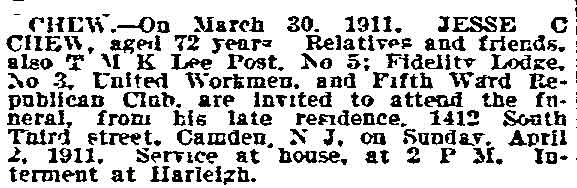
Death notice for Jesse C. Chew, aged 72 years, who died March 30, 1911. The funeral was held from his late residence, 1412 South Third Street, Camden, with interment at Harleigh.
Tag
Death notice for Jesse C. Chew, aged 72 years, who died March 30, 1911. The funeral was held from his late residence, 1412 South Third Street, Camden, with interment at Harleigh.
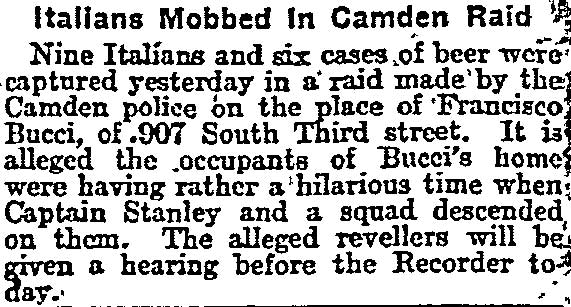
Nine Italians and six cases of beer were seized in a Camden police raid on the home of Francisco Bucci at 907 South Third Street, made by Captain Stanley and a squad.
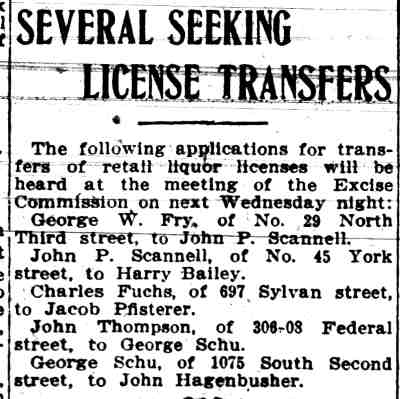
Five applications for transfers of retail liquor licenses, including George W. Fry's at 29 North Third Street, were listed for hearing before Camden's Excise Commission in October 1910.
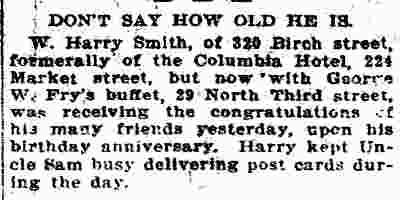
W. Harry Smith, then with George W. Fry's buffet at 29 North Third Street, was congratulated by his friends on his birthday anniversary, the Camden Daily Courier reported in September 1910.
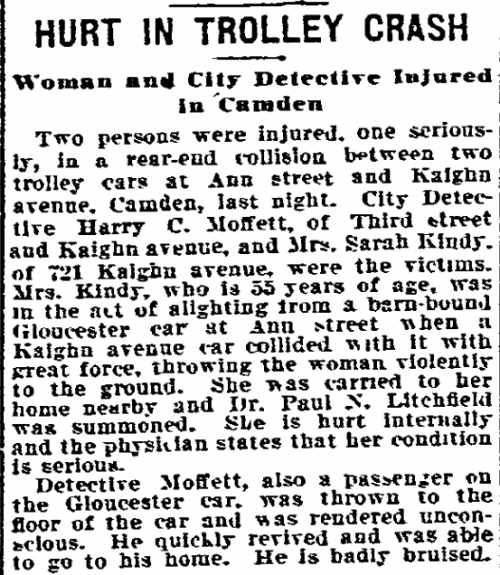
City Detective Harry C. Moffett and Mrs. Sarah Kindy, of 721 Kaighn Avenue, were injured in a rear-end collision between two trolley cars at Ann Street and Kaighn Avenue, Camden; Dr. Paul N. Litchfield attended Mrs. Kindy.
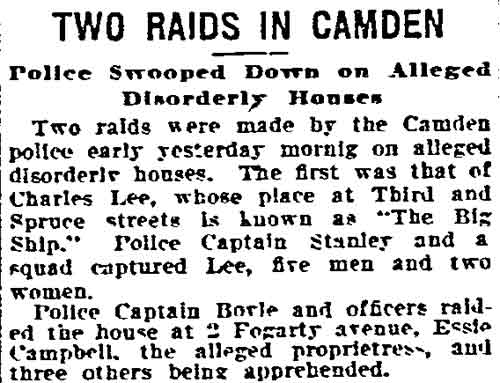
Camden police raided two alleged disorderly houses: Captain Stanley took Charles Lee's place at Third and Spruce Streets, known as "The Big Ship," while Captain Boyle raided 2 Fogarty Avenue.
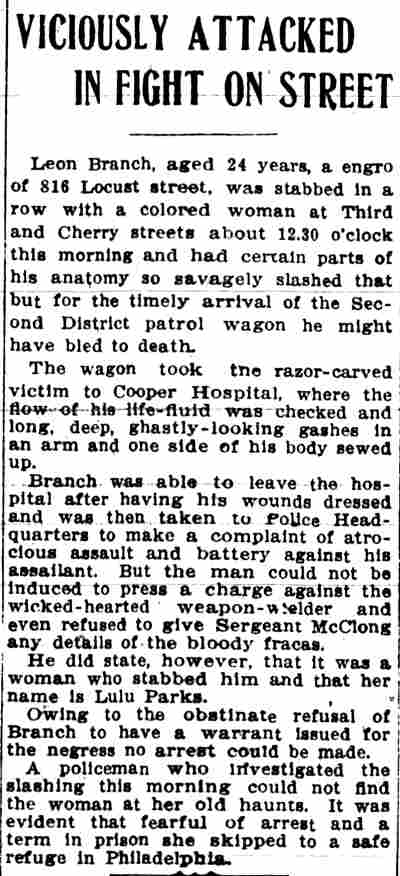
Leon Branch, 24, of 816 Locust Street, was slashed in a row with a woman at Third and Cherry Streets and treated at Cooper Hospital, but refused to press a charge against his assailant, Lulu Parks.
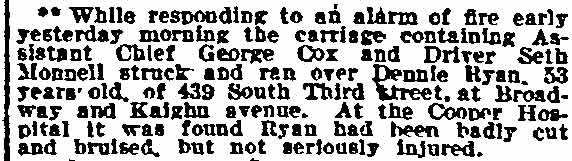
Responding to a fire alarm, the carriage carrying Assistant Chief George Cox and Driver Seth Monnell struck and ran over Dennie Ryan at Broadway and Kaighn Avenue; at Cooper Hospital he was found badly cut and bruised but not seriously injured. Philadelphia Inquirer, April 24, 1909.

City on Saint Valentine's Day, Will Observe the Anniversary of Its Incorporation—Some Facts and Figures Concerning "Slow Town" Across the River Eighty years will have passed on Friday, February 14, since Camden became an incorporated city, and just now the citizens are looking back over those years and recalling with a pardonable pride the epochs that have made it a community of homes, of splendid industries and of clean, progressive government.
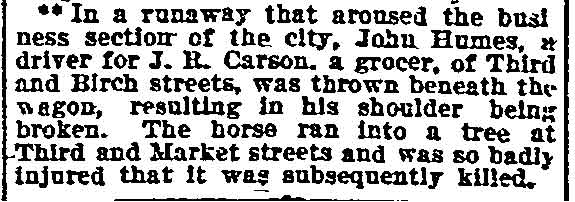
John Humes, a driver for J. R. Carson, a grocer of Third and Birch streets, was thrown beneath his wagon and had his shoulder broken in a runaway that aroused Camden's business section.
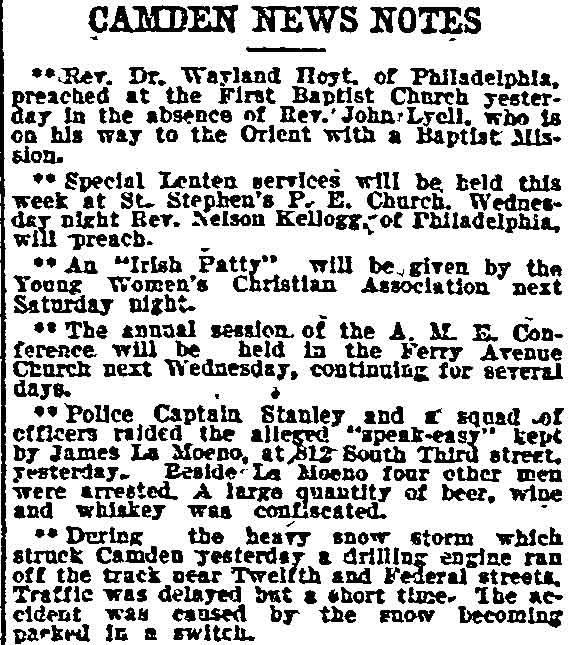
Camden briefs for March 11, 1907, including Captain Stanley's raid on an alleged speak-easy kept by James La Moeno at 812 South Third Street, where beer, wine and whiskey were confiscated.
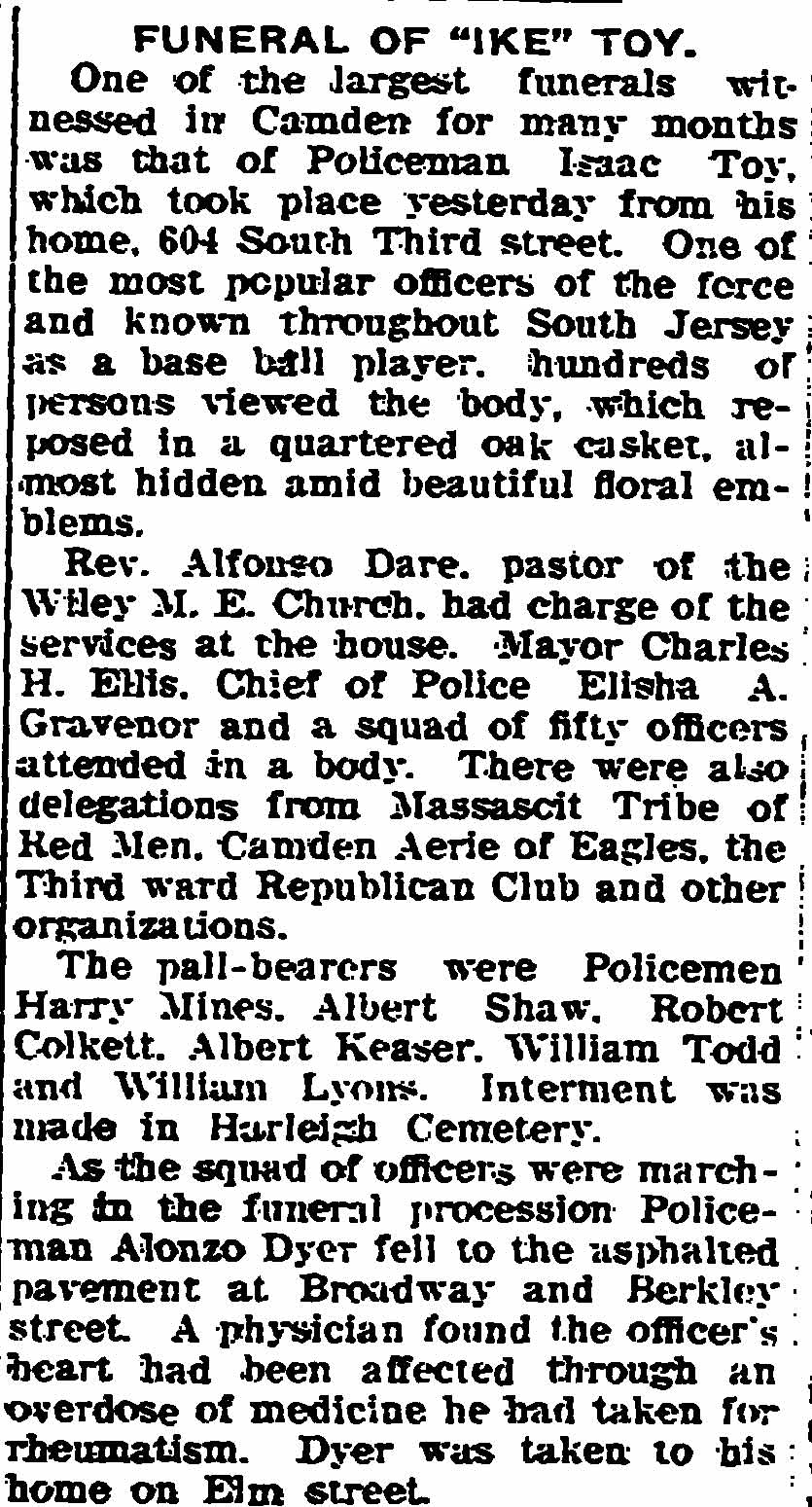
The Bridgeton Evening News describes the funeral of Camden Policeman Isaac "Ike" Toy, held from his home at 604 South Third Street and attended by Mayor Charles H. Ellis, Chief of Police Elisha A. Gravenor and fifty officers, with interment in Harleigh Cemetery. During the procession Policeman Alonzo Dyer collapsed at Broadway and Berkley Street.
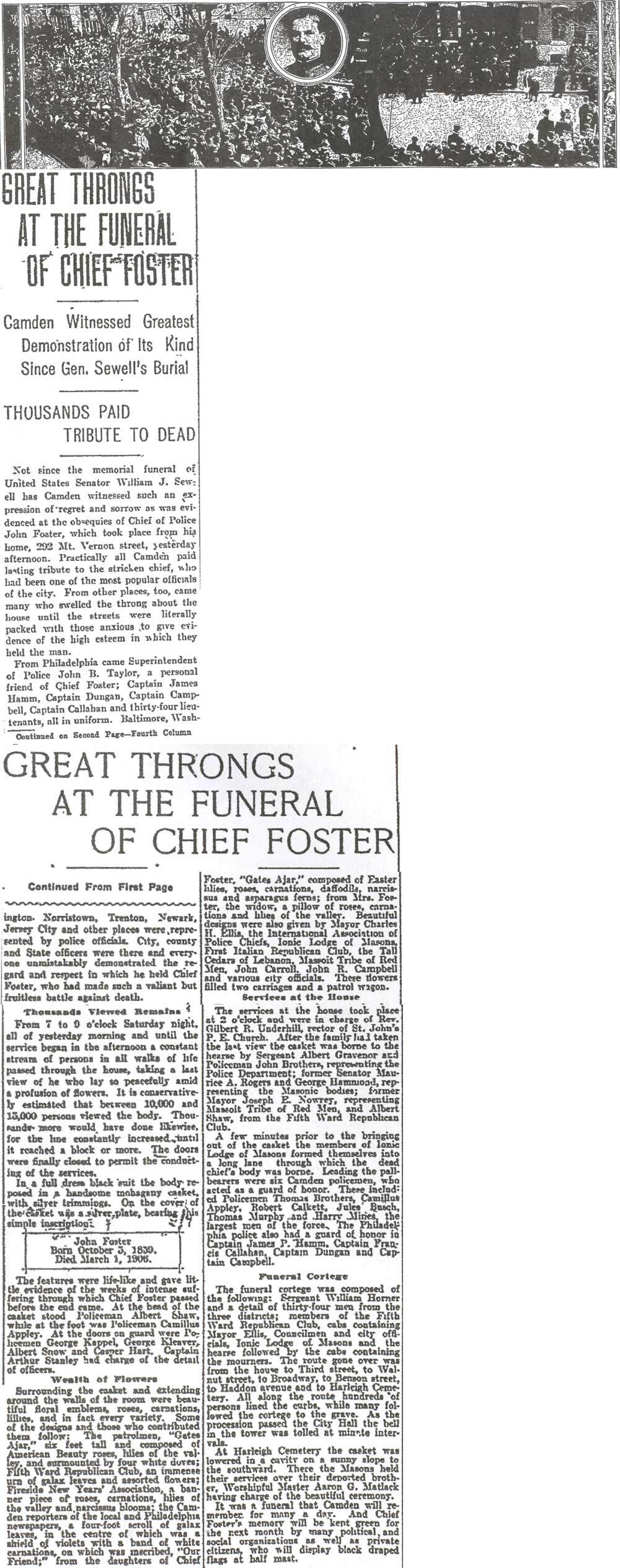
Thousands attended the funeral of Camden Chief of Police John Foster in March 1906; among the donors of floral tributes was John Carroll.
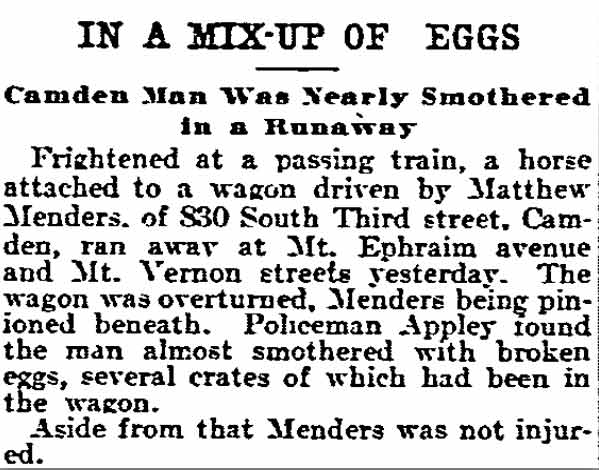
Matthew Menders of 830 South Third Street was pinned beneath his overturned wagon and nearly smothered in broken eggs when his horse ran away at Mt. Ephraim Avenue and Mt. Vernon Street.
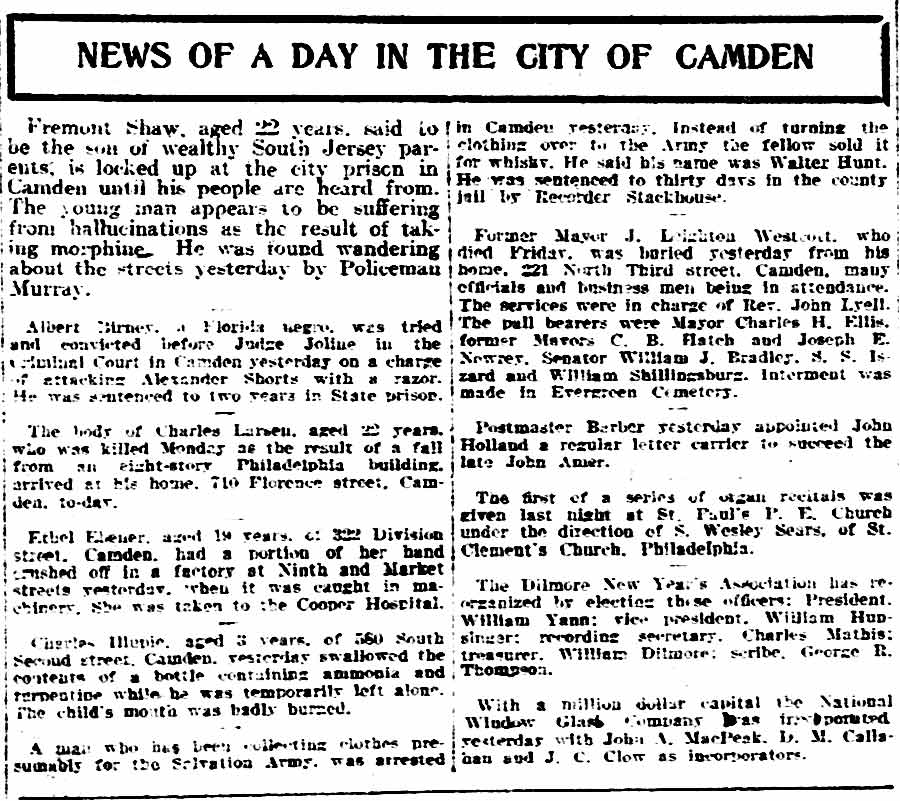
A Philadelphia Inquirer column of Camden news for January 17, 1906, including the burial of former Mayor J. Leighton Westcott from his home at 221 North Third Street, and a girl's hand crushed in factory machinery at Ninth and Market Streets.

Philadelphia Inquirer - March 1, 1905 Attacked at Third and Mickle street s, Camden, late Monday night by a man, Mrs. Bessie O. Day, of Seventh and Clinton streets , had her clothing cut in strips.
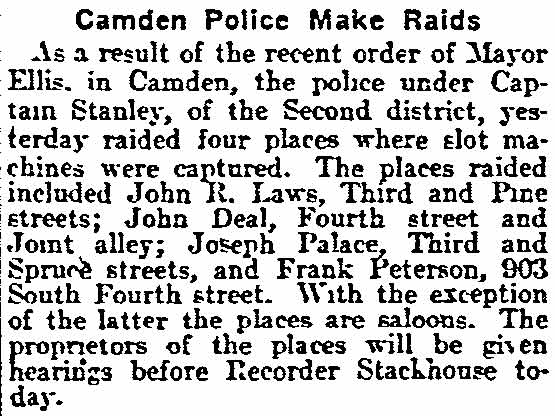
Acting on Mayor Ellis's recent order, police under Captain Stanley raided four Camden places and seized slot machines; the proprietors were to be heard before Recorder Stackhouse.
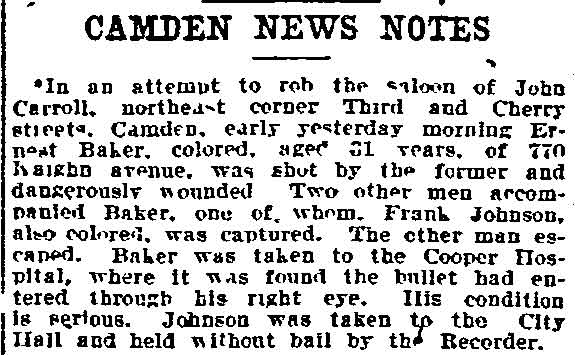
An attempted robbery at John Carroll's saloon at the northeast corner of Third and Cherry Streets left Ernest Baker shot and wounded; Frank Johnson was captured and a third man escaped.
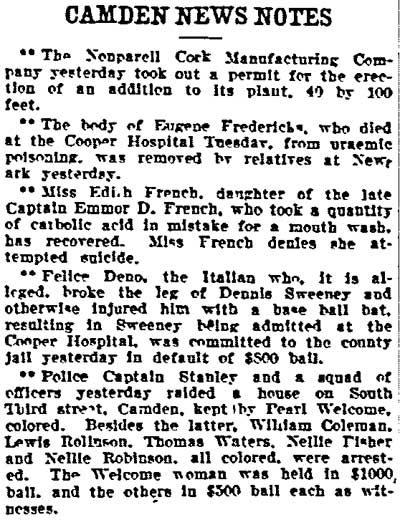
Camden briefs for August 25, 1904, closing with Captain Stanley's raid on a South Third Street house kept by Pearl Welcome, in which six people were arrested.
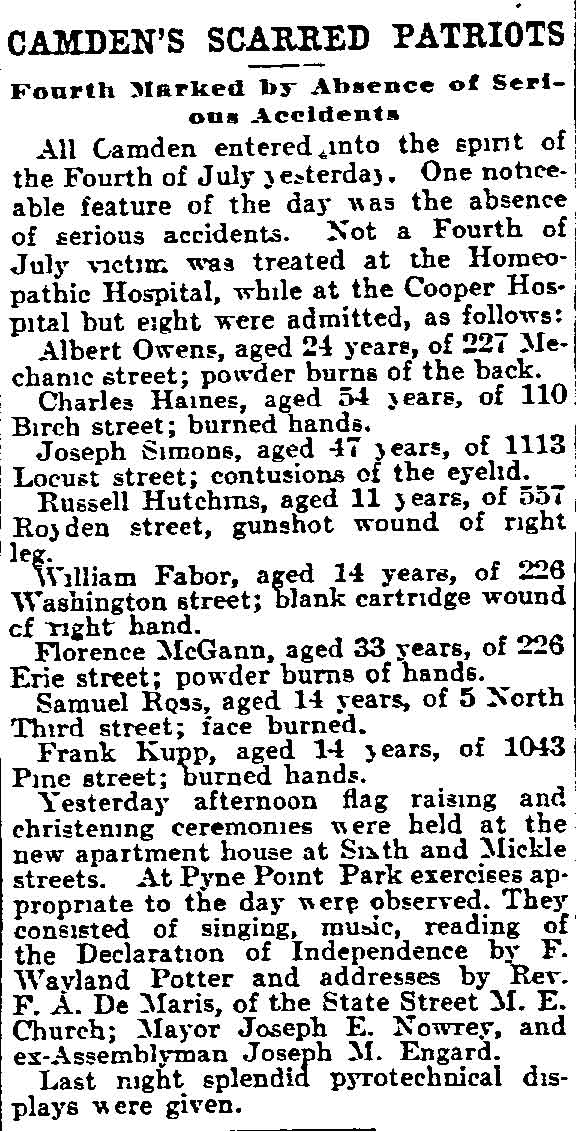
Camden's Fourth of July in 1904 passed without serious accidents; eight people were admitted to Cooper Hospital, and flag raising and Pyne Point Park exercises were held.

The main court room was crowded with interested Third warders this morning, when the first of the criminal complaints growing out of the riots at Third and Beckett streets, on the night of July 28, last, during the Congressional primary, was taken up. It charged Charles Wagner with assault and battery on Policeman Harry Miller.
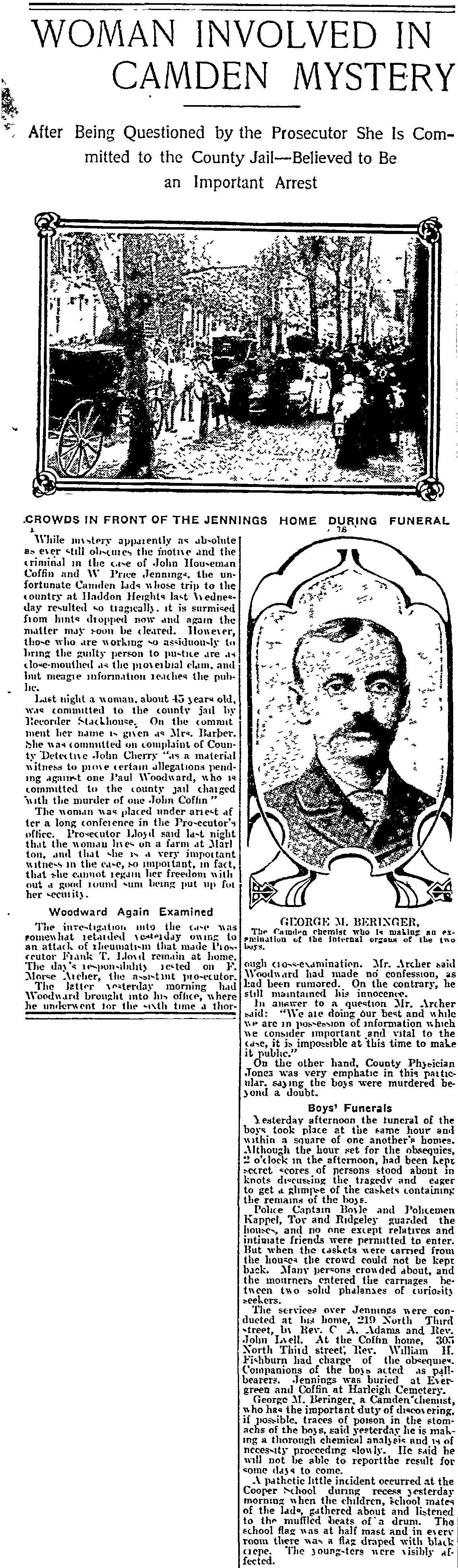
While mystery apparently as absolute as ever still obscures the motive and the criminal in the case of John Houseman Coffin and W. Price Jennings, the unfortunate Camden lads whose trip to the country at Haddon Heights last Wednesday resulted so tragically, it is surmised from hints dropped now and again the matter may soon be cleared.

Col. George G. Felton, real estate dealer and former City Treasurer, was found dead of gas in his office in the Felton building at Second and Federal streets. The same Camden Daily Courier column reported the sudden death of Walter C. Fish, florist of Broadway and Spruce streets.
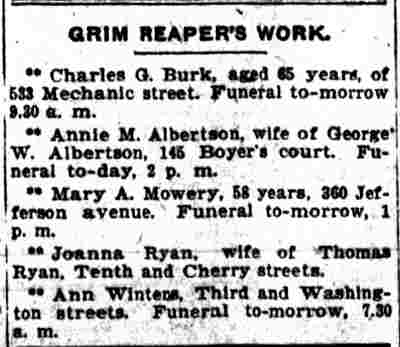
A Camden Post-Telegram death notice column listing recent funerals, including Mary A. Mowery, 58, of 360 Jefferson Avenue.
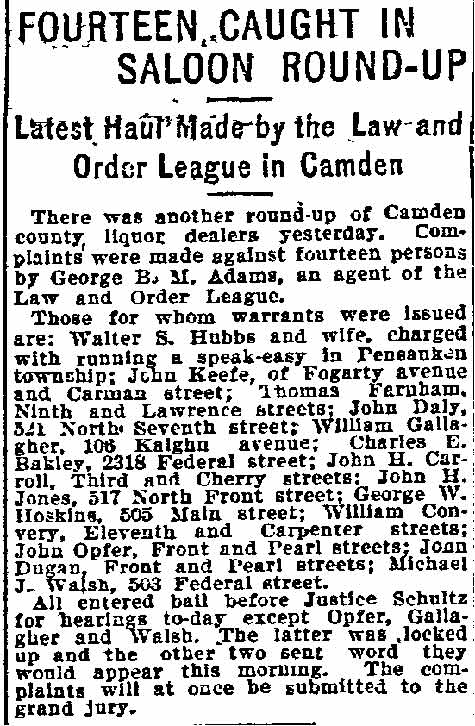
Fourteen Camden county liquor dealers arrested by Law and Order League agent George B. M. Adams, including William Convery at Eleventh and Carpenter Streets; all entered bail before Justice Schultz.

The Camden County Law and Order League renewed its complaints against forty-eight liquor sellers who escaped indictment, hinting that political pull had saved them, and gave the grand jury a list of accused saloonkeepers including several on Kaighn avenue.
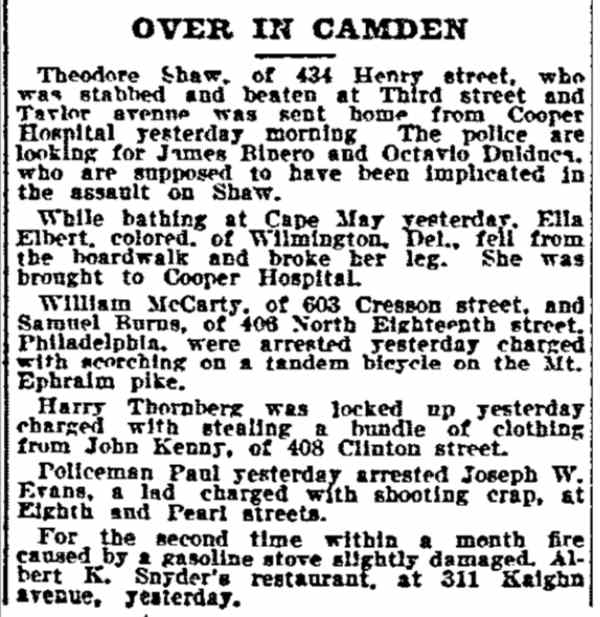
The Philadelphia Inquirer's Camden roundup of July 31, 1899: Theodore Shaw of 434 Henry street sent home from Cooper Hospital after a stabbing, a tandem-bicycle scorching arrest on the Mt. Ephraim pike, and a gasoline-stove fire at Albert K. Snyder's restaurant at 311 Kaighn avenue.

Successful Raid on an Alleged Pool Room in Camden Seven Men Captured Keefer, Who Says He Spent His Employers' Money in the Place, Identifies the Prisoners The Camden police yesterday raided the alleged poolroom at 25 South Third street, where Walter H. Keefer, former manager of the Merchantville Light and Power Company, claims he lost $254, belonging to his employers.
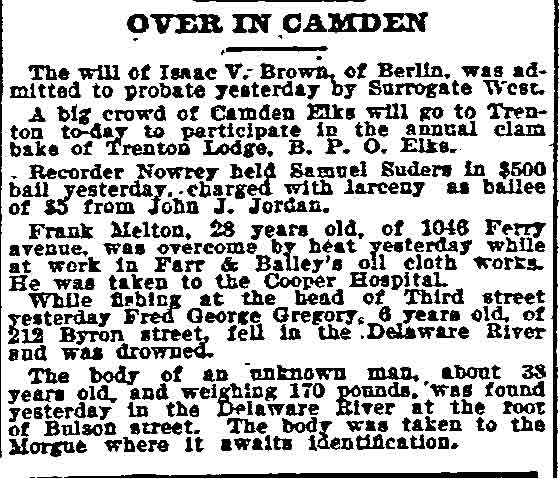
Fred George Gregory, 6, of 212 Byron Street, drowned in the Delaware River while fishing at the head of Third Street.
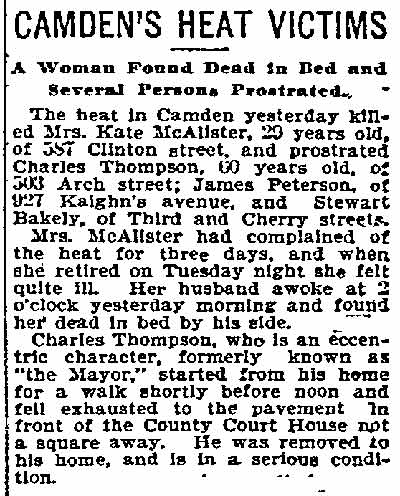
The August 1896 heat killed Mrs. Kate McAllister, 29, of 587 Clinton Street, Camden, and prostrated Charles Thompson of 503 Arch Street, James Peterson of 927 Kaighn's Avenue, and Stewart Bakely of Third and Cherry streets.
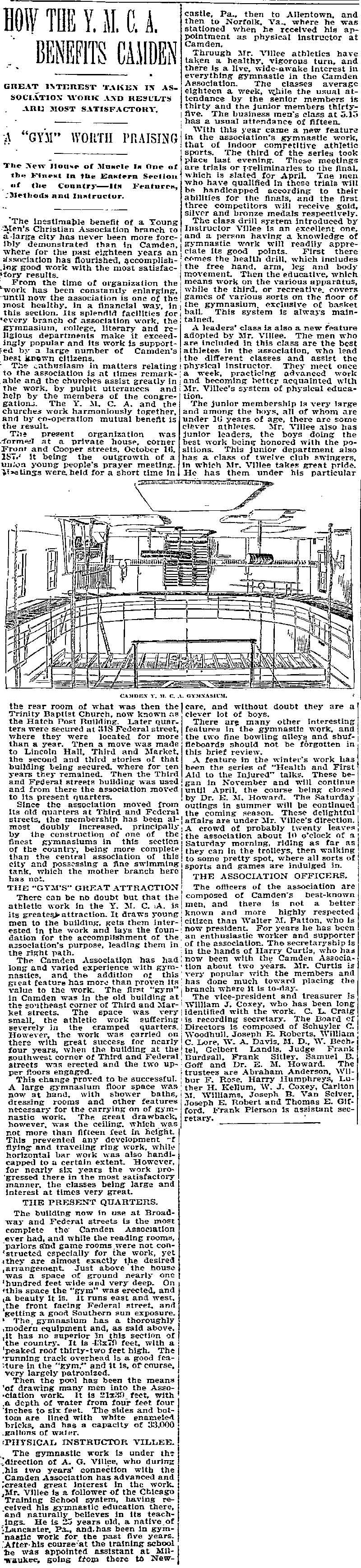
The Philadelphia Inquirer profiles the Camden Y. M. C. A. in 1896: its history since organizing at a house at Front and Cooper streets, its new gymnasium and swimming pool at Broadway and Federal streets, physical instructor A. G. Villee's methods, and the association's officers.
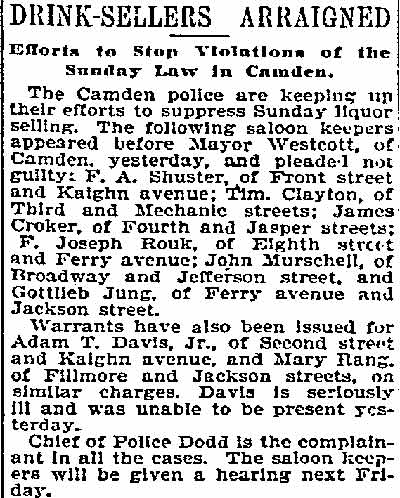
Camden saloon keepers charged with Sunday liquor selling, among them James Croker of Fourth and Jasper streets and John Murschell of Broadway and Jefferson street, pleaded not guilty before Mayor Westcott; Chief of Police Dodd was the complainant in all the cases.
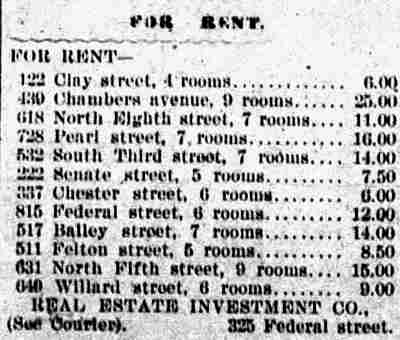
Real Estate Investment Co. advertises 122 Clay Street for rent — 4 rooms at $6.00 per month — along with other Camden properties. Camden Daily Telegram, October 9, 1895.
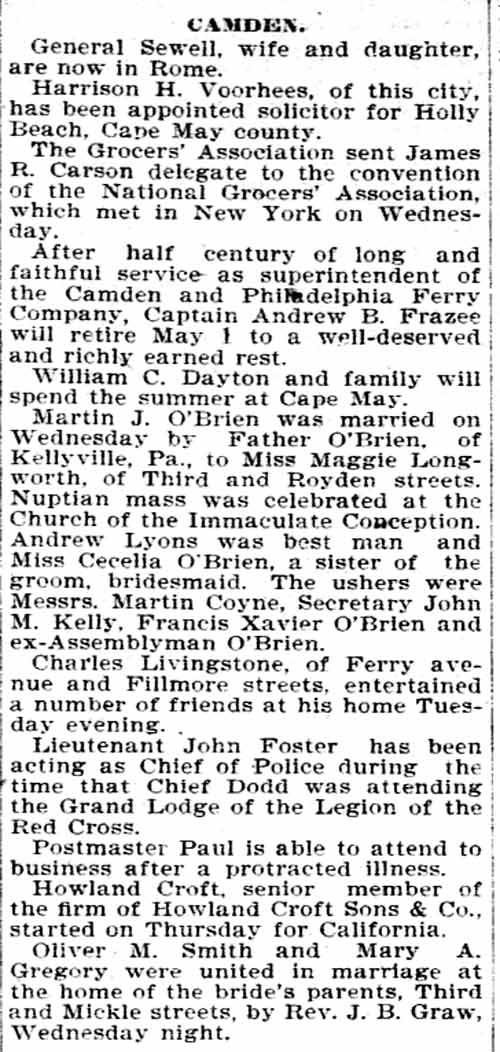
A column of Camden local items from the Philadelphia Inquirer of April 28, 1895, including Captain Andrew B. Frazee's retirement from the Camden and Philadelphia Ferry Company and the O'Brien-Longworth wedding.
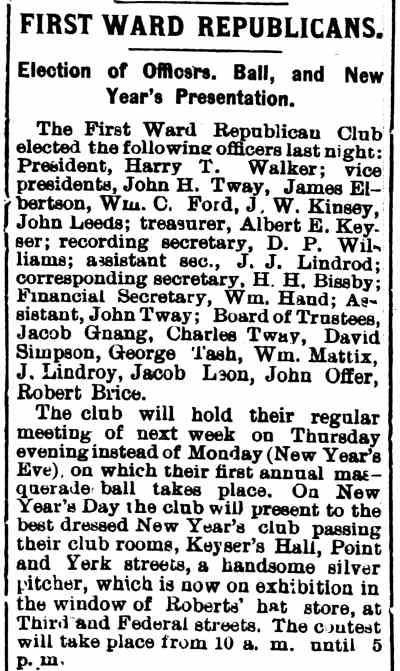
The First Ward Republican Club elected its officers, with Harry T. Walker as president, and announced its first annual masquerade ball and a silver pitcher to be presented on New Year's Day to the best dressed New Year's club passing its rooms at Keyser's Hall, Point and York streets.
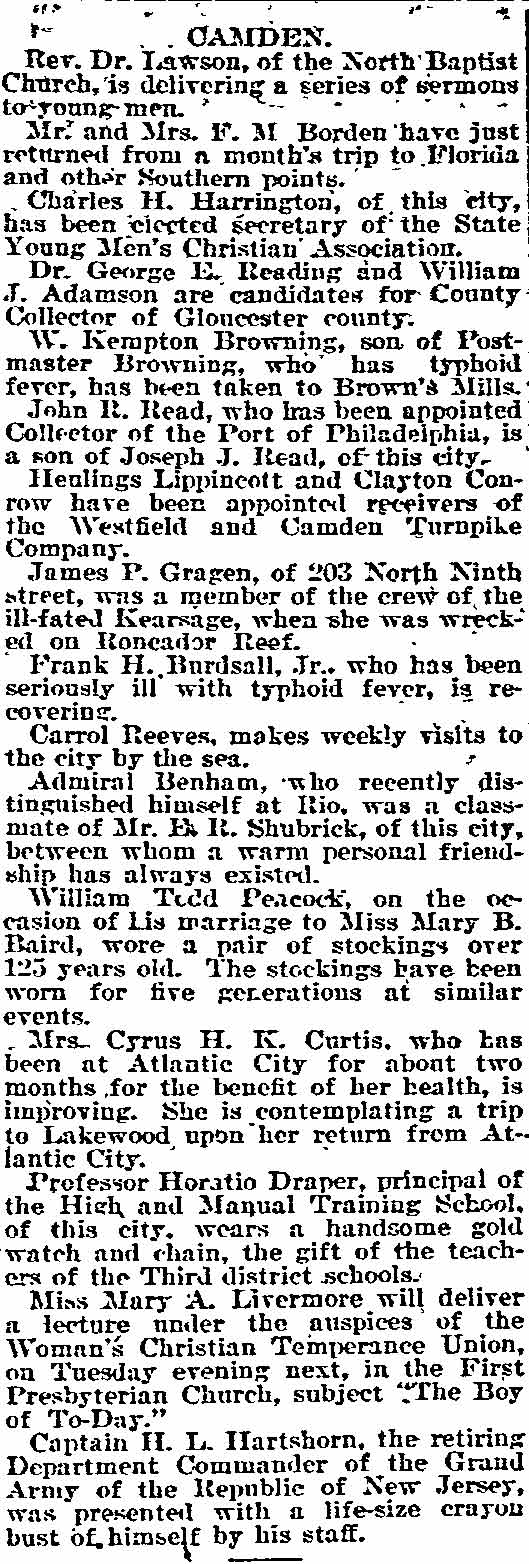
Camden News column from the Philadelphia Inquirer, February 18, 1894. Notes residents at 429 Cooper Street in 1894: Joseph J. Read and family.
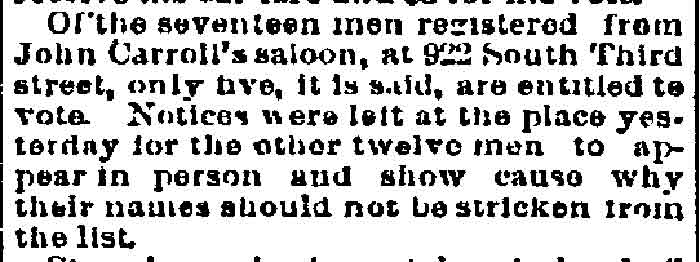
Of seventeen men registered to vote from John Carroll's saloon at 922 South Third Street, only five were said to be entitled; the other twelve were notified to show cause.
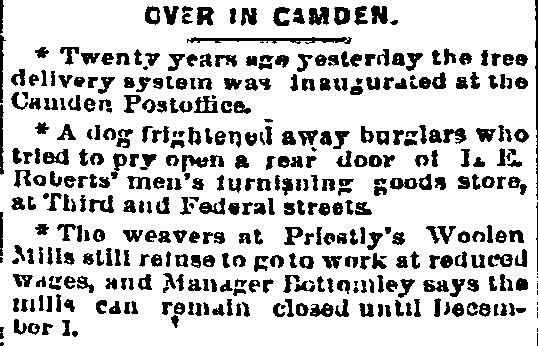
The Philadelphia Inquirer's Camden roundup of September 2, 1893: the twentieth anniversary of free delivery at the Camden Postoffice, a dog that frightened burglars away from a men's furnishing goods store at Third and Federal streets, and weavers at Priestly's Woolen Mills still refusing reduced wages.

The Quarter Sessions Court trial of John F. Stratton and Henry Mellon, charged with the May 6, 1888 knife and blackjack attack on Joseph Logue near Starr's crossing, Tenth and Line streets, with testimony from Logue, Miss Sarah Lewine, Christopher Smith, Dr. Henry Jarrett, Charles R. Locke and Knight Haines.

Two Camden lads, Howard Woolston and Lewis Rothkogle, were held in bail by the Mayor for the larceny of pigeons from fruit dealer L. W. Frome.
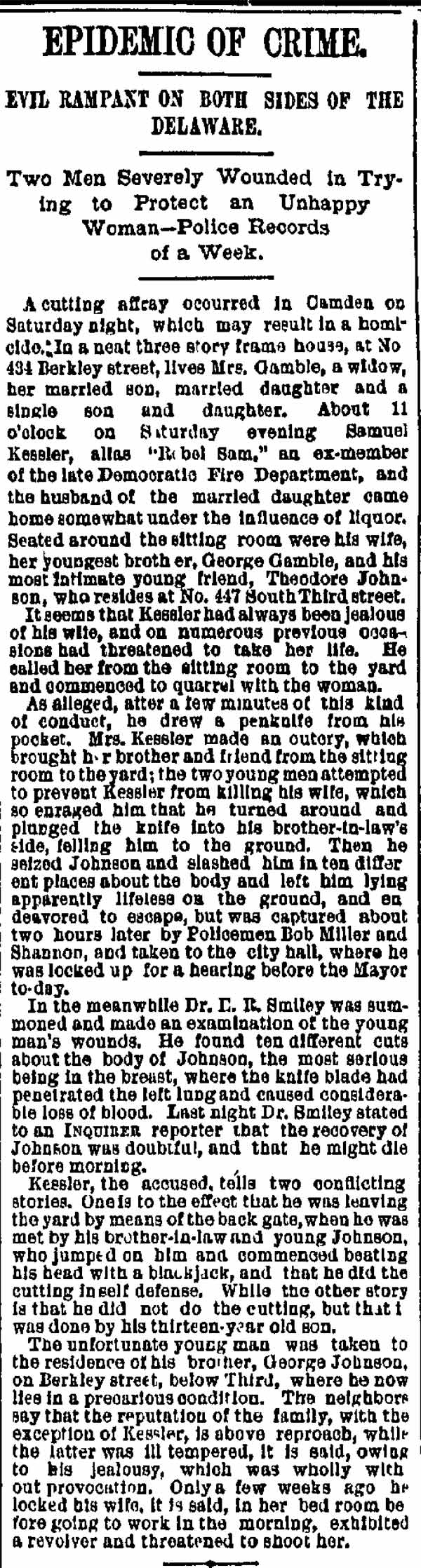
Philadelphia Inquirer, June 6, 1887: a cutting affray at 434 Berkley Street in Camden leaves Theodore Johnson gravely wounded and Samuel Kessler, alias "Rebel Sam," in custody.
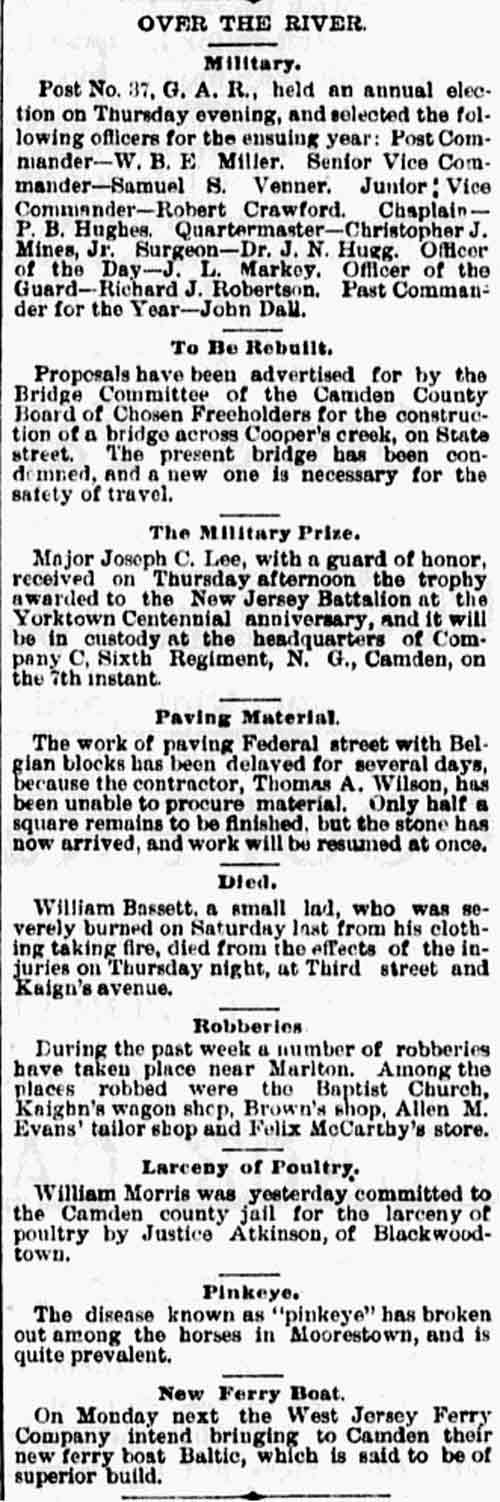
A December 1881 Philadelphia Inquirer column of Camden news: the annual election of officers of Post No. 37, G. A. R., with Christopher J. Mines, Jr. as Quartermaster, a delay in paving Federal Street with Belgian blocks, a new bridge planned across Cooper's creek on State Street, and other local items.
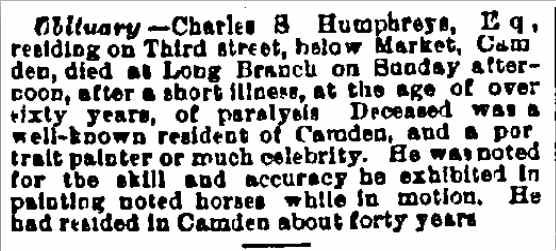
An October 26, 1880 Philadelphia Inquirer obituary: Charles S. Humphreys, Esq., of Third street below Market, Camden, a portrait painter noted for painting horses in motion, died at Long Branch after a short illness. He had lived in Camden about forty years.
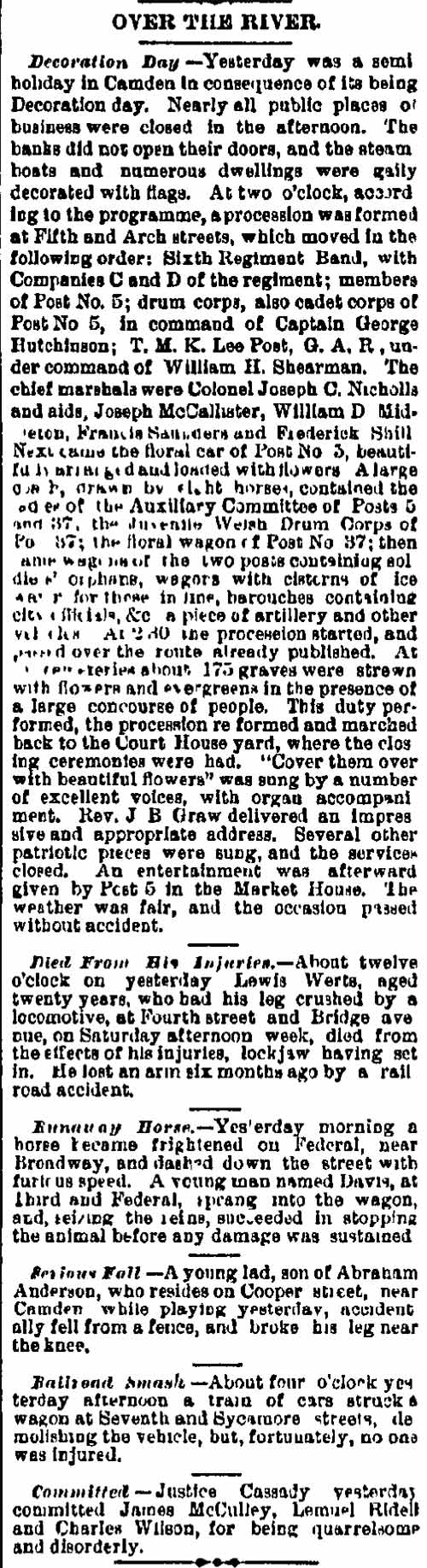
A June 1880 Philadelphia Inquirer column of Camden news: the Decoration Day procession of G.A.R. Posts 5 and 37, the death of Lewis Werts, a runaway horse stopped on Federal Street near Broadway, and other local items.

During the Civil War, Camden purchased its first steam fire apparatus on June 4, 1864 the Independence Fire Company No. 3 purchased an Amoskeag steamer for $3250. This apparatus was a third class, single pump style with serial #92.

On March 12, 1841 the Camden Mutual Fire Insurance Company was chartered.
City Council authorized the construction of a market house on Market Street at the intersection of Third Street on March 13, 1837. This market house containing 8 stalls was erected at a cost of $250, and was ready for use December 28, 1837.
That section of the city commonly known as Fettersville was purchased by Richard Fetters in 1833 from Charity and Grace Kaighn and embraced the land lying between Line and Cherry Streets, extending from Third Street to the Delaware River.
Cholera appeared in Camden. This was said to be the first appearance here of the disease in epidemic form.