Skeeters Brought Camden Only E.L. Court Crown
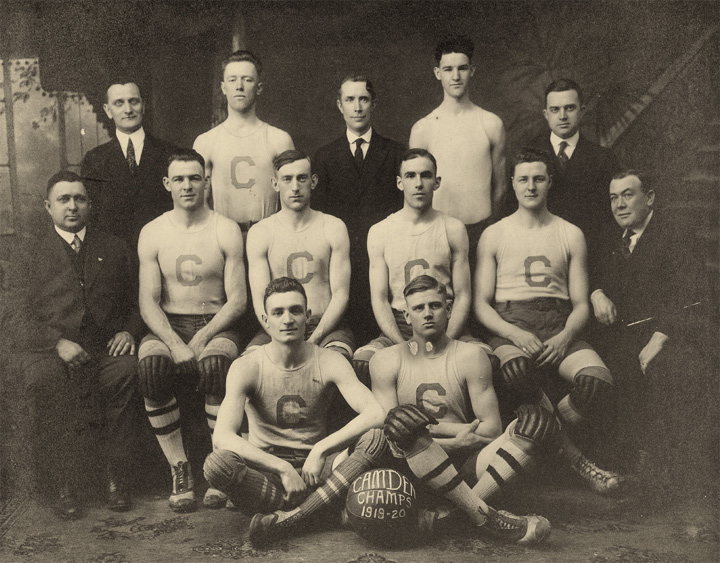
Dolin, N. Deighan, Campbell, Kerr, Steele 1919-20 Pro Champions
By JACK CARTY
There was an era when Camden was known for more than its production of ships, soups, radios and sundry other commercial items. That was when the
Camden Skeeters were the scourge of the Eastern Professional Basketball League.
It was over 35 years ago when a banner line screamed across four columns of an old Daily Courier sports page proclaiming that "All Hail the Champions!"
The date was March 11, 1920. It was the day after the Camden team won its first and only championship of the old Eastern League.
Kennedy Was Manager
After 10 years of striving to bring home the coveted flag, Manager "Whispering Will" Kennedy's Skeeters sewed up the title by defeating the Bridgeport, Conn., quintet, 45-34 at the
Third Regiment Armory, now known as the
Camden Armory at
Haddon avenue and
Mickle st.
The date is a memorable one for many, especially those who were around in the days when professional basketball was "the thing" in Camden. Days when such outstanding stars as
Neil Deighan, Jimmy "Soup" Campbell, Rich Deighan,
Dave Kerr,
Roy Steele,
Eddie Dolin and others were the masters of the cage game. They mastered it to the delight of two and three thousand fans every time they stepped on the floor at the Armory.
That season and that 1919-20 basketball team provide one of the proudest sports memories in the history of Camden. Although its short-lived glory lasted for less than two years, the mark the Skeeters left is indelible.
Corson, Helm Owners
The Skeeters, owned and financed by former Sheriff
W. Penn Corson and
Dr. Charles B. Helm, a veterinarian, had many near misses in the search for the pennant. But they never made the direct hit until Kennedy stepped into the picture.
It was the first season the Eastern League had resumed operation following
World War I that the ex-Jasper coach took over the club.
He molded a winner with three veterans of former years—Steele, the captain, Dolin and Neil Deighan—with a couple of comparative unknowns, Kerr, and a youngster named Campbell.
With this aggregation as his nucleus, Kennedy won the pennant for Camden and it seemed that only he could have done it.
Frank H. Ryan, late editor of The Courier-Post, who then was sports editor of The Daily Courier, wrote of Kennedy following the team's successful first half finish:
Describes Kennedy
"He has been connected with the cage game for a score of years, never bullyrags his men and can get results where others fail. Working hand and glove with Steele, who is captain and the king pin of the men on the floor, Kennedy has succeeded in giving Camden what others have failed to do, namely, the much coveted pennant. If the Skeeters can crown their achievement with the second half crown the natives from the city of ships, phonographs, soaps, furniture and fair zone activities can well afford to look our way and give us a silent sneer."
And they did.
The Skeeters went right on to win 16 more games and the second half, which also included the "much coveted pennant." They tied a league record of the Reading Bears with 30 wins per season, even though they had one more loss—10.
'Reading Bear Pit'
Ryan had said of the Skeeters: "The desire to do the right thing at the right moment, a willingness for team play and a general pull together spirit made a combination which the other five teams found too formidable to surmount." That was one description of the champions.
One of the biggest moments of that glorious season was marked when, for the first time in more than five seasons, Camden was able to beat Reading on the latter's own court. The Skeeters prevailed 31-24 in the "Reading Bear Pit."
Campbell, the import from Homestead, Pa., playing his first year in the "fast" ranks of professional basketball, fired the victory with an 11-point effort. That was Jan. 31, 1920—one of the opening games of the second half.
Wallop DeNeri
Prior to that, Campbell, Dolin and Neil Deighan were consistent leaders in point-making to spark the team to the first half championship.
During the season, Germantown, second place finisher in both halves, Trenton, Reading, DeNeri (Philadelphia) Bridgeport and North Philadelphia competed. Bridgeport took over the North Philadelphia franchise in the second half, after the North Phillies dropped out of the league.
In one game against DeNeri, Camden broke all existing records when it beat the Philadelphians, 53-28. Twenty-three field goals were registered by the "coming champs" that December night in 1919.
Campbell set the pace with seven double deckers, tieing the individual high score record for the season.
Only Two Regulars
DeNeri took the floor at the Armory with but two regulars in the lineup. That was blamed for the rout. The other regulars were playing with teams in other leagues—a situation which was to cost the Skeeters the pennant the following season.
The opening account of that particular Camden-DeNeri game read: "That the Eastern League is due to regret the rule which allows its men to play in other leagues was demonstrated by the misfit combination that Manager Myers, of De Neri, brought to this city last night to oppose the local league leaders at the Third Regiment Armory."
The rule later was amended by league president
William J. Scheffer. The amendment cost Adamless Express one of its brightest young stars and took away its championship in 1920-21 when the owners suspended Campbell.
'Adamless Express'
The 1919-20 Skeeters often were called the "Adamless Express." When Jackie tucked away his uniform after the league took time out for the first World War, Camden assumed the "Adamless Express" tag.
Brown was one of the mainstays of the North Philadelphia team during Camden's Championship year, but missed much of the opening half campaign after he suffered a knee injury.
Meanwhile, the Adamless Express got up its head of steam and sailed merrily along its way.
A capacity crowd of nearly 3000 fans turned out at the Armory when the Skeeters opened the 1919-20 season by defeating DeNeri, 26-18, on Nov. 5, 1919.
Trenton Causes Trouble
It was Steele, Campbell, Dolin, Neil Deighan and Kerr who played the entire game and Ryan's account of the victory was very enthusiastic about their showing.
"It surely did seem strange to see the locals enter the cage minus the familiar and popular faces of
Jackie Adams and
Jimmy Brown as it was the advent of those two stars along with Eddie Dolin that took Camden out of the 'also ran' class in the Eastern and gave this city a permanent pennant contender. It can truthfully be said that more than one fan was indeed sorry to note the wrecking of the famous Adams Express, but at the same time no fault can be found with the aggregation Manager
Bill Kennedy substituted in its place last night, as the new combination gave a dandy exhibition and looks strong enough to give any club in the circuit a battle for the pennant," Ryan reported.
There were some squeakers in that first half. Four of them were with Trenton, a team which always had been a formidable foe of the Skeeters.
In the second game of the season Camden stacked up against the Royal Bengals and edged them, 20-18, in Trenton. Camden later won verdicts of 15-14, 24-23 and 20-18, the latter in overtime.
N. Deighan KO's Schmeelk
However, in a game against Germantown, Kennedy's cohorts dropped their second verdict of the race—their first at home that season—when the "Germs" prevailed, 21-18. Camden lost its next game and Germantown made it three straight reverses for the Adamless Express when it won, 35-27, Dec. 23, 1919.
The locals league lead was cut to a single game in the rip-snortin' contest which featured the first fight of the season and banishment of two players. Kerr and Germantown's Gary Schmeelk had come to blows, but it was Neil Deigham, who entered the melee and "dropped Schmeelk to the floor."
Referee Bill Kelley banished both men—Schmeelk and Deighan—from the game and both were fined $10.
However, two nights later on Christmas, Camden regained its winning ways by clobbering Reading, 36-15, when Deighan got back into action to score 11 points.
The overtime battle with Trenton clinched the first half diadem—before 2500 fans at the Armory.
Rich Deighan Plays
Camden breezed through the second half without too much trouble and wound up that part of the race with a 16-5 record, clinching the title with the win over Bridgeport and closing the season with Campbell's 15 points sparking a 35-26 decision over Trenton on March 17, 1920.
Richie Deighan made his first appearance in the Camden lineup early in February that same year when he played the last 10 minutes against Bridgeport. The Skeeters romped home 42-15 winners, with Rich getting three points.
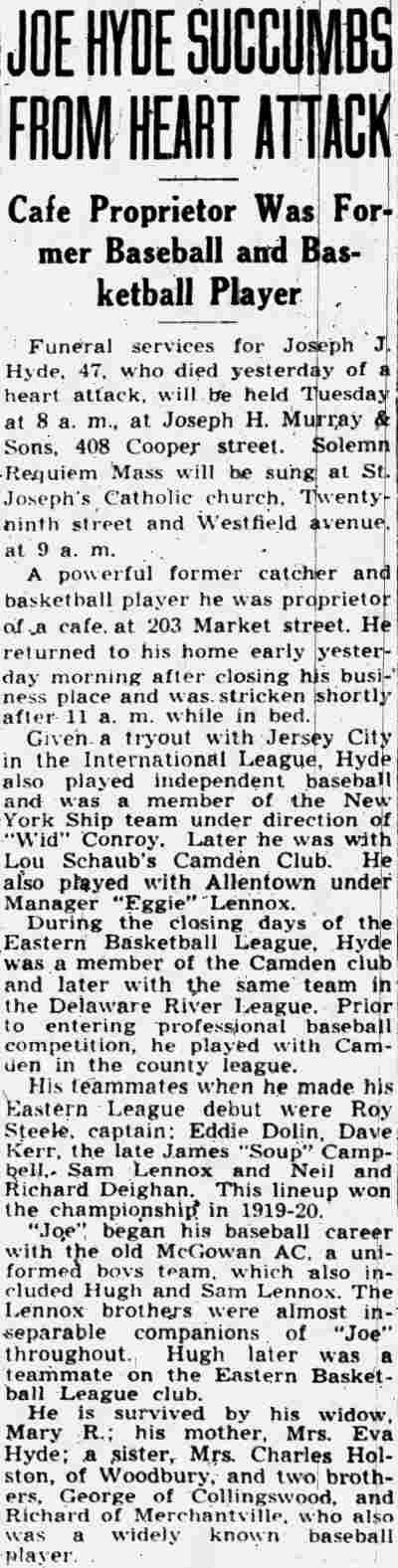
"The last six minutes of action saw the cloak-room boys, Sam Lennox and
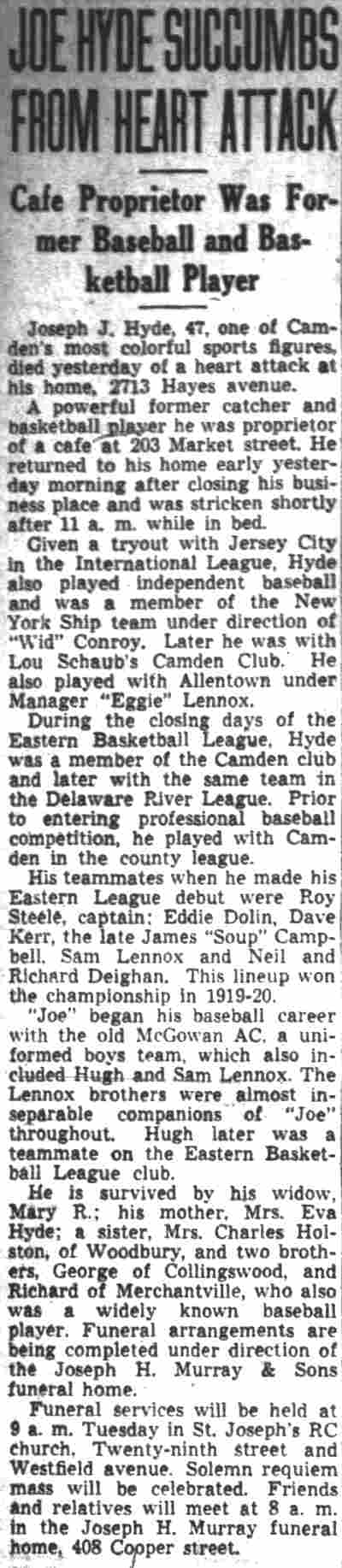
Joe Hyde in action for Camden and six points of Bridgeport's total were amassed in this period," clippings stated.
Rich Deighan, following the championship season, shifted his alliances to Coatesville.
Entered League in 1910
The championship was the end of a long and detoured road for the Skeeters. Early experiences by Camden teams were not quite as pleasant even though it had the pennant in its grasp twice. Once it was awarded to the Skeeters on forfeit, but even then they found a way to get rid of it.
Camden first entered the Eastern League in 1910 when it took over the franchise forfeited by Princeton. The Skeeters just about "tottered along for three years."
However, they wound up in a three-way tie for first place in 1913-14 season but lost out in the playoffs, finishing second to Jasper. Trenton was third.
Reading Didn't Show Up
The next season, the Skeeters were part of the league's worst "fiasco." Camden and Reading carried the fight from start to finish and ended in a stalemate (identical 25-15 records). Camden, then under Sam Herrmann, won the first game of the playoff at the Armory, but was clobbered in Reading.
The third game was to be played at the Musical Fund Hall at Eighth and Locust sts., Philadelphia. After the hall was packed and hundreds of fans turned away, Reading refused to play the game. In fact, the Bears never showed up.
The Reading team claimed Camden misrepresented the ticket situation. The first decision by the league, which had not handled the playoffs originally—leaving it up to the two teams—was to award the championship to Camden via the forfeit route. But the club owners thought different and agreed to close the season with no championship awarded.
It was one of the worst black eyes the Eastern League ever got.
Third in 1916
The Skeeters fell heir to third place in the spring of 1916 and fourth the following year. The first World War closed the Eastern for the next two seasons and the first year back in the harness Camden started its successful bid for its first championship.
The Champions couldn't quit find themselves in the 1920-21 race. Although they were continually in contention for the flag, they never did make it two in a row.
The Skeeters finished third behind Reading and Trenton and ahead of Philadelphia, Germantown and Coatesville in the first half.
Owners Scold Players
They were going great guns in the second half as Campbell, Kerr and Steele began stepping up the attack. The Adamless Express once again was back in first place—all alone. Then one February 4, the disintegration began.
Headlines blurted: "Camden Owners Scold Players. Threaten to Suspend Team Members Playing in Other Leagues. Campbell, Kerr and Deighan Offenders."
Kerr and Neil Deighan had been playing for a club in the Penn State League. Campbell was active in that and another circuit. Dr. Helm was quoted as saying: "It has come to a showdown. These players will either stick to the Camden team or play with others. A Camden player who violates the rule will be definitely suspended. We want to give the people of Camden a square deal. The players owe it to the fans. No man can serve two or three masters."
Campbell Suspended
Two days prior to Helm's attack, Reading had downed Camden, 25-32 and handed Germantown a tie for the lead. Camden won its next game, but still shared the lead with Germantown. Then came the big blow.
Campbell was suspended for not complying with the management. He did not play for the Skeeters again until the next season. There went their chances for the pennant.
Louis Sugarman took over the Homestead star's position and made a creditable showing, but it just was not up to the standard of Campbell.
'Say It With Flowers'
Camden retook the lead with its eighth victory by defeating Philadelphia, 32-15, Feb. 9. But a loss to Germantown the following week dropped them into second place and they never were to regain outright possession of first place again.
The Skeeters tied for the lead twice in the late stages of the second half race in March and had a chance of forcing the race
week but finished out of the money. The first half saw the Skeeters in a tight race with Trenton. That half merited Camden second place with over 20 victories. In the final half race Kennedy's courtmen again became the bridesmaid, despite a 15-5 record.
Campbell was back in the harness again and with Kerr, Dolin, Steele and Neil Deighan they had a pretty powerful club.
Eight teams, including the New York Celtics, battled in the first half, while the roster dwindled to six quintets in the final race.
But the league registered eight teams when it opened its 1922-23 season. It was believed by many to be the best setup for the Eastern League in its history. The other major circuits in the area had folded and the Eastern was supposed to be set solidly.
League Folds
It started an early season (October) and that was the beginning of the end. Football was in full swing. Baseball had just ended. Fans like their sports in season.
The league began to crumble when Scranton and then Wilkes-Barre dropped out.
Atlantic City and Reading were next to toss in the towel. A meeting at Musical Fund Hall saved the league for a short time when Trenton, Camden, Coatesville and Philadelphia vowed to make a go of it.
However, in mid-January of 1923 the Eastern League succumbed as the four remaining teams went broke. The main reason for the crackup was put to the "inflated salaries" of the players. But the Skeeters' backers decried that explanation when they said "every Camden player was worth every cent." They had kept Camden in first place until the league folded.
Fans Were Confused
Following one of the last games played in the league in Camden, Ryan wrote, "Wednesday night's crowd would have been a disgrace to the East Side Church League." That about summed it up.
Constant rearrangement of the league had jumbled the schedule. Fans never knew when or where their teams were playing. The gates were pitiful and the teams couldn't operate without the money.
That was the end of the championship era of players like Steele, the Deighans, Campbell, Kerr, Dolin and the others. Some of them competed in the Philadelphia League the following season, but Camden dropped out of that league in 1924-25.
Old-timers who can recall the days of the championship Skeeters claim it was the "greatest basketball" team the East ever had.
Players Still Around
And some of the boys who played on that club are still around to verify that. Neil Deighan runs a restaurant in Gloucester and brother Rich manages the Sports Center here in Camden.
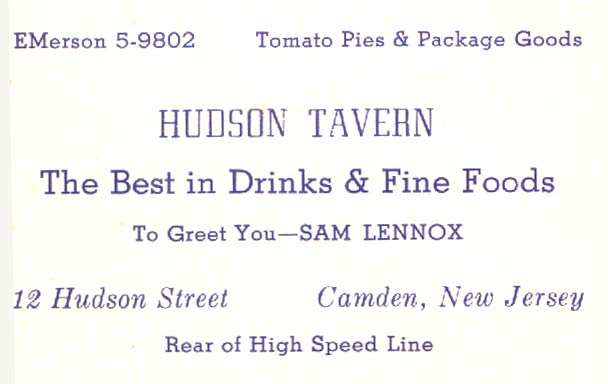
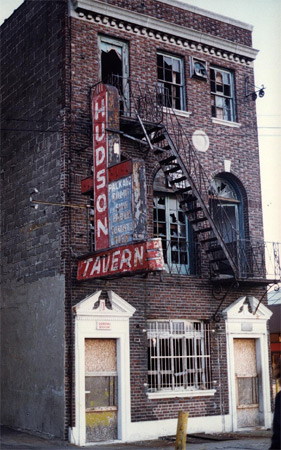
Eddie Dolin is a familiar figure as the bridge operator at 12th and Federal sts. Sam Lennox tends bar on
Hudson st. and Davey Kerr deals in sporting goods in Ohio.
The rest — Steele, Campbell, Hyde, timekeeper
Jim Kane, Helm, Corson and Kennedy—have passed away. But the memories of their court capabilities are very much alive.