Walter Edgerton
Kentucky Rosebud (Walter Edgerton)
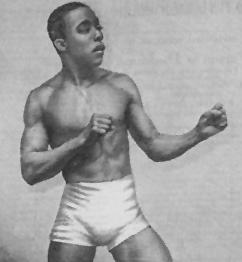
KENTUCKY ROSEBUD, whose real name was Walter Edgerton, boxed professionally, generally as a featherweight, from 1886 right up until 1916, when he twice fought and defeated John Henry Johnson in Philadelphia. “Kentucky Rosebud” was past 60 at the time of the fights, and Johnson was well past 40.
Walter Edgerton was born in Raleigh, North Carolina, on November 18, 1854. He is known to have appeared in the ring around 100 times, compiling a known record of 28 wins, 41 losses, and 30 draws. In all likelihood he fought far more than what is currently known. Most of his fights were in Philadelphia. He was at his peak in the mid-1890s, and fought featherweight champion George Dixon to a draw twice in 1892, and was defeated by him on points twice in 1893. On March 22, 1894, in a non-title fight, he knocked Dixon out in the second round. They fought again in 1896 with Dixon winning and fought to a draw in 1897. “Kentucky Rosebud” also fought former world champion Young Griffo and twice fought future world champion Joe Gans. He remained fairly active as a fighter as late as 1902, when he fought at least nine times. He is known to have fought once in 1903, then seems to have retired. In 1913 another man boxed in Altoona as “Young Kentucky Rosebud,” and it is doubtful that Walter Edgerton was the man who fought light-heavyweight Battling Holmes in New York in 1915. What is certain is that Walter Edgerton, fighting as Kentucky Rosebud, defeated John Henry Johnson in Philadelphia on June 28, 1915, and did the same thing twice in 1916, on January 27 by knockout and on August 23.
Regarding Walter Edgerton’s age at the time of the John Henry Johnson fights in 1916, the 1910 Census and his death certificate indicate that he was born around 1855. At least one newspaper article gives his birth date as November 18, 1854, which fits the Census and death records. Perhaps adding to the public confusion about his age are the newspapers of the time of the Johnson fights in 1916, who are somewhat all over the place regarding exactly how old he was, but who all have him born in the 1850s, save one report by Robert Maxwell of the Philadelphia Evening Ledger, who took a few years off, perhaps in disbelief that a man that old could move around the ring.
“They are the famous Kentucky Rosebud, aged 63 years, and the equally famous John Henry Johnson, aged 45.” (wire, January 24, 1916)
“The Kentucky Rosebud, the former great negro featherweight, who modestly admits being 61 years old, knocked out his veteran rival John Henry Johnson, another dusky warrior, who admits to having been on this earth for forty-three summers and as many winters.” (wire in Trenton Evening Times, January 28, 1916)
“The Rosebud, who confesses to being 62 years old, … knocked out John Henry Johnson, another veteran colored pugilist, whose span of life covers some 43 years.” (wire in Indianapolis Freeman, February 12, 1916)
“Philadelphia, May 18. John Henry Johnson, 56 years of age, defeated the Kentucky Rosebud, who is 61, in six rounds at the National A. C. here last night.” (wire, May 18, 1916)
“In the semi-windup there is offered a novelty in the bout between John Henry Johnson and the Kentucky Rosebud, two of the oldest pugilists in the world. The Bud is 60 years and Johnson near that mark.” (Philadelphia Inquirer, August 22, 1916)
“The semiwind-up was real exciting, as it brought together the Kentucky Rosebud and John Henry Johnson, a couple of sterling athletes who used to go big when Hector was a pup. The Bud is 55 years old and J. Henry a couple of years younger.” (Robert Maxwell in Philadelphia Evening Ledger, August 24, 1916)
“My record books show that the ‘Bud’ has turned his fiftieth year, but when he called on me he confidentially told me that he was 64 years old. I don’t believe he is that old, but he says so and we’ve got to believe him.” (Walter Schlichter in Philadelphia North American, quoted in Anaconda Standard, December 29, 1918)
Perhaps what is more amazing is that in April of 1921 he climbed back into the ring with John Henry Johnson for an exhibition bout.
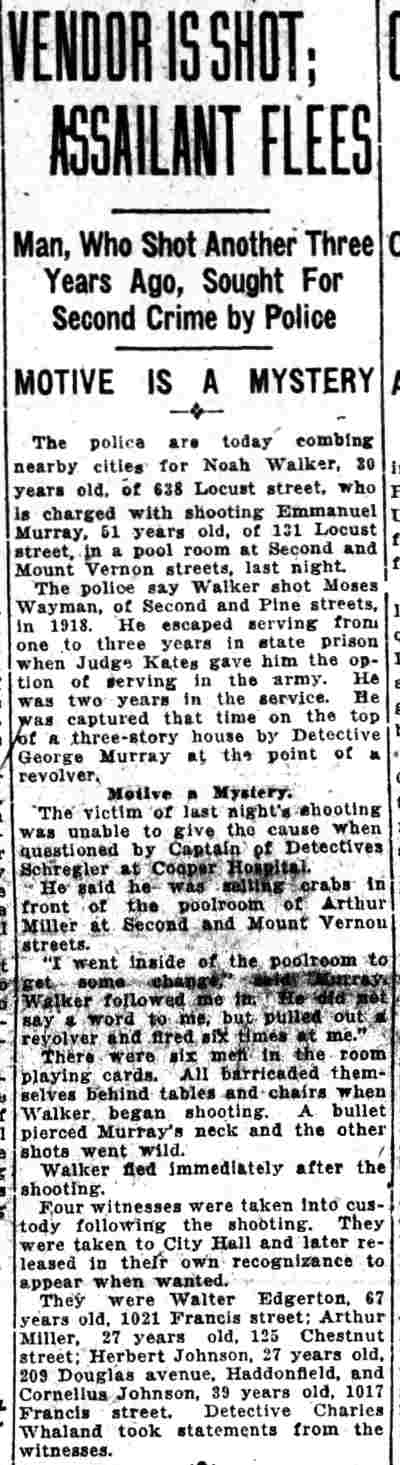
Aside from his boxing exploits, Walter Edgerton was in and out of the newspapers quite a bit in his later years, involving several scrapes with law enforcement in Philadelphia and in Camden, New Jersey. His legal problems centered around running disorderly houses, i.e., prostitution and gambling, and he served jail time in Philadelphia and in New Jersey’s state prison. His first brush with the law that this writer has found happened in 1904 in Philadelphia, when he was arrested for running a crap game. In 1906 he was arrested again on similar charges, and in 1910 got into more trouble for running a disorderly house, i.e., a bordello. This and other offenses earned him some jail time in Philadelphia.
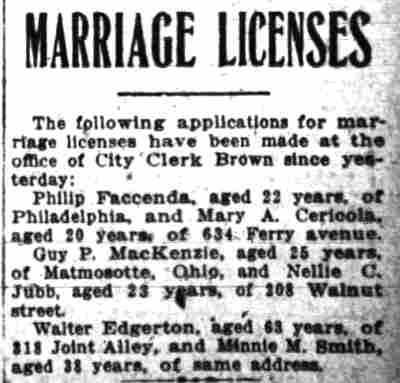
Walter Edgerton appears in the 1910 Census in Philadelphia, living at 245 Warnock Street in Philadelphia, with a wife of 11 years, Minnie M. Smith, and two step-children, Clifton and Nettie. This appears to have been a common-law marriage, as the two were legally married in Camden in November of 1917. The Census states he was keeping a cigar store at the time, and he also had five lodgers in the house, three of them female and under twenty-five years of age.
By the spring of 1912 Philadelphia had gotten too hot for him and he moved to Camden. Over the next eighteen years he resided at different addresses in the vicinity of Second and Sycamore Streets.
In June of 1913 Walter Edgerton was arrested at his home at 811 Locust Street on charges of running a disorderly house. He went to trial in October and was sentenced to serve one to three years imprisonment at Trenton State Prison.
Upon release, Walter Edgerton operated a pool hall for a time, and apparently continued to make money off of vice-related activities. As mentioned before, he fought three times professionally in Philadelphia in 1915–1916 and also appeared in exhibition bouts in 1920 and 1921.
In October of 1922, Minnie Smith Edgerton died and was buried at Mt. Peace Cemetery in Lawnside, New Jersey. Walter Edgerton was arrested again in 1924 and 1927 on gambling charges. He passed away at Philadelphia General Hospital on May 3, 1930. Cause of death was acute myocarditis and vascular syphilis, and he had been suffering from arteriosclerotic dementia.
In the Newspapers
Kentucky Rosebud Knocks Out Dixon
Philadelphia Inquirer, March 23, 1894

View transcription
Read the article: Kentucky Rosebud Knocks Out Dixon
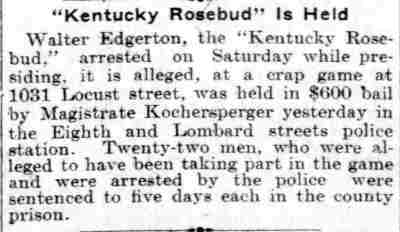
"Kentucky Rosebud" Is Held
Philadelphia Inquirer, January 25, 1904
View transcription
Read the article: "Kentucky Rosebud" Is Held
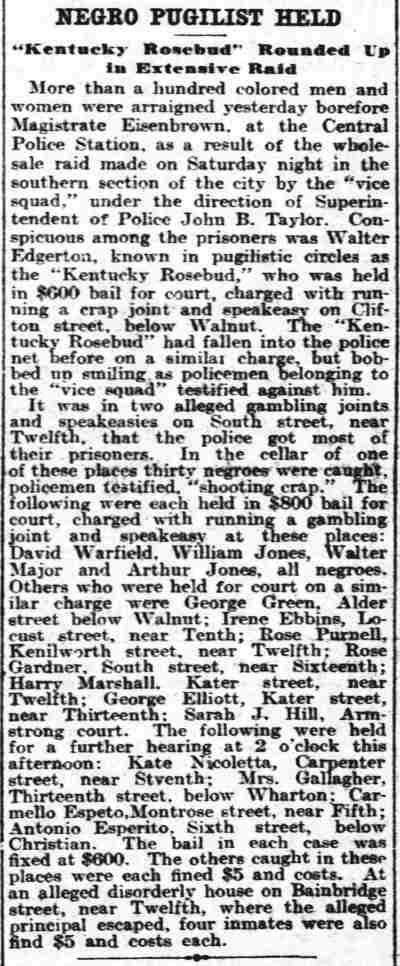
Negro Pugilist Held
Philadelphia Inquirer, December 24, 1906
View transcription
Read the article: Negro Pugilist Held
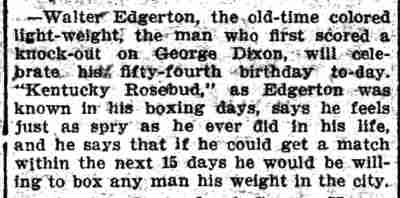
Walter Edgerton Fifty-Fourth Birthday
Camden Evening Courier, November 18, 1908
View transcription
Read the article: Walter Edgerton Fifty-Fourth Birthday
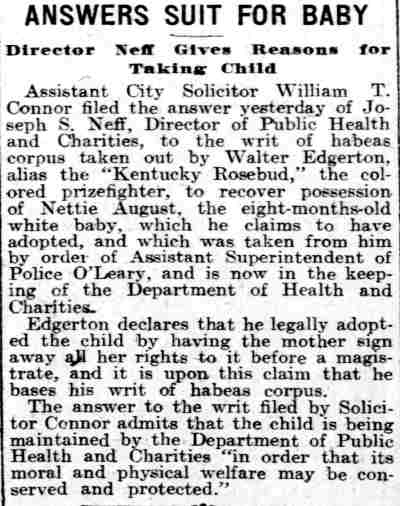
Answers Suit for Baby
Philadelphia Inquirer, August 6, 1910
View transcription
Read the article: Answers Suit for Baby
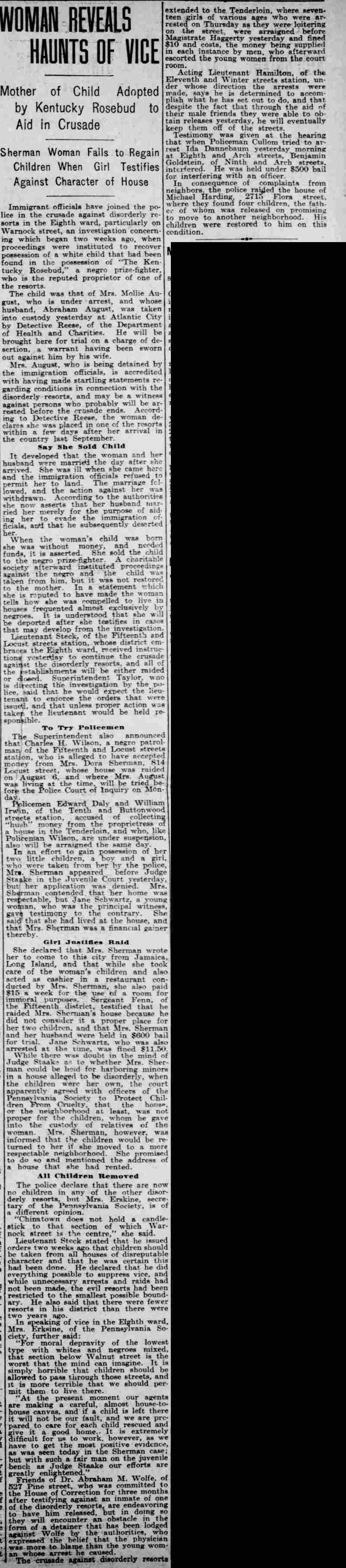
Woman Reveals Haunts of Vice
Philadelphia Inquirer, August 20, 1910
View transcription
Read the article: Woman Reveals Haunts of Vice
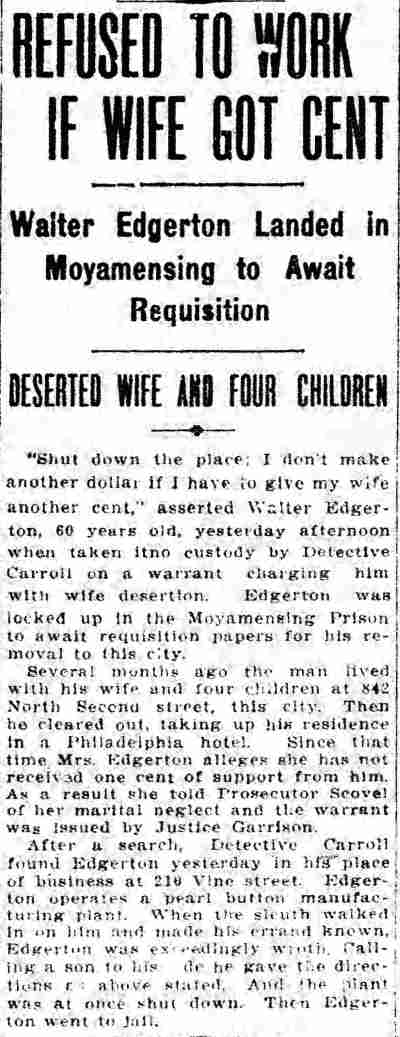
Refused to Work If Wife Got Cent
Camden Daily Courier, October 27, 1910
View transcription
Read the article: Refused to Work If Wife Got Cent
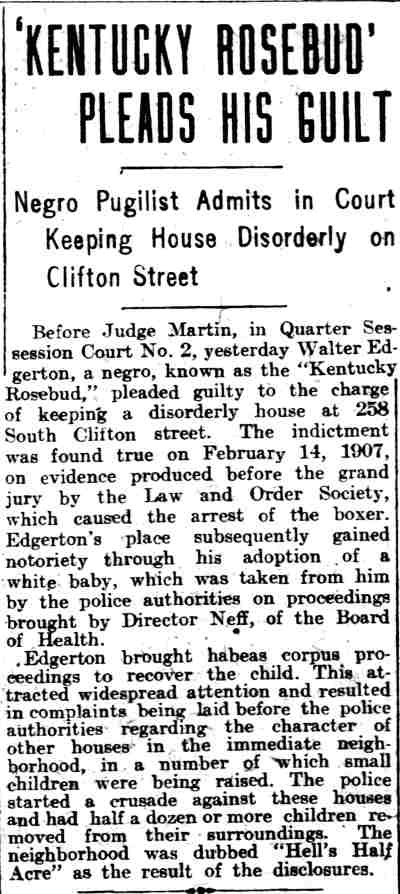
'Kentucky Rosebud' Pleads His Guilt
Philadelphia Inquirer, April 20, 1911
View transcription
Read the article: 'Kentucky Rosebud' Pleads His Guilt
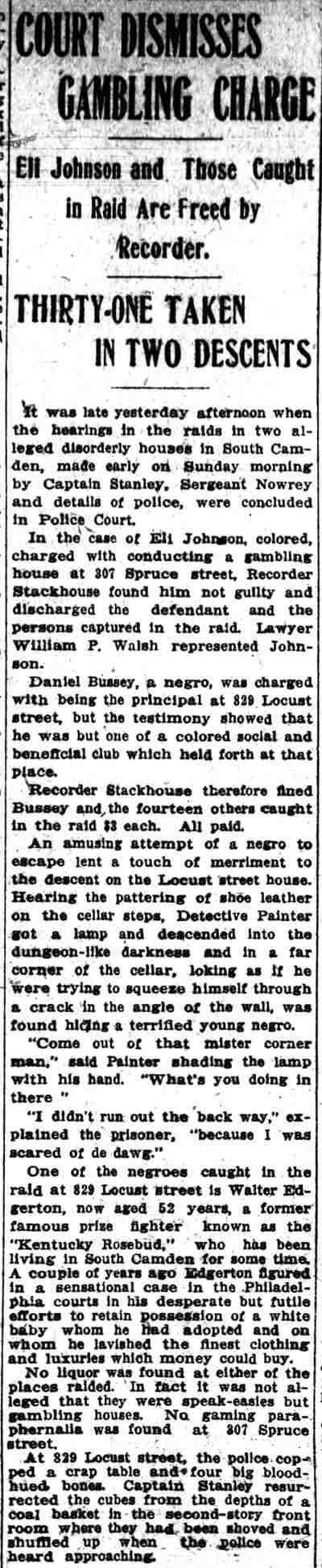
Court Dismisses Gambling Charge
Camden Post-Telegram, April 9, 1912
View transcription
Read the article: Court Dismisses Gambling Charge
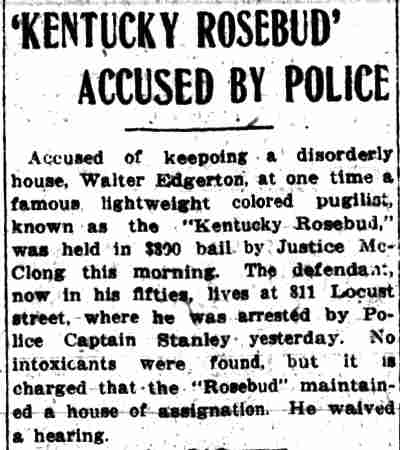
'Kentucky Rosebud' Accused by Police
Camden Post-Telegram, June 9, 1913
View transcription
Read the article: 'Kentucky Rosebud' Accused by Police
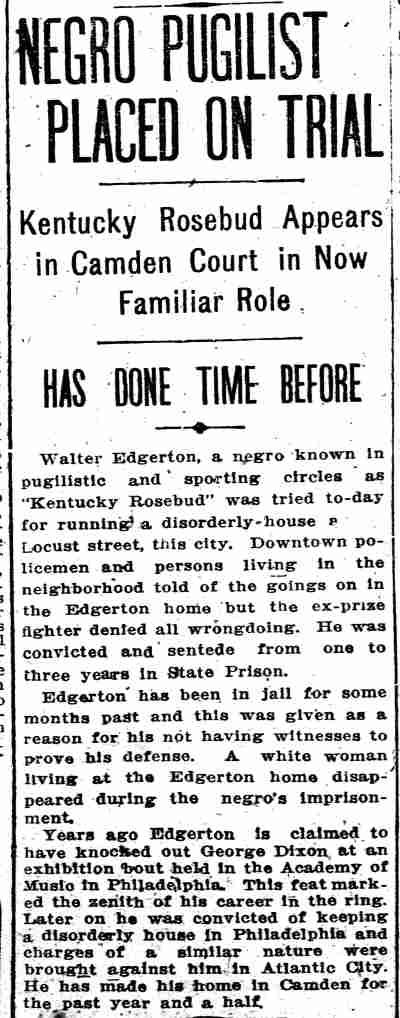
Negro Pugilist Placed on Trial
Camden Daily Courier, October 16, 1913
View transcription
Read the article: Negro Pugilist Placed on Trial
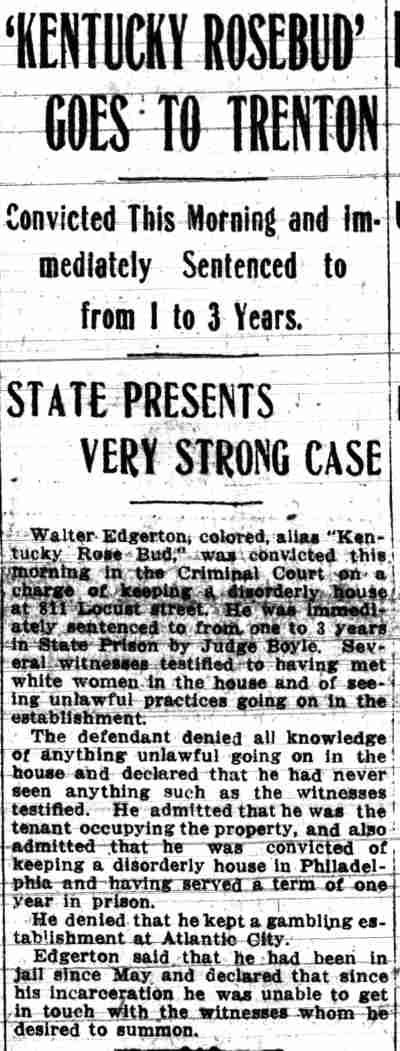
'Kentucky Rosebud' Goes to Trenton
Camden Post-Telegram, October 16, 1913
View transcription
Read the article: 'Kentucky Rosebud' Goes to Trenton
Marriage Licenses
Camden Post-Telegram, November 20, 1917
View transcription
Read the article: Marriage Licenses
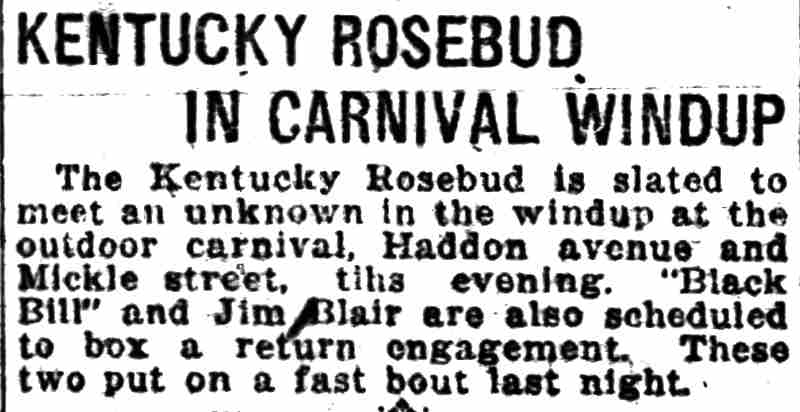
Kentucky Rosebud in Carnival Windup
Camden Daily Courier, September 25, 1920
View transcription
Read the article: Kentucky Rosebud in Carnival Windup
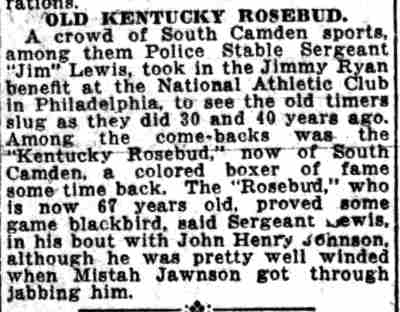
Old Kentucky Rosebud
Camden Daily Courier, April 30, 1921
View transcription
Read the article: Old Kentucky Rosebud
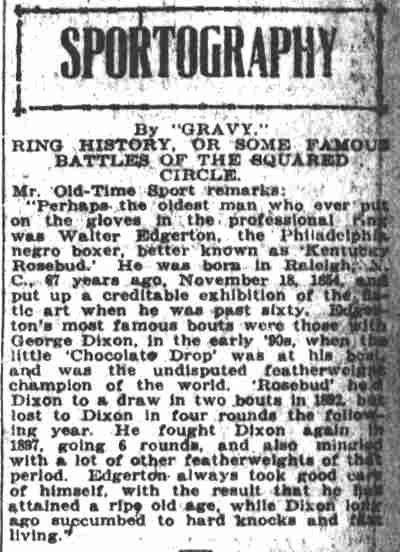
Camden Post-Telegram, May 18, 1921
View transcription
Camden Daily Courier, November 23, 1921
View transcription
“Kentucky Rose Bud’s” Wife Called by Death
Camden Daily Courier, October 6, 1922
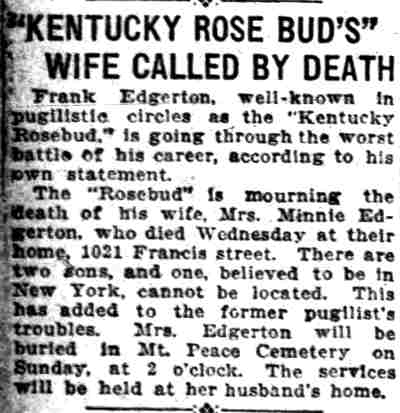
View transcription
Read the article: “Kentucky Rose Bud’s” Wife Called by Death
Camden Daily Courier, December 29, 1924
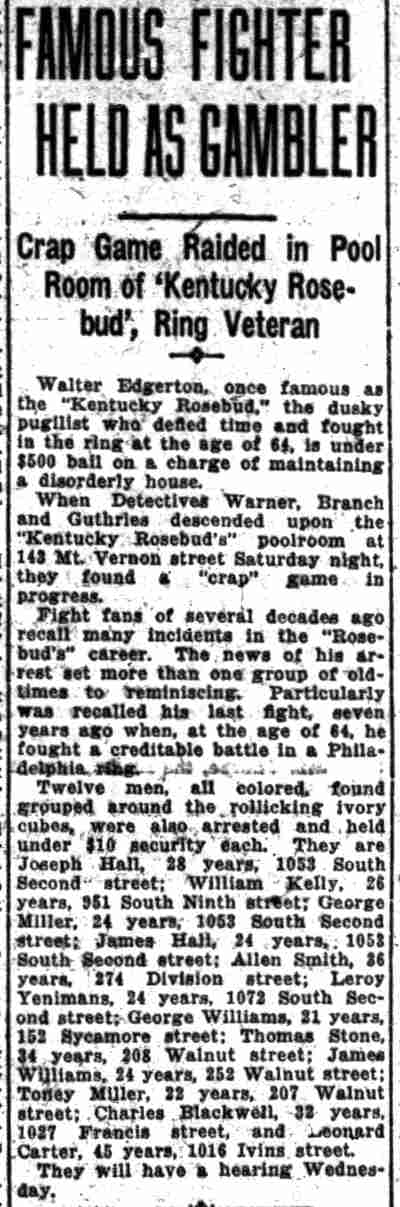
View transcription
Vice Squad Raids Nine Disorderly Houses
Camden Courier-Post, February 7, 1927
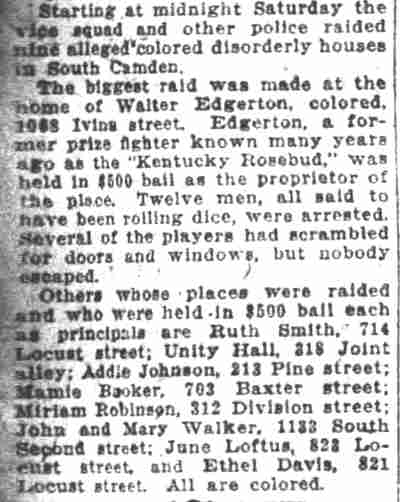
View transcription
Read the article: Vice Squad Raids Nine Disorderly Houses
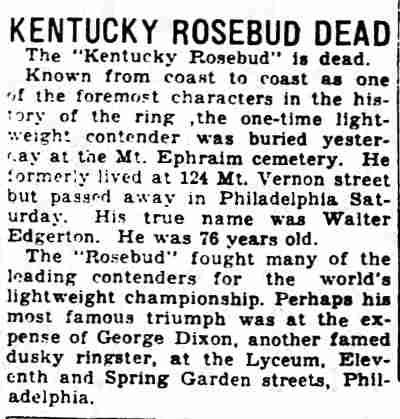
Kentucky Rosebud Dead
Camden Courier-Post, May 8, 1930
View transcription
Read the article: Kentucky Rosebud Dead
Tag: walter-edgerton
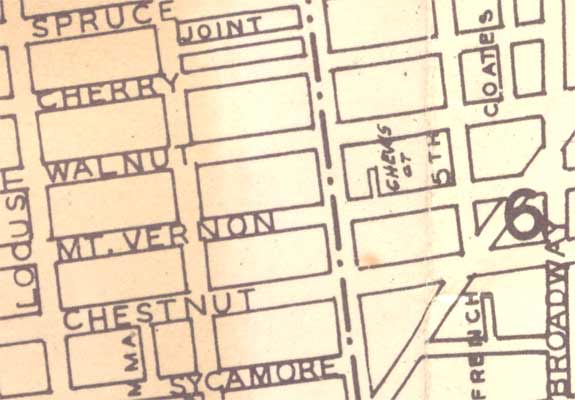
Joint Alley
Joint Alley, also known as Joint Street, is a one-block alley in Camden running east from South 3rd to South 4th Street, between Spruce and Walnut Streets. It first appears in city directories in 1850; only six houses remained by 1947, and no buildings stand there today.

Locust Street
Locust Street ran south from Beckett Street to Mechanic Street between South 2nd and South 3rd Streets in Camden; its 700 block was known as Oak Street until about 1883 and its 600 block as John Street in the 1870s. Homes and businesses disappeared block by block after World War II, and the last structure, at 1128 Locust, was razed after a fire in 2010.
Kentucky Rosebud Dead
Obituary notice in the Camden Courier-Post, May 8, 1930, for boxer Walter Edgerton, known as the Kentucky Rosebud, buried at Mt. Ephraim cemetery.
Vice Squad Raids Nine Disorderly Houses
The Camden vice squad raided nine alleged disorderly houses in South Camden in February 1927. The largest raid hit the home of former prize fighter Walter 'Kentucky Rosebud' Edgerton; Unity Hall at 318 Joint Alley was among the places raided.
“Kentucky Rose Bud’s” Wife Called by Death
The Camden Daily Courier of October 6, 1922 reports the death of Mrs. Minnie Edgerton, wife of the boxer known as the Kentucky Rosebud, at their home at 1021 Francis street.
Old Kentucky Rosebud
A Camden Daily Courier item on the aging boxer Kentucky Rosebud, then 67, fighting John Henry Johnson at a benefit for old-timers at the National Athletic Club in Philadelphia.
Kentucky Rosebud in Carnival Windup
The Kentucky Rosebud was slated to meet an unknown in the windup at the outdoor carnival at Haddon Avenue and Mickle Street on the evening of September 25, 1920.
Marriage Licenses
Camden marriage license applications from November 1917, including Walter Edgerton of 318 Joint Alley and Minnie M. Smith of the same address.
Negro Pugilist Placed on Trial
The Camden Daily Courier reports that Walter Edgerton, the former prizefighter known as "Kentucky Rosebud," was tried in Camden for running a disorderly house on Locust street and sentenced to one to three years in State Prison.
'Kentucky Rosebud' Goes to Trenton
Walter Edgerton, alias "Kentucky Rose Bud," was convicted of keeping a disorderly house at 811 Locust street and sentenced to one to three years in State Prison by Judge Boyle.
'Kentucky Rosebud' Accused by Police
Walter Edgerton, the former lightweight pugilist known as the "Kentucky Rosebud," was arrested by Police Captain Stanley at 811 Locust Street and held in $800 bail on a charge of keeping a disorderly house.
Court Dismisses Gambling Charge
A Camden Post-Telegram account of the April 1912 police raids on two alleged South Camden gambling houses. Eli Johnson and Daniel Bussey were discharged or fined; among those caught at 829 Locust Street was former prize fighter Walter "Kentucky Rosebud" Edgerton.
'Kentucky Rosebud' Pleads His Guilt
Walter Edgerton, the boxer known as the "Kentucky Rosebud," pleaded guilty in Quarter Sessions Court to keeping a disorderly house at 258 South Clifton street, Philadelphia.
Refused to Work If Wife Got Cent
Walter Edgerton, 60, was arrested in Philadelphia on a warrant charging wife desertion and held in Moyamensing Prison to await requisition papers; he reportedly had his pearl button plant shut down rather than support his wife.
Woman Reveals Haunts of Vice
Philadelphia Inquirer report on the police and immigration crusade against disorderly resorts in Philadelphia's Eighth ward, especially Warnock street, where the child of Mrs. Mollie August was found with "The Kentucky Rosebud."
Answers Suit for Baby
The city's answer to the habeas corpus writ in which Walter Edgerton, the boxer known as Kentucky Rosebud, sought to recover an eight-month-old baby he said he had adopted, Philadelphia Inquirer, August 6, 1910.
Walter Edgerton Fifty-Fourth Birthday
The Camden Evening Courier notes that Walter Edgerton, "Kentucky Rosebud," the old-time light-weight who first knocked out George Dixon, celebrated his fifty-fourth birthday on November 18, 1908.
Negro Pugilist Held
Walter Edgerton, the pugilist known as "Kentucky Rosebud," was held in $600 bail on a charge of running a crap joint and speakeasy on Clifton Street after a police vice squad raid.
"Kentucky Rosebud" Is Held
Walter Edgerton, the boxer known as "Kentucky Rosebud," was held in $600 bail by Magistrate Kochersperger after his arrest at an alleged crap game at 1031 Locust Street; twenty-two other men were sentenced to five days each in the county prison.
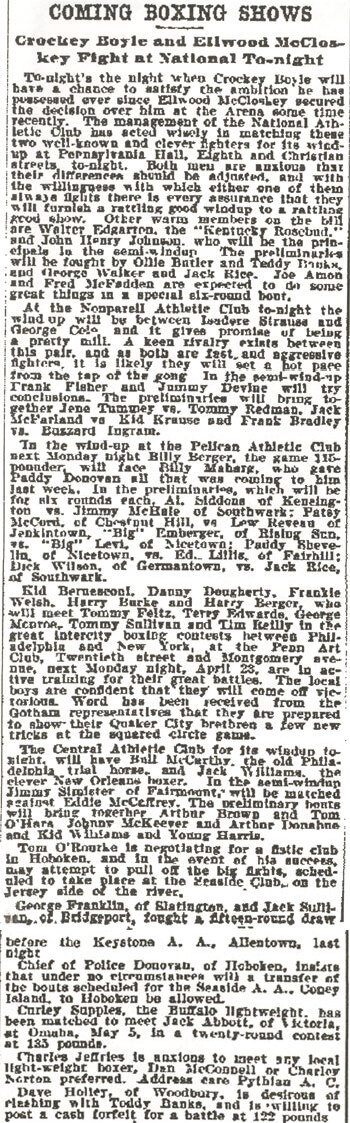
Coming Boxing Shows
To-night's the night when Crockey Boyle will have a chance to satisfy the ambition he has possessed ever since Ellwood McCloskey secured the decision over him at the Arena some time recently. The management of the National Athletic Club has acted wisely in matching these two well-known and clever fighters for its wind-up at Pennsylvania Hall, Eighth and Christian streets, to-night.
Kentucky Rosebud Knocks Out Dixon
Philadelphia Inquirer report of March 23, 1894 on Walter Edgerton, the "Kentucky Rosebud," knocking out featherweight champion George Dixon in the second round at the Industrial Hall carnival for the Bread Fund.