Harry H. Franks

Henry Houston "Harry" Franks, also commonly referred to as H.H. Franks, is best remembered as having served as Camden's Chief of Police from April 1, 1886 until his untimely death on January 1, 1887. He succeeded Josiah Matlack.
Harry Franks was born in 1836 in the Northern Liberties section of Philadelphia. He moved to Camden in 1859. The 1860 Census shows him, wife Susan, son Harry, and a six year old sister-in-law, Clara Harrison, in Camden. Harry Franks supported his family as a tobacconist, manufacturing and selling cigars. Sadly, young Harry did not survive the decade. Upon moving to Camden he became politically active.
Harry H. Franks enlisted as a sergeant with Company G of the 25th New Jersey Volunteer Infantry, a 9-months regiment, on September 2, 1862. He was promoted to Sergeant Major on September 30. Among those he served with were Major John Kelley Brown (also known as J. Kelly Brown), Adjutant Daniel B. Murphy, and Private Steven L. Thomas.
The Twenty-fifth New Jersey Infantry was led by Colonel Andrew Derrom, assisted by Lieutenant Colonel Enoch J. Ayres and Major John Kelley Brown. Among the 9-months regiments sent to the field from New Jersey, few performed more signal service or made a finer record than the 25th. The regiment, composed about equally of citizens of the northern and southern sections of the state, was fortunate in securing as its commander a man of thorough soldierly qualifications, combined with great energy and force of character, whose heart was in the work in which he was engaged, and who, enjoying the entire confidence of his command, was able to make it, in the highest degree, useful and efficient. Moreover, the men composing the regiment were of the best class, whether as to intelligence or personal physique, and adapted themselves readily and cheerfully to all the requirements of the service.
The regiment left its camp at Beverly on October 10, 1862, and arrived at Washington on the following day. Going into camp at Capitol Hill, it was assigned to the 2nd brigade of Casey's division, consisting of the 27th N. J., 12th and 13th Vermont, and 12th Massachusetts Artillery, Colonel Derrom being placed in temporary command of the brigade. Acquia Creek was reached on December 8, the regiment crossing the Potomac in transports from Liverpool Point, and on the following day proceeding directly to Falmouth, where it was assigned to the 1st brigade, 3d division, 9th army corps. It took a conspicuous part in the Battle of Fredericksburg and met with a loss in the conflict of 9 killed, 58 wounded and 18 missing. It also participated in an engagement near Suffolk in May, 1863, in which the behavior of the men was most admirable, the loss of the regiment being 2 killed and 9 wounded. That was the last fight in which the 25th was engaged. On June 4 it was ordered to proceed to Portsmouth and take transportation for New Jersey, and four days later reached Camp Cadwallader at Beverly, where on June 20 it was mustered out of the service. The total strength of the regiment was 1,019, and it lost during its term of service, by resignation 11, by discharge 92, by promotion 13, by transfer 3, by death 57, by desertion 18, by dismissal 1, not accounted for 5, mustered out, 819.
Sergeant Major Franks was among those who mustered out with the Twenty-fifth New Jersey Volunteer Infantry Regiment on June 20, 1863 at Beverly, New Jersey. His obituary states that he reenlisted and served until the war's end with the Twenty-fourth New Jersey Volunteer Infantry Regiment.
Harry H. Franks returned to his family in Camden and his tobacco business. The 1863 Census shows him living at 456 Royden Street. The 1865 Directory shows him living at the Royden Street address, and conducting business on South Second Street south of Bridge Avenue. He soon moved his residence to this location, which the 1870 Directory states was 112 South 2nd Street. The 1870 Census shows the Franks household consisted of Harry and Susan, sister-in-law Clara Harrison, and Susan's parents, Joseph & Elizabeth Harrison.
Not long before the 1874 Directory was compiled, Harry H. Franks moved his home and business to 18 South 2nd Street. The 1876 Directory shows him living at 322 Hamilton Street, which was renamed Berkley Street in 1882. The 1877 Directory has him at 229 Hamilton Street, and the 1878 Directory puts him at the northeast corner of South 2nd and Benson Streets, which is 330 South 2nd Street, where he lived out his days. The 1882 Directory shows Harry H. Franks also had a retail location at 3 Market Street, near the ferry, at least in that year.
In 1878 Harry H. Franks was elected Constable from the Third Ward, which involved him in law enforcement but was outside of the Camden Police Department. He served in this and associated positions until the spring of 1886. Well respected for his work as a constable, as an officer of the courts, active in veterans and fraternal organizations, Harry H. Franks campaigned within his party to run for Mayor in 1886. He stepped aside and threw his allegiance to Jesse Pratt with the understanding that he would be named Chief of Police if Pratt won the election. Jesse Pratt in fact was elected Mayor of Camden in the spring of 1886, and Henry H. Franks was sworn in as Chief of Police on April 1. Sadly, he fell ill shortly after taking on the Chief's job, and died on January 1, 1887 of cancer of the esophagus.
On April 13, 1887 Mayor Jesse Pratt appointed Samuel Dodd to succeed Harry H. Franks as Chief of Police.
Harry H. Franks was an active member of the William B. Hatch Post No. 37, Grand Army of the Republic (G.A.R.), the Knights of the Golden Eagle and the Kearney Conclave of Heptasophs or Seven Wise Men. He was survived by his wife Susan, who was quite active as a member of Hatch Circle No. 2, Loyal Ladies League which was the female auxiliary of the G.A.R. She moved to 603 North 3rd Street shortly after her husband's death. Mrs. Susan Franks stayed active in Hatch Circle No. 2 affairs until her death in 1911.
Civil War Pension Record
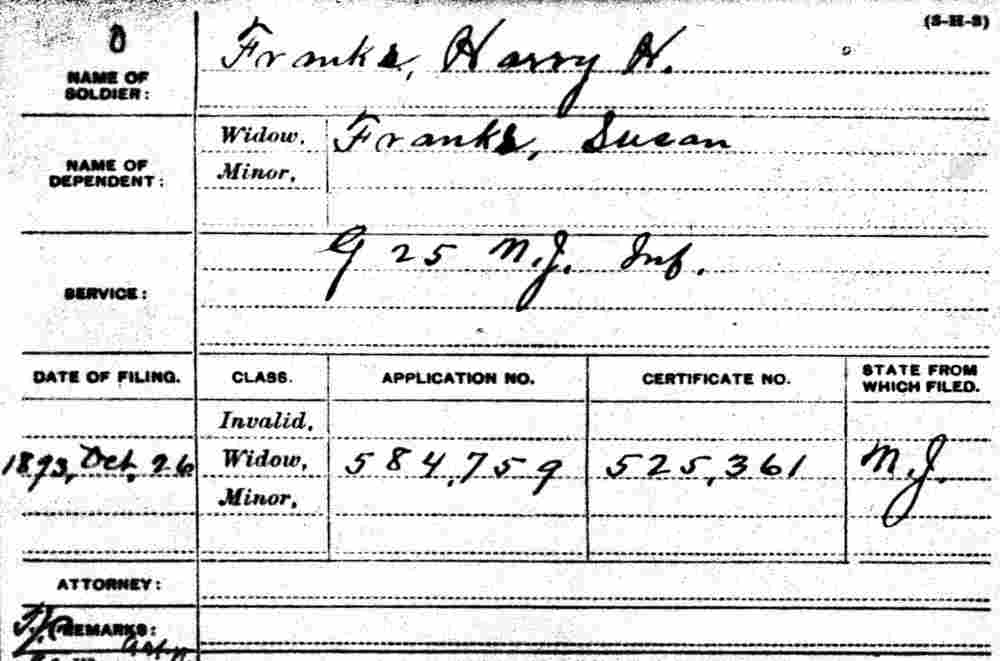
View transcription
Tag: harry-h-franks

Josiah Matlack
Josiah Matlack served as Chief of Police of Camden from 1880 to 1886. Born in Lancaster, Pennsylvania in 1830, he came to Camden as a young man, served on City Council, and was appointed police chief by Mayor Claudius W. Bradshaw.

3rd Street
Third Street runs north and south, parallel to the Delaware River, through North and South Camden, featuring notable corner buildings like the Security Trust Building at 301 Market Street and the Mickle Tower Apartment House at 200 Mickle Boulevard.

Arch Street
Arch Street ran from Delaware Avenue to North 5th Street between Federal and Market Streets in downtown Camden. Formerly known as Plum Street, it was home to Oetzel's Saloon, the Genova Cafe, the Collings Carriage Company, and the Camden Fire Department headquarters at 5th and Arch.
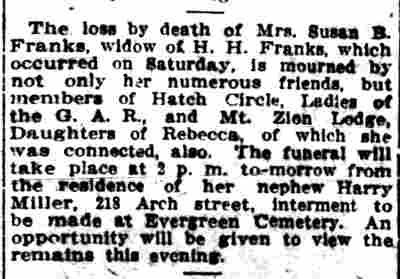
Death of Mrs. Susan B. Franks
Death notice for Mrs. Susan B. Franks, widow of Chief of Police H. H. Franks; her funeral was held from the residence of her nephew Harry Miller at 218 Arch Street, with burial at Evergreen Cemetery.
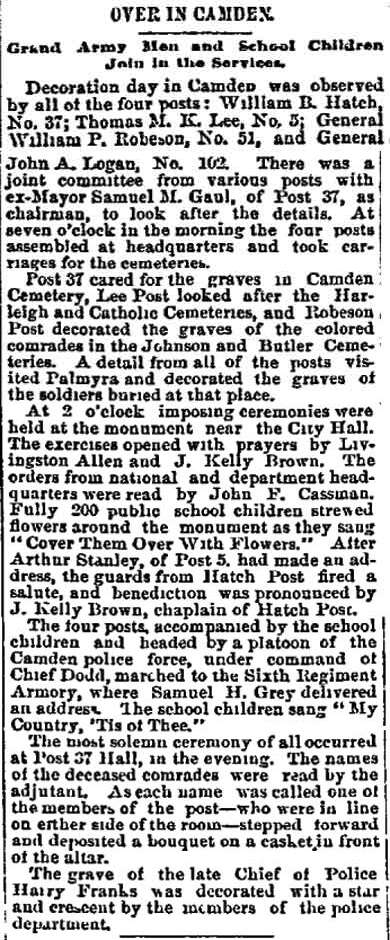
Over in Camden
Decoration Day 1890 in Camden; the four Grand Army posts and school children joined in the services, and the grave of the late Chief of Police Harry Franks was decorated with a star and crescent by the police department.
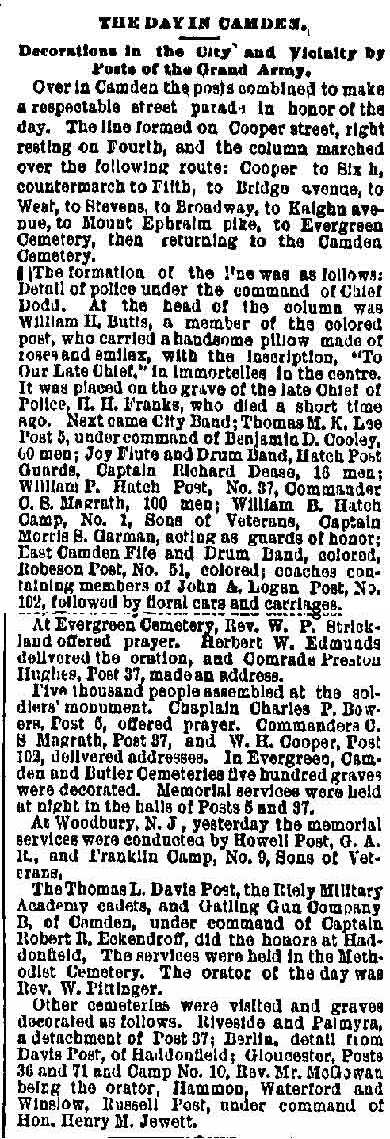
The Day in Camden
Decoration Day observances by the Grand Army posts of Camden; a rose-and-smilax pillow inscribed 'To Our Late Chief' was placed on the grave of the late Chief of Police H. H. Franks.
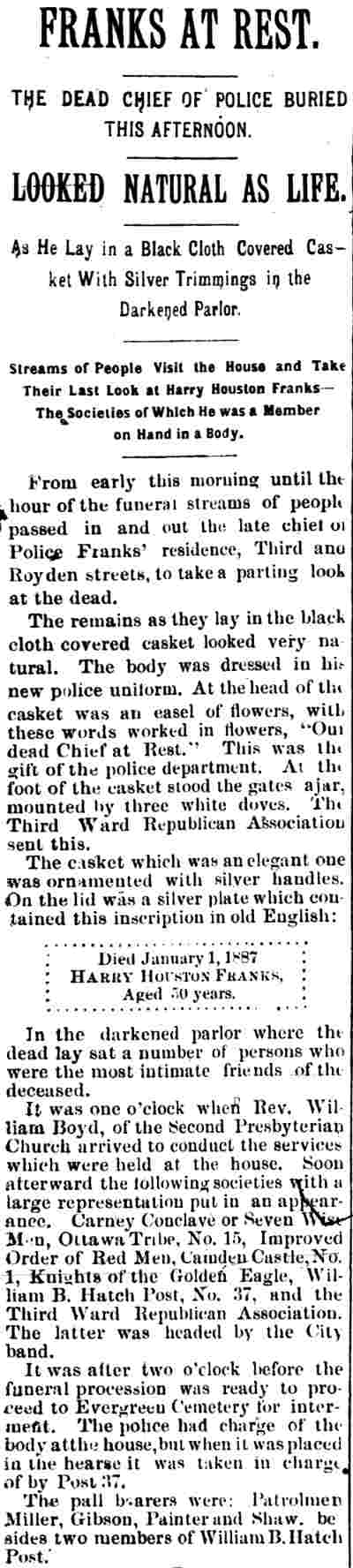
Franks at Rest
Account of the funeral of Chief of Police Harry Houston Franks, held at his home at Third and Royden Streets, with burial at Evergreen Cemetery.

Chief Franks Dead
Obituary of Chief of Police Harry Houston Franks, who died January 1, 1887 at his home at Third and Royden Streets; a post-mortem attributed his death to cancer of the oesophagus.
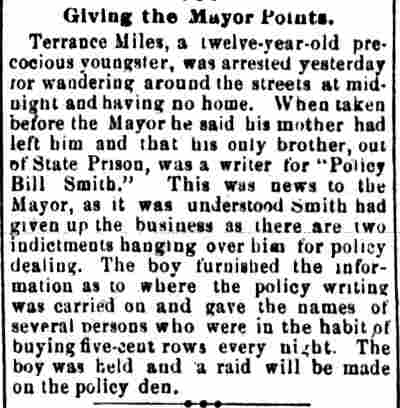
Giving the Mayor Points
A twelve-year-old boy, Terrance Miles, arrested for vagrancy, gave the Mayor information on the policy-writing operation of 'Policy Bill' Smith.
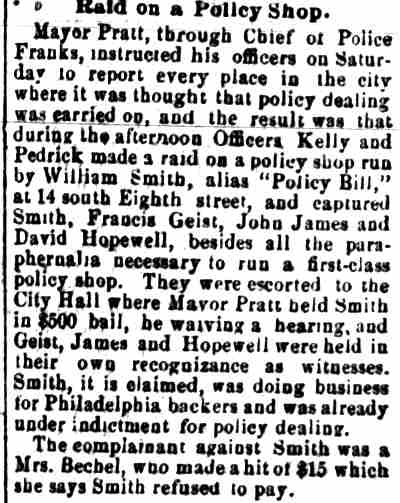
Raid on a Policy Shop
At Mayor Pratt's direction, Chief of Police Franks had officers raid the policy shop of William 'Policy Bill' Smith at 14 South Eighth Street.
Franks Sworn in as Chief
Harry H. Franks and six new patrolmen took the oath as retiring Chief Josiah Matlack bade the police department farewell and formally turned it over to his successor.
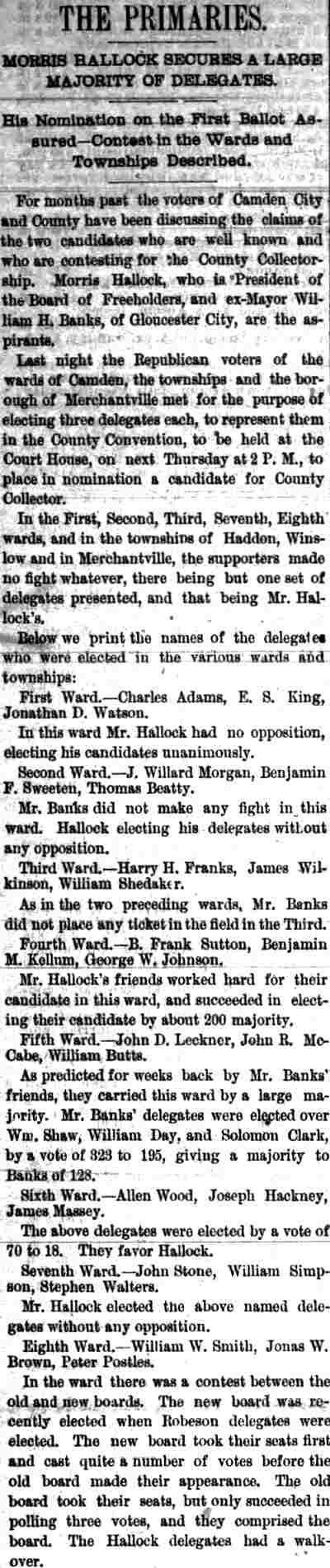
The Primaries
Republican ward primaries to elect County Convention delegates; Morris Hallock secured a large majority. Harry H. Franks was elected a Third Ward delegate.
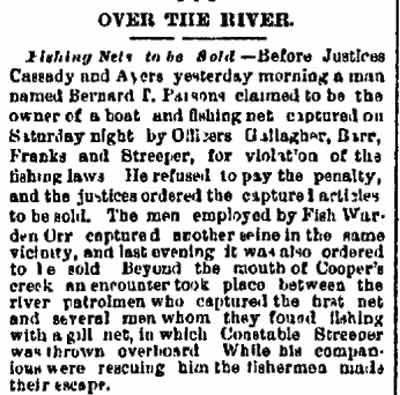
Over the River
Before Justices Cassady and Ayers, a seized boat and fishing net were ordered sold; Officers Gallagher, Barr, Franks and Streeper had made the capture, and Constable Streeper was thrown overboard in a later encounter.

Over the River
Camden City Council - An adjourned meeting of Camden City Council was held yesterday afternoon at half past four o'clock for the purpose of acting on and disposing of miscellaneous business, President Abels in the chair.
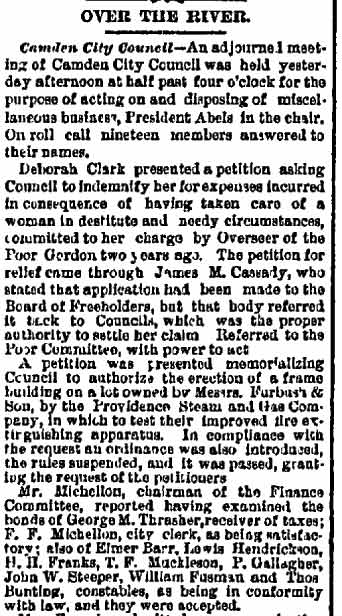
Over the River
Report of an adjourned Camden City Council meeting; the bonds of the city constables, including H. H. Franks, were examined and accepted.