Camden Grocers Exchange. Northwest corner of Atlantic Avenue and Ferry Avenue
Atlantic Avenue lies three blocks south of Kaighn Avenue, and runs from Front Street east to Haddon Avenue. Atlantic Avenue east of 7th Street was and remains a mix of homes and commercial properties. The street continues between 7th and 9th Streets, with interstate highway I-676 and the elevated rail line crossing the street. East of 9th Street to Haddon Avenue the street is primarily residential.
Dr. Henry Hill Davis was born at Crosswicks, New Jersey, on August 16, 1848. He began the study of medicine in 1867 in the office of Dr. Alexander Mecray, enrolled at Jefferson Medical College that fall, and graduated in March 1869. At the same time he completed a course in pharmacy at the Philadelphia College of Pharmacy and Science, and then began practicing medicine in Camden. In 1874 he opened a drug store, which he conducted alongside his practice through at least 1886. In 1881 he joined the Camden County and Camden City Medical Societies and the State Medical Society. He ran unsuccessfully for Mayor of Camden in 1883, losing to Claudius W. Bradshaw.
For most of the 1880s Davis made his home and conducted his practice and pharmacy at 299 Kaighn Avenue, at the northwest corner of Third Street and Kaighn Avenue; by the 1890–1891 City Directory he had moved to the southeast corner. He later served as a physician at the Camden City Dispensary. The 1910 census recorded him and his wife residing at 232 North 2nd Street, at the southeast corner of Second and Penn. He later lived with his wife, the former Harriet Blizzard, at 417 Cooper Street.
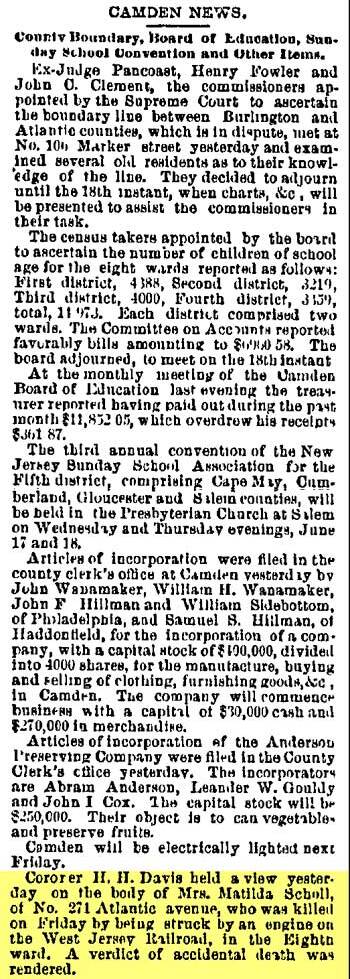
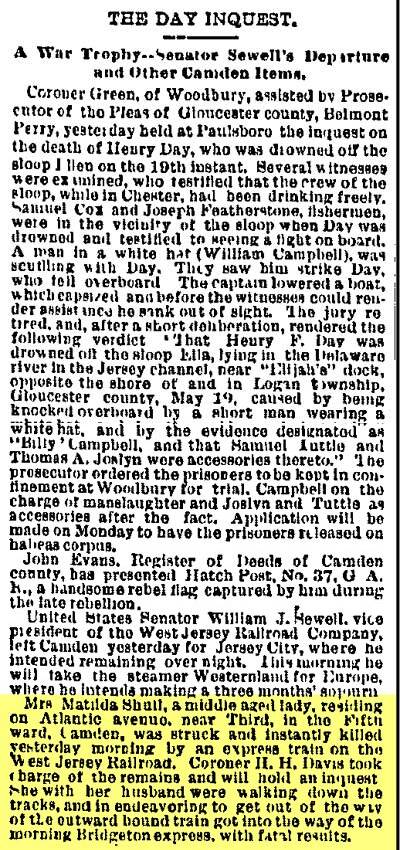
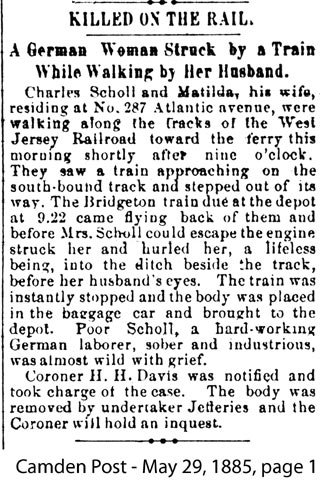
Over his career Davis served as a school board member and county coroner, and became Camden's first medical inspector and first chief medical inspector. He spent many years on the Board of Health, serving as its president when the Camden Municipal Hospital for Contagious Diseases was planned and built. He was also Chief of the Medical Department of Camden's public schools and the first School Medical Inspector in the State of New Jersey.
Plans for the Municipal Hospital were drawn in 1910, and construction began in 1912 under a building committee of Raymond L. Warren, John A. Mather Jr., and William H. Kensinger, M.D. The 1912 Board of Health comprised Davis as president, Marcus K. Mines, E. Winner Collins, Reuben L. Gaskill, S. G. Bushey, Melbourne F. Middleton, and William I. Kelchner. Bids to equip the hospital were let in 1914, with Dr. David Rhone selecting the medical supplies.
In September 1911 four assistant medical inspectors were appointed in addition to Davis, and five inspectors examined more than 2,700 students in the first full month. A year later Dr. Roscoe L. Moore, of the Camden High School class of 1903, was appointed assistant medical inspector for the colored schools at a salary of $240 a year.
That same September the schools enrolled immigrant pupils from Germany, Italy, England, Prussia, Poland, Romania, and Holland. Inspectors found 81 children malnourished, 16 native-born children with defective vision, and 84 with periodontal problems. Unvaccinated children were refused admittance, and a rule allowed teachers sick leave of up to 30 days.
A scarlet fever epidemic struck in February 1913, followed by measles in March. Davis spoke out about unreported disease and about the risks posed by movie houses.
In September 1913 an open-air class for girls opened at the Bergen School, furnished with Rochester and portable desks, with milk served twice daily and Horlick's malted milk donated. The class was discontinued on February 1, 1925.
Medical cabinets and examination screens were purchased for the schools, and Davis classified some children as “dull or deficient.” He pushed for full-time nurses, citing another New Jersey city that had grown from 8 to 38 nurses, and proposed a ratio of one nurse for every 5,000 students.
Miss Sarah Kroenwetter was hired as the district's first nurse on January 19, 1914, at a salary of $625 a year, and was assigned to the Central School. She visited 101 homes and received a $100 raise beginning in January 1915.
By February 1915 no school reported a child's death from illness, and Davis held a “court” each Wednesday for parents.
In 1915–1916 nurse Rebecca O. Kandle was hired at a salary of $720 a year.
When the Spanish Influenza epidemic arrived in September 1918, average daily attendance dropped by about 2,000, and Davis was given authority to close the schools. He closed the day and evening schools from October 1 to November 6, 1918. A second wave followed from January to March, and influenza returned in February 1920, this time with no fatalities.
The Camden Municipal Hospital for Contagious Diseases opened in 1916 under Davis, who by then held the title of Health Director. Dr. Rhone treated more than 100 polio patients that year, and Dr. Jungman served as full-time Medical Director.
In 1917 Dr. Jungman entered military service, and the hospital was run by Davis and Dr. John Leavitt. During the 1918 epidemic, overflow patients were housed in the doctor's bungalow, the nurses' home, and the Haddon Avenue armory, and the New York Shipbuilding Corporation assigned staff. Davis worked alongside Dr. Marcus K. Mines.
Smallpox epidemics before 1910 were reduced by Davis's vaccination campaign; a 1925 outbreak brought 97 cases and 44 deaths, with single fatal cases in 1933 and 1947. In 1923 Davis was succeeded as Health Director by Dr. Arthur L. Stone.
The Henry H. Davis School, the largest elementary school in Camden, was built in 1925 at 3425 Cramer Street in East Camden, designed by architect Benjamin Howell Lackey. Davis Street, adjoining the Municipal Hospital property, was also named in his honor.
Davis served as president of both the Camden County and Camden City Medical Societies, was a member of the American Medical Association, and was an active member of Camden Lodge No. 293, B.P.O.E..
Dr. Henry Hill Davis died in 1929; a later account records that he was killed by an automobile in his eightieth year.
In the Newspapers
The newspaper articles and documents below record Dr. Davis's work as county coroner and, later, as a Camden health official. Each is preserved as its own post.
Sycamore Street in Camden, New Jersey, is a notable example of the city's "tree" streets, a naming convention common in many American cities. Originally running east from Front Street to Haddon Avenue, Sycamore Street has played an important role in Camden's cultural and community history.
At various times, the intersections along Sycamore Street, particularly at 7th, 8th, and Louis Streets, have been vital hubs for different ethnic and cultural communities in Camden. These intersections have served as focal points for the city's African-American, Jewish, and Polish communities, respectively.
The intersection at 7th Street emerged as a central area for Camden's African-American community. This area likely featured businesses, churches, and social clubs that catered to and supported the African-American population in Camden, reflecting the community's social and economic life.
Similarly, the intersection at 8th Street became a hub for the Jewish community in Camden. This area would have been characterized by the presence of Jewish-owned businesses, synagogues, and community centers, playing a significant role in the cultural and religious life of Jewish residents.
The intersection near Louis Street was known as a center for the Polish community. This area would have included Polish businesses, cultural institutions, and possibly a church or social club, serving as a gathering place and support network for Polish immigrants and their descendants.
These intersections on Sycamore Street, each serving as a hub for different cultural communities, highlight the diverse ethnic tapestry of Camden. They reflect how various immigrant groups and their descendants have contributed to the city's cultural richness, community cohesion, and economic vitality.
Sycamore Street sign at South 3rd Street, Camden, NJSycamore Street at South 2nd Street, Camden, NJLooking West on Sycamore Street from South 3rd Street - March 16, 2012
Looking East on Sycamore Street from South 3rd Street - March 16, 2012
Edward N. Cohn was born in 1832. On the 1870 U.S. Census, he reported his birthplace as Bohemia, while in the 1880 Census he listed it as Germany. It is likely he was born in a region that is now part of the Czech Republic.
Cohn served in the Civil War as a sergeant in Company C of the 34th New Jersey Regiment from January 17, 1865, to January 16, 1866, and was mustered out in Mobile, Alabama.
By 1870, he was living in Camden's North Ward with his wife, Adeline, who was born in Pennsylvania. They had a three-year-old daughter, Adelia. At the time, Cohn was working in the lumber business and doing well enough to employ a live-in domestic. He had also begun building houses.
When the 1880 Census was taken, Cohn was living in Bordentown, New Jersey, and working in the retail lumber trade. His business remained prosperous, and the family continued to employ domestic help. Throughout this period and into the 1880s, Cohn remained active in construction.
In 1886, George Reeser Prowell wrote of Edward N. Cohn, in his book History of Camden County, New Jersey:
Among the builders of Camden are several who have erected five or six hundred houses each. The heaviest operators are undoubtedly Cohn & Roberts, Wilson Ernst, and George Holl. Fine examples of the work of the firm first named are to be seen on Front and Point Streets, between Cooper and Linden. Mr. E. N. Cohn commenced building in 1866, erecting in that year 12 houses on Pearl Street. He then continued putting up blocks and separate structures, operating alone and in conjunction with Charles B. Richard and Asa R. Cox, and building not less than one hundred and fifty houses. He also erected the Pfeil and Galtz building, which was burned. In 1882 he formed a partnership with Joseph E. Roberts, who, individually, had built about two hundred houses, and as a firm they have since constructed at least four-hundred and fifty dwellings, to which line of building they devote themselves exclusively.
By 1887, Edward N. Cohn had returned to Camden, where his family lived at the corner of 8th and Line Streets until 1889. In 1888, he began construction on a mansion at North 8th and Cooper Streets. The 1890 Camden City Directory lists the Cohn family at 804 Cooper Street, then one of the city's most prestigious addresses. Edward Cohn died on November 9, 1890.
As noted earlier, Cohn had partnered with Joseph E. Roberts, president of the West Jersey Railroad Company, and later with George Holl. The firm of Roberts and Cohn operated from 105 Market Street. Cohn purchased land from John F. Starr Jr. in North Camden, and with Roberts and Holl, developed numerous two- and three-story row houses and frame houses from Cooper's Point to Pearl Street. These homes were sold or rented to working-class families.
Cohn Alley—running west from Haddon Avenue between Kaighn Avenue and Liberty Street—was named in his honor.
Edward N Cohn800 Block of Cooper Street, Camden, NJ - 1893. The house on the left is 804 Cooper Street, which was the David Baird family home from the 1890's until October 1936. Prior to that, it was built and owned by E. N. Cohn.
Over the years, Eighth Street has undergone significant expansion, extending its original length from Morgan Boulevard to Pyne Point in North Camden, with a few major interruptions.
During World War II in the early 1940s, the Chelton Terrace public housing project was constructed on the 2100 block of South Eighth Street, between Chelton Avenue and the adjacent railroad tracks along Bulson Street, east from Broadway. These homes, managed by the Housing Authority of the City of Camden, underwent demolition and subsequent reconstruction in the 2000s.
In the early 1950s, properties along Eighth Street, spanning from Van Hook Street to Ferry Avenue, were demolished to make room for the Roosevelt Manor public housing project, also owned and operated by the Housing Authority of the City of Camden. Roosevelt Manor was demolished in late 2004 and 2005, with new construction completing by the spring of 2010.
The bar at 303 Kaighn Avenue was in operation as early as June of 1939, when Lauraine Bieri was granted a liquor license renewal by the city of Camden.
Lauraine Bieri and her husband Charles appear in the 1930 Census as living at 1210 Hyde Park, a small street that runs between Kaighn Avenue and Liberty Street and 2nd and 3rd Streets. Charles Bieri was then working as a baker. The Bieri family appears to have left Camden by 1947.
It was reported in the August 6, 1936 edition of the Camden Courier-Post that Clara Auerbach had obtained a tax lien on the property on October 3, 1934. This lien was apparently satisfied before the property would have been sold.
The 1940 Camden City Directory shows a Joseph Pierzinski as the proprietor. Joseph F. Pierzynski was the son of Frank and Laura Pierzynski, both of whom had been born in Poland. The Pirzynski family lived from about the time of World War I through at least 1947 at 920 Atlantic Avenue. Frank Pierzynski operated a business called the Lansdowne Bottle Exchange, which may indicate that he had a role in the bar as well. In any event the Pierzynski family's involvement in the bar seems to have been short-lived. Frank Pierzynski died in Camden in 1068 at the age of 79, survived by his wife Laura. Joseph F. Pierzynski lived at 909 Atlantic Avenue from the 1940s through at least 1977. He later moved to Somerdale NJ, passing away. He passed away in 1997.
The Directory for 1943 shows that a Charles Redemann was the owner, and that he lived on premises with his wife Fannie. Apparently his involvement in the bar ended in 1947, as the next published directory, that of 1947, has two entries for this address. Charles and Fannie Redemann are shown as living at 303 Kaighn Avenue, and Charles Redemann is shown as operating the tavern there. Another party is also shown as being in business at this address, the Three-O-Three Bar & Liquor Store Inc., with V. DeFalco, President; A.J. DeFalco, Secretary-Treasurer; and Samuel DeFalco Vice President. The directory indicates that V. and A.J. DeFalco resided in Collingswood NJ, and that Samuel DeFalco resided at 100 West Cedar Avenue in Oaklyn.
In 1967 the liquor license renewal application listed the 303 Bar & Liquor Store Inc.'s officers as follows:
The business continued as the Three-O-Three through at least 1970. Samuel DeFalco passed away at the age of 73 in August of 1972. The listing in the New Jersey Bell Telephone Directories from 1978 through 1981 is for the Togetherness Bar. As more and more homes and businesses buildings were abandoned and razed in the area near 3rd and Kaighn, it became more and more difficult for the bar to remain in business. By the 1990s the building at 303 Kaighn Avenue had been leveled as well.
Baring Street runs for one block south of Chestnut Street to Kaighn Avenue, between Marion Street and South 6th Street. The houses on Baring Street were built in 1888 by Wilson Ernst, who was active as a builder in Camden in the 1880s. In the late 1880s Ernst had offices on Benson Street above 4th Street and at 521 Kaighn Avenue.
In 1886 George Reeser Prowell wrote, in his History of Camden County New Jersey, that "Wilson Ernst has been actively engaged since 1876 and about four hundred buildings, chiefly dwellings, attest to his enterprise." Prowell cited Ernst as one of the three most active builders in Camden at the time.
In August of 2007 I received this remarkable set of articles about growing up in Camden in the 60s and 70s by Richard Brodowicz. Over the years a lot of e-mails have come my way about Camden, but I'm hard put to find one as extensive and in detail as what Rich sent. I decided to use it as the basis for a web page of its own.
Camden Childhood Reflections
The stories and thoughts shared are of a time remembered for its simplistic carefree existence. I have many wonderful memories of my boyhood home, Camden New Jersey. A recent view of the city in its current deplorable condition has left it almost unrecognizable shell of a previous era. The decaying unattended structures and unkempt streets are a far cry of a time from the not too distant past. The hard working immigrant families that called Camden home lived side by side with the utmost pride and concern for family and community involvement for many years. Neighbors were so friendly; they would come out and talk after dinner for hours, to catch up with the day's events. Whether Polish, Irish, German or Italian the family values and aspirations were the same for everyone. They were to work hard and strive to achieve the best possible results in school and future goals. Parents always aspired to have their children have a better life then they had. I am not deluded in my fond reminiscing about the past, our city might not have been New York or Los Angeles, but all the same it had great character and warmth in its day. Since the mass exodus of the baby boomer generation to the suburbs and beyond, Camden our city that we called home has lost its luster, destined for ruin at the current pace. I can only hope that a new transformation can occur and save our beloved city for its historical past and that it might have a new beginning with a bright future.
My family background on both sides is Polish. My father grew up in Camden in the Great Depression era, he knew his way around Camden very well. My father was a very easygoing guy who easily made friends, some of the people he knew he had been friends with for 40 and 50 years. Since many people did not move around much they were able to stay in contact. In his day my dad was quite a ladies man because he introduced me to many women of his age through the years and said he would go clubbing and dancing and meet them. He always said that dancing was a great way to meet young ladies and that I needed to just try and I would do all right. My father was an Army veteran of WWII he was very proud of that but he never bragged or mentioned any of his accomplishments. He did like to reminisce and would often tell my brother of places he saw and stories about specific days and events. Dad had been involved in some very important European Campaign battles including the Battle of the Bulge and the invasion at Normandy — in many respects I was very lucky to be born. An unusual story that he mentioned was that during the war he was in Atlantic City providing escort duty for some big stars and when the singer Kate Smith was climbing the stairs she had tripped on her mink jacket and my dad helped so she would not fall and she gave him a kiss on the cheek all the guys were so jealous. My father had these really nice documented papers that detailed all the different countries and battles he was in and around the edge of the paperwork was colorful country flags, somehow this paperwork had become lost during our moves and storage. My cousin Bob Gorski was a big history buff and he liked to sit for long periods and talk to dad about WWII, you could see how intently he listened and how dad enjoyed the questions and reliving a very important time in our history.
My mother was originally from the Poconos portion of Pennsylvania, her family moved to Camden in the 40's. Strange how people meet and fall in love — my dad was outgoing and gregarious, my mother shy and reserved but they worked out well together. Mom primarily took care of everyone and the house and put up with me and my brother and our antics. My dad often worked nights and weekends and overtime at the shipyard so Mom was left to handle the boys. Strange as it was my father was a better cook than my mother but she tried very hard to please us and would always have something for us no matter what the time was, either after little league or some other late night event.
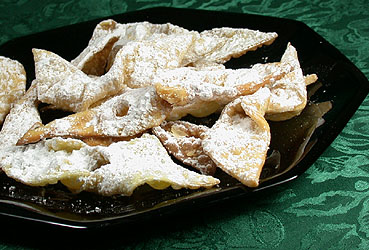
Since a good deal of Camden residents were immigrants coming from Europe we had his pick of various wonderful butchers and meat markets which had fresh or smoked kielbasa and would cut and handle your meat requirements as you desired. I loved going with him when he shopped, the smells of the different places was great — I particularly liked Frank's Meats at Chase and Norris Street. The Polish Baking Company bakery located at 1009 Kaighn Avenue had the best rye bread and fresh Kaiser rolls (I usually ate one on way home). They had a way with cheesecake; especially pineapple, the poppy-seed cake was also very good. Let's not forget the powered puffed pastries tied into bows (KRUSCHICKI).
KRUSCHICKI (aka Chrusciki, Angel Wings, Bow Tie Cookies, Chrust, Faworki) — Traditional Polish Cookies.
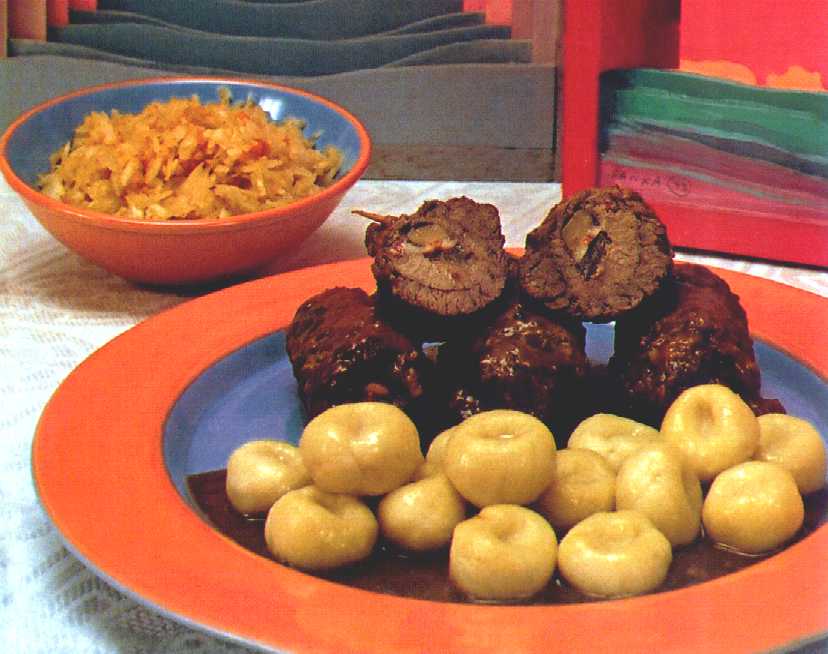
The Polish foods my mother and father cooked were wonderful dishes; they were simple home-style meals that were passed down in families that could feed several people in lean times as in the depression era. We enjoyed several traditional meals such as potato pancakes (PLOTSKI) dusted with sugar, potato dumplings (KLUSKI), with added flavor of bits of bacon or fatback skin with onions both primarily made of potatoes that were inexpensive but good. Cabbage rolls or with other such names as pigs in the blanket (GOWUMPKI) was just ground beef balls mixed with cooked rice wrapped in cabbage leaf covered in tomato sauce. Heaping pots of sauerkraut with portions of smoked kielbasa, pork spare ribs and even pigs feet was simmered to perfection for a meal to dream about. The individual families enhanced the wholesome meals with individual touches but the overall ingredients were the same. I was a rather large child growing up and this is understandable with the meals we tended to eat but they were dishes that I only wish I could cook now and even taste half as good as my parents cooked them.
KLUSKI — Silesian Noodles, wonderful especially when accompanied by rolada meat and redbeet salad or sauerkraut.
My family kept to a specific time to eat each day, throughout my childhood up through the young teens years my parents looked for me and called my brother and my name around the neighborhood so I wouldn't miss dinner. I made a good effort to try and make it home so I wouldn't get embarrassed — nothing like your mom calling you in the middle of a neighborhood football game. My mother and father thought it was important to come together and eat as family; this was the way most families around the United States kept together and shared what was going on during their day. Food was an important part of life growing up especially during holidays and special occasions. Polish families would make potato and macaroni salad along with cooked ham and special desserts each Christmas and Easter, when we would visit each other's families it was part of the normal visit to taste each other's food to determine which style was best, each family was convinced theirs was the best.
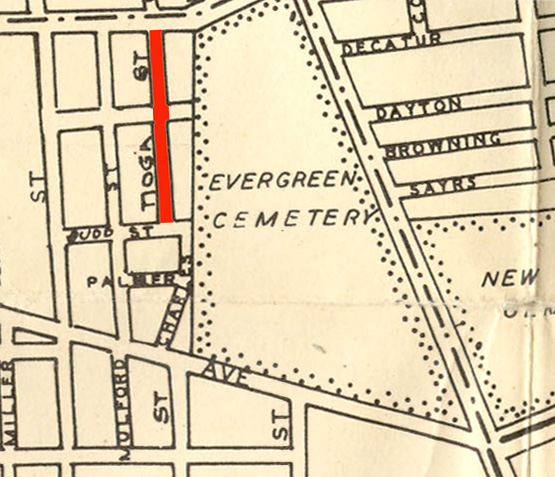
My earliest childhood recollections are of my life growing up on Tioga Street in South Camden in the psychedelic decade of the 60's. This was a volatile period of time, filled with great social and political strife and violent change throughout the country. For the most part though I considered childhood a very pleasant one growing up in this area of the city, experiencing many different things, but oblivious in many ways of the turmoil outside the confines of my neighborhood world. Some areas were not so friendly but everyone kept aware of them and did not think much of it. I felt very safe in my neighborhood because I had many friends and enjoyed simple things that all young children do. In many respects the day-to-day life resembled the 1960's television show Dennis the Menace show town of quiet streets and friendly people.
Tioga Street is marked red, running north-south, between Mulford Street and Evergreen Cemetery. 1946.
Crime of any sort was of a very minimal consideration at that period of time. The atmosphere living in the city at the time seemed to have a small town attitude, and solitude, well at least till I was old enough to know better. It seemed our generation was the last one to grow up knowing peaceful and carefree times probably a further product of the period. It just amazes me how often a person's childhood is portrayed as a significant reason why his adult life is in turmoil. Inauspicious beginnings should not be deemed a telltale sign how a life will progress. Most of the friends and people I knew as I grew up in Camden came from low to middle income families. Our families tried their best to give us a good comfortable life but for the most part we did not know what it was to have a lavish lifestyle so you can manage on simple means. Some of the neighborhood children endured some severe disciplining and physical abuse to some degree, but they turned out just fine. People growing up in the latter generations after the 1960's and early 1970's expect people to hand them things and have the government take care of them, basically they do not like to take responsibility for one's actions. When I see the confused, mixed up people seen throughout the news and court related stories I thank the Lord for the simple hard working beginnings of my childhood days in Camden.
My family wanted my brother and I to have a good Catholic education so they enrolled us in St. Joseph's Grammar School, it was part of the St. Joseph's Parish in which my family attended church. We lived about a mile to a mile and a half away from school — my brother and I walked each morning. I did not mind walking to school; it seemed a way to be a little independent and get to know the neighborhood very well. Most children have memories of their parents retelling tales of walking 10 miles to school in deep snow; I normally walked to school with my brother and some of the other kids that we knew. There were several ways to get to school from where we lived so we would take a different way each day so we wouldn't get bored, utilizing short cuts as much as possible. I would walk home by myself, and head outside to play as soon as I could.
My father and mother were the normal two working parent family. My mother had originally stayed home and took care of my brother and I until we were old enough to go to school, she returned to work once I was of school age. My parents both worked during the day, this left my brother and I alone home for a period of time, not very long but just enough time to get into trouble before my mother returned from work at 5:00 PM. I believe my brother and I were a couple of the first latch-key kids even before the term was coined — I'm sure some laws were probably broken or at least bent leaving kids for any amount of time alone especially when they are so young but the times were different. The street that our house had been on was a quiet, out of the way place that was ideal area for young children to grow up. The neighborhood provided many safe play areas close to our home. Right down the street was an old junkyard [Kendzierski Brothers Inc., 1829 Tioga Street — pmc]; it was a very large business that took up space on two sides of the street. My friends and I would go into junkyard sometime to see what we could come up with, many cool things. If we were trying to build go-carts, we could find mostly everything we needed for practically nothing because we normally would sneak through the holes in junkyard fence and scrounge for items. The junkyard was also good for making a little money by collecting newspapers and other items to take in for its worth. I remember the huge stacks of newspapers set for sorting and shipping, we went through the stacks looking for old Playboys and other adult magazines, back in the middle sixties they were very tame but still great for a first look at some beautiful women.
One of the best places to play was in an old cemetery [Evergreen Cemetery — pmc] across the street and up the hill from our house. The cemetery was a very inviting place to play, it provided many open areas with plenty of room for football, baseball, and I enjoyed playing many different kids games there. One of my favorites was to play hiding go seek. That game was especially fun to play as the sun was going down, the graveyard made a very creepy game, we used old graves and other surrounding things, the place sort of reminded you of old Dracula and Frankenstein movies. I had always heard the old caretaker was very mean and to scare people and kids away used a shotgun with rock salt. I especially enjoyed climbing trees, the cemetery had some very old, large trees great for climbing. One day I was with some of my buddies climbing trees and goofing off, when they jumped out of tree and took off. I didn't notice what was going on but just then I heard something whiz over my head, it was the caretaker blasting his rock salt gun — I jumped from the tree and took off and didn't stop till I was home.
One day my friends and I had decided to try and make some homemade bows, we wanted to learn how to shoot, and the cemetery provided a very good practice area so we would not hurt anyone. We made pretend this was a survival and hunting area. We progressed with our bows and the few arrows we bought, targets were set up and we did our best to be Robin Hood. Eventually, most of us bought beginner bow and arrow sets and continued to hone our skills. Sometimes we even tried to hit some small animals like squirrels and rabbits but for the most part we hit nothing. Some of the guys really got into trying to kill small animals and things just like the trappers of the old Northwest, but I didn't have it in me to be so cruel. One of the older guys John Sweeney was actually very good shot; he hit a few rabbits and pretty much whatever he wanted to. Some of our games we made up playing with bows and arrows were kind of wild; lucky no one was accidentally shot due to our stupidity. New Jersey has its share of good deer hunting, but since I did not progress as a hunter by learning how to shoot rifles, my hunting experience was over.
A very good friend from the neighborhood was Randy Collins — he was a few years older and very large strong kid above 6 foot. He had a real nice big back yard and a very cool patio area that we would hang out playing games. One day a few of the guys were playing darts in the backyard, the board was hung on the back of a large doghouse. I was winning the game and very anxious to get the darts and was waiting next to the dog house with my hand on the edge, Randy wound up and threw it as hard as he could and it went through my left hand all the way to the feathers. I don't remember exactly how things were taken care of but I was not really badly hurt just more afraid than anything.
Winter provided a great deal of things to do around the neighborhood. I remember it seemed like it snowed quite a bit each winter; sometimes many inches of snow would be on the ground — I guess since I was so young the snow was very deep. Even though I was cold and tired I didn't want to go in the house — nothing like a day off from school. One of my favorite winter's activity was sledding down the hill that went up to the cemetery — it was a load of fun. We graduated to sledding down the large highway off ramps; they provided room for many people and the ability to go very long distance at high speeds. We built snow forts and tried to defend them during snowball fights. I tried building an igloo and did all right; some others built complete structures that remained for quite a while until the last of the snow melted.
My family moved from the Tioga Street address to our new home at 1049 Mechanic Street in 1969. We lived very close to St. Joseph's Church and school that made it nice — I could wait till a few minutes before Church or School was to start and still be on time.
A big cultural event took place each October in the Whitman Park area of Camden — the Pulaski Day Parade. It started as a Polish Pride Parade but it grew into a diverse group of organizations displaying community involvement. I remember having so much fun watching the people walk by, the noise, the overall atmosphere with friends and neighbors enjoying the games and food. The groups that participated included bands, clubs and older men dressed in their uniforms from WWII, everyone could just see the pride they felt, many of them were Veterans of Foreign Wars (VFW) contingent. I participated in the parade a few times when I was young, I remember walking in the parade with the little league a couple of times and the school — the parade route wound through different streets, because we were so young it seemed like it would never end. As time went by I preferred to wait at the Whitman Park area where most of the action was going on and where the parade concluded and of course where the judging took place. It's really a shame that the area changed so much, families moved out that supported the organizations, so that meant the end of the parade celebrations each year. One year when I was maybe 10 or 11 I was with my father watching the parade at Whitman Park when he made a real point to introduce me to someone. The man was a very large Black man and when he shook my hand it engulfed my hand, I remember he was very nice and had a big smile and deep voice. It did not really have a great impact at the time but the man was Arnold Cream, the Camden City Sheriff and otherwise known as Jersey Joe Walcott, former Heavyweight Champion of the World.
At different times of the year I could find fruits growing wild throughout Camden, little green apples which we called crab apples that were very sour. After eating what we could we would pick more and have fights throwing at each other and get sticks and use them like little baseballs. On the way to little league near the ball fields there was some bushes and trees that had these very sweet purple fruits called mulberries, they tasted great but got your hands and face all dirty. When the fruits were ready for picking you could smell the sweet scents. Other fruits included grapes and cherries — it's funny you wouldn't think you could actually find such things but I enjoyed them for years.
When we are young we are taught many of the life lessons that we need to learn from our parents, but at the time we get tired of hearing or sometimes don't take things seriously. Learning how to cross the street especially in the city with traffic and other things that take your mind off crossing seems like a small thing but it instills character and how to follow instructions. A rather important lesson is not to talk to strangers and especially don't get into a car with someone you do not know. Of course I was taught these things but one time when I was late for a little league game I took a ride from some guy out in front of West Jersey Hospital so I could make the game, as we were riding things started in mind what my family had taught me. I was quiet and was relieved when he turned down the street that I needed to go to the park, I quickly said thanks and took off running — never did that again with someone I didn't know. My parents are of an older generation; they had old fashion ways to do things and they found it difficult to talk about life and things that parents would normally talk to their children about when they are growing up and in the teenage years. This seemed to be the standard for many families and children learned about many things at school or from their friends. Often my father would just say be careful and that was the extent of his warnings, he told me that up until I joined the Navy. It's not that my father did not care, he loved me very much but he found it hard to express himself and I believe he actually trusted my decisions.
It would be ludicrous to think that South Camden or any other city or small town would be totally without problems no matter what the era of time. Although I had participated with the practice never the less, I never really liked the way most kids when angry or to get back at someone would blurt out "Your Mom" or "Pop." Many times the parent's first names would be used in a derogatory manner to a degree where a fight would break out. Even the way parents called a kid to dinner or some other peculiar trait or statement could be used as a strange sense of amusement and ridicule, sometimes these unassuming things would be carried on for years and the individuals would carry the resentment for many years.
Camden News Items and Thoughts
Like most childhoods I had some very nice memories and others, which were not so nice. The Decade of the 60's and the early 70's was a very turbulent time throughout the country due to racial tensions and the Vietnam War. I can vividly remember what was a very bad time in our history, ("The Puerto Rican Riots of South Camden") I was not sure what was going on at the time just the Spanish people were very angry and took out some aggression on non-Spanish people. Around the neighborhood houses were being damaged and an unofficial way to let the people know they should be left alone was to put a red bandana or such on the front of your house. Camden had its fair share of ethnic mix and diversity.
Growing up in Camden as in most cities made people grow up quickly, the surrounding seemed to make you very aware of things and how to assess situations and people and how not to be a victim. I felt very safe in my neighborhood most of the time. My friends and I would walk from one side of Camden to the other to play a game or just go and hang out, without much thought or regard.
The Manson family killings in California had occurred, and at first no one knew exactly what was going on. It seemed to be a way to get your children to come home on time and to make them think someone was out on the loose in the area, and to be very careful when you were outside and come home at the right time. The things that go through a kid's mind that is confused more by other friends whom do not know any better.
Another rather peculiar South Jersey tale that had children rather on edge was the legend of the Jersey Devil. I had heard of this thing for years as a child and but it off as something similar to thinking Santa Claus was real. As funny as it seems, people had stories that went back for many years that resembled Urban Legends about some weird, wild creature thing that would get kids, especially at night if they were not doing what their parents or family expected. That's kind of a lot for kids to be thinking about that might have something to do with my staying inside and watching TV more during the ages of 10–14 than others young teens and learning bad habits.
I have always been interested with history; it has fascinated me even as a kid. A few times I investigated some of the gravestones to see if I could find some old ones. I seemed to remember some from early 1700's and some others that had some unreadable dates but possibly from 1600's. One of the most famous Camden residents was Walt Whitman. I stumbled upon his family mausoleum in an old cemetery across from Our Lady of Lourdes Hospital on Haddon Avenue. Items of interest Camden can be proud of include Campbell's Soup, which originated in the city and still maintains corporate offices and a museum there. The first drive-in movie theater in the United States opened in Camden during the early 1930's. RCA-Victor had its start in the city. Camden had many factories and big business that were around for years since the depression but as the city lost its manufacturing base so did it lose its people and interest.
City Games and Related Pastimes
Growing up in Camden many people tended to stay there a long time or their whole life. This was common for people there from the turn of the century up till the 60's–70's. From the very young age you made friends and kept them a very long time, from grade school through high school and beyond. As youngsters we had to find things to do to keep ourselves busy. Many memorable city games came to be; one of my favorite games was called box-ball, which we played right in front of St. Joe's Church. A baseball diamond was normally drawn with chalk or we would incorporate manhole covers and other street devices into our games. In the summer we would play virtually from the morning until dark, just stopping long enough for when our folks called for dinner. The best area to play in our neighborhood was the open area around the front of the church at the corner of 10th and Mechanic Street. Thinking back I am simply amazed, the beautiful stain glass windows survived getting hit by various types of items through the years. The neighbors around the area, that the game was played, really disliked us to play there but reluctantly gave in and let us play. This was also the place we tended to play touch football, normally from one telephone pole to another. Step ball was rather big for a period of time, similar rules to baseball. The thing to remember was the areas which our games were played — all of our games were had with active street traffic; somehow we had an understanding to stop and adjust time and get a play in.
Our choice of games seemed to follow what time of the year it was, and what particular sport was being played by the professionals. Summer of course was baseball; fall was a combo of football and basketball. I have always had a very competitive nature — I always hated to be left out or be picked last. Even from an early age most kids tried their best to excel at whatever game it was, but sometimes you were better at some sports than others. The common way we picked sides for teams would be the group's best two recognized players would be captains and they would pick sides according to abilities. When it came down to last even number for each side, the teams were done and if someone remained they would have to wait till someone else came or one of the players left or even got hurt. Once the teams were selected, the first at bat or who received the football first normally involved one of the old methods of selection: "My mother and your mother were hanging up clothes, my mother punched your mother in the nose what color blood came out," or possibly "inks the binks the bottle of ink the cork fell out and you stink." One potato, two potato, three potato, four…
When there weren't enough guys to play baseball one of the games we would play was called hit the bat. Basically someone would be the batter and hit the ball to the players in the field. After each hit the batter would drop the bat and the guy who fielded the ball would try and toss it at the bat — if the guy who fielded the ball and threw was lucky enough to hit the bat then it was his turn to bat. Another option was if a batter hit the ball in the air and one fielder caught the ball in the air three times he would then be the batter. I started playing this game very young when I was on Tioga Street, the game made you better at fundamentals for when you were ready to play baseball. I developed a nice throwing arm from an early age that was very noticeable in Little League.
A very exciting event occurred each spring; it was the Whitman Park Little League parade from the old park with the water tower to the baseball fields across town. Boys of various ages from the very young to high school age, dressed in baseball uniforms marching with teams. I remember the team sponsors; they were the same for minors (6, 7, and 8) and majors up through 12 years of age: Tri-County Bank, Predpelski Funeral Home, Polish American Citizen Club (PACC) and my team throughout my little league years was Randolph Chevrolet. I normally played shortstop and pitched — I had a pretty good little league career. I improved along the way from year to year. The first year I was playing with the majors I believe 1969, our team won the Whitman Park Championship and the Camden City Championship. Our best player was Bob Falconerio, great pitcher and all-around player [In July of 1976 Bishop Eustace Prep named Bob Falconiero boys' basketball coach. Falconiero, a 1976 Bishop Eustace grad, is a member of the school's athletic Hall of Fame. He played on three state championship teams and scored more than 1,000 points in his career. — PMC].
Some vivid memories of some wonderful things that happened during your little league years really stay with you. The great catches and plays made, and of course the times you made an error and couldn't wait to be anywhere else. I was a decent hitter but not much power; I hit only three homers over the fence during my little league years but two came in the same game against Tri-County. The pitcher was a kid named Dean — his father was the coach. All the little leaguers looked forward to the annual banquet we had, pretty exciting being called up for a Championship team award and the anticipation for league individual accomplishments. While with the Randolph team I was lucky to be awarded the league MVP one of the years. I did very well in baseball in my younger years but when it was time to graduate to next level of ball (13–16 years old) I was not ready for that. For some reason I had become afraid of fast pitching and those guys were really good, and pitched very fast. Thinking back I guess the time I got hit in the head by a pitch and I was temporarily blind for about ten minutes had something to do with me being timid. When I was that age I was a slow runner and overweight — that didn't help the situation.
Basketball was a very important city game. I played with the St. Joe's Grammar School team, not really amounting to much of a player — at that age I was still trying to get the fundamentals down. I did not have that much height which is an asset, and of course I could not jump as well. Mark Tainer was the guy who was good from an early age, kind of had the Earl the Pearl Monroe game with the Muhammad Ali words. During grammar school recess many of the boys would play variations of basketball, using a garbage can for a goal or the slanted marble windowsills of the school cafeteria.
Most times kids would try just about anything to keep busy, some guys would become boy scouts (kind of cool thing for city kids to get out and see the outdoors, but I had issues with the uniforms and the rules), and others would get involved with organized sports. This still left lots of free time that was filled with various activities and games — kick the can, jailbreak, step-ball and several others. For a period of time we were all trying out yo-yos and tops. The top game was decent — each guy started out with all the guys spinning the tops together; the one top that stopped spinning first would have to put their top in the middle and then the rest of the guys would take turns trying to slam into the top or at least touch the top in the middle while it was still spinning.
A game that the gang liked to play was fun but could get very tiring and leave you with some black and blue marks — "Kill the Man with the Ball." The game was played in someone's yard or field, involved a group of guys and a football. Someone would roll the ball into the middle of the group and one brave guy would pick it up and try and evade the rest of the guys as long as he could. Either the ball would get ripped out of his hands or he would toss it up in the air when he was absolutely beat tired.
Some other things we did involved collecting baseball cards. I tried my best to get all the Phillies of the 1970's and then other good players throughout the league — very seldom would I trade any of the cards that I had because no one was willing to make a decent trade. Most of the guys put a certain amount of worth on good players and would only try to pawn off the mediocre players. I was resigned to the idea that I would have to try and collect all the cards that I wanted by myself and in the 1970 the cards were a nickel a pack and filled with many great players of the era. I normally kept my cards in a shoebox with rubber bands around the various groups. (I eventually had so many cards that it got kind of hard managing them — I only wish I had kept a couple stacks of the better players). I do not remember how the game came about but the guys started this baseball game with our baseball cards that involved selecting and making baseball card teams, each player at the correct position. The rest of the game involved 9 innings of a game with the person at bat rolling dice, getting hits, scoring runs and then making outs. Most times an agreement would be made prior to the game that the loser would have to give the winner their losing team baseball cards.
Kids will be kids and the generation I grew up with did some unusually strange things to amuse ourselves — for instance having peashooter fights. Each guy would get a bag of split pea or other type of bean and use a straw to fire the beans at your friend, very inexpensive and fun. The velocity that the peas were shot out the straw was very fast and could leave a welt on the skin. Another more painful and rather dangerous activity was shooting paperclips with rubber bands — now that was something; it is just by mere luck that no one really got hurt.
Each year the kids had some fun and wreaked havoc on the neighborhood the night before Halloween — it was called mischief night. Some mild things included soaping cars and house windows, toilet paper wrapped around the trees and houses. Other more vicious things included throwing eggs and tomatoes at people, cars, and houses. If the egg was not cleaned off the car before it dried and hardened it could take paint off. As a young teen I thought nothing of the pranks but later as an adult I did not care for these tricks to be played on my family or me.
Throwing snowballs at cars and busses was a fun activity that many times would involve running away from an irate driver. Timing a hit on a vehicle so they could not stop due to traffic took some skill; Jacek and I did our share and got good at it. In later years when I was driving a car and a snowball hit the windshield I thought it was a bomb — just a way of evening the score I guess.
Some of our interests of course changed when we got older. I used to like to go bowling but I was not really all that good. From the neighborhood Zenon was the best bowler from our group of friends and from our class Joe Collasi was really good — had a 200 average and played in many leagues. One year Jacek had signed us up to bowl all night for the Jerry Lewis Telethon; after that I didn't bowl for some time.
Another big period of time was when we were in the 7th and 8th grades; we would go to the old roller rink [originally a commercial laundry — pmc] across from St. Joe's High School. By that time we were thinking about girls and how we can impress them. I really stunk at skating but I often went to try and be with everyone. I believe Victor was good at skating and was able to ask girls to skate with him. But for the most part the gang would be struggling to skate and eventually we moved on to other things.
From a small child I always enjoyed watching the Three Stooges on TV. Late in his life Moe was doing shows around the U.S. as an ambassador for the old programs. In '73 or '74 Moe was playing at the Harwan movie theater in Mt. Ephraim so some of the gang went — Frances Anne, Victor, Jacek and Zenon. They played a few of the movies and then Moe got up on stage and slowly described how some of the tricks were done for the movies so no one would get hurt. When everything was done and we were leaving Victor had run up to the crowded stage and got some autographed pictures — that was so cool and he was really nice and gave me one. I have kept it all these years.
St. Joseph's School and Church Years
St Joseph's Catholic Grammar School and High School were the primary schools that the area kids went to. Since the schools were Catholic we had Nuns and Priests teaching subjects along with other teachers. From an early age most kids gain a great deal of respect for nuns, either due to the strict fashion in which they handled the students or possibly the dark foreboding clothes they wore. This was very common atmosphere at St. Joe's. My primary years of school (K–8) were between the years 1965–1974 so it was not uncommon for unruly children to get physical punishment. Corporal punishment was never really an issue; for the most part if a student got whacked they deserved it. I feel the loss of some of this control of children, especially at a young age, contributes to horrendous conditions that plague our educational systems and society in general today. Granted punishment needs to be carried out with due concern for the child and as not to injure or degrade, but to help control problems and necessary. It has now grown in society today where a parent is in fear of going to jail or losing their child for a swat on the behind.
It was during the early part of my school years around 1967, a new Polish family moved to the neighborhood settling in at 1041 Liberty Street. The Rykala family had the mother and father, eldest daughter Grace, brother Mark and the two younger brothers Jacek and Zenon. The two younger brothers Jacek and Zenon entered school in the first grade in the same class that I was in. Little did I know that Jacek and I would become close life long friends. Astonishingly enough looking back many of the original kids stayed in same class from 1st through 8th — it was fairly common throughout the history of the school. Jacek and I were completely different in our character. Jacek tended to be very outgoing and easy to make friends and be the center of attention for many situations, in many respects the proverbial class clown. I tended to be rather quiet and shy, but I didn't have much problem making friends but definitely stayed away from being the focal point. When something happened in school, normally a prank of some sort, Jacek was usually in on it, or at least knew who did it. He was very loyal to his friends and never informed. On the other hand, I normally followed all the rules and was looked upon as a straight-laced kid.
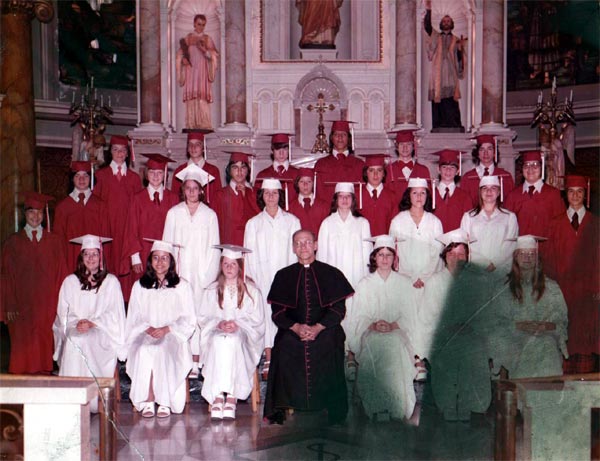
Some very memorable events happened during the years of my Catholic School education. I remember the uniforms we wore — some of the girls really looked good in theirs, especially the short tight skirts. When the time came for getting new school uniforms I looked forward to it. Normally that meant that I grew some and had to get another size or the old sets were worn old and needed to be replaced. The styles we had to wear were very plain consisting of white shirts, gray pants and a plain crimson red tie. The girls had pretty much the same white top, red long skirt and red tie. Sometime in the middle of my grammar school years the uniform scheme changed and the plain red was substituted with a red plaid, and it was at this point I believe the girls' skirts got shorter.
I felt the teachers taught us very well, most of the children could read fairly well and understand what they read. They used the Phonics method to sound out words and helped to understand and break down the way words are put together. Spelling was one of my favorite subjects along with social studies. The third grade was a very interesting year — most boys fell in love with the very young pretty teacher Miss Moles and I definitely was one of them.
Most of the teachers and the nuns stayed with the school for years, they would teach different generations of children of the same family, and the steady influence of the teachers had a calming effect on the children and the way they acted. I thought Mrs. Pointkowski and Mr. Kanaszka were two good teachers who related to children very well — both gained respect not by intimidation but by teaching methods that kept your interest. Mr. Skiba was a decent teacher who really knew his subjects but contrary to the vast majority of teachers maintained discipline by force. He had famous methods that became legendary. He would make difficult students grab a broomstick with both hands and while still hanging on, kneel on the broomstick, pinning your hands and knuckles beneath in a very painful manner. Another rather cruel punishment was to throw uncooked rice on the floor and then have the students kneel on it — after a short while the hard rice would be unbearable especially for girls who were of course dressed in skirts.
Catholic nuns tend to make many people feel very uncomfortable, due to the life they have chosen to live. The Catholic nuns of course live the same way that other women do, they are able to visit their families, go on trips to amusement parks etc. — the main difference of course being they live a certain way to maintain religious life. I always had felt a strong reverence for nuns and priests; it is because of this that I had little difficulty throughout grammar school.
The nuns had a weird effect on most children's thought process and conditioning, instilling the idea that you have to be good or you will pay here or worse yet in hell. Even given this, I became friendly with a few of the younger nuns who had come to teach; they had new ideas and fresh religious views. What's kind of funny — I remember a couple of movies about nuns (The Trouble with Angels and Where Angels Go, Trouble Follows) that came out in the late 60's — our school seemed to have the same atmosphere, religious change that brought the old church doctrine to more up-to-date standards. Another religious movie with a different story line all together came out during the early 1970's — The Exorcist — it contained many religious issues, problems and of course some very foul language. The Catholic Church and our nuns in particular issued a strong request that all good Catholics should not see the movie and I even heard some stories that if the girls went to it they would not be able to have babies. I really think a lot was made of the movie and for its time The Exorcist was very political — actually all the press just helped to make people want to see it even more.
I feel the years that I was part of the school and church were a very interesting time — a few of the priests and nuns made a good impact on helping to bring parishioners into the church. One Nun in particular was Sister Jo-Allen, she was a young, pretty and full of energy. She was put in charge of the school choir and introduced guitar masses and large choir participation throughout the mass. She had many very good ideas for teaching as well and ways to improve the community religious involvement. She had a way to get people to listen and made joining the choir cool. Jacek became friendly with her; she even tried teaching him how to play the guitar. Whenever she needed help Jacek was sure to lend a hand and I joined in when I could. Another good thing that helped the church atmosphere along with Sister Jo-Allen was Father Julian, a young priest with lots of charisma that made going to church a good experience. Father Julian liked to get very involved with children, he went out of his way and took some of the kids in his own car to the Blackwood CYO Athletic complex where we played basketball and enjoyed heated swimming pools. Father Julian was in our church for a couple of years but then had to leave; I think he was asked to take over another parish to help with its revival.
Some of the best times our class had were on the class trips we took; I really liked the long bus rides hanging out with friends. For our second grade trip we went to New York City. The Statue of Liberty and the Empire State Building were awesome. Later our class went for three straight years to Hershey Park — that was really cool and the Chocolate Factory was very interesting. Clementon Park was a local trip that was always fun. Our last trip was to Washington DC — it was so hard to see everything in one day that we spent a lot of time rushing from one place to next. Arlington National Cemetery was a very impressive sight with the Tomb of The Unknown Soldier and John F. Kennedy's grave.
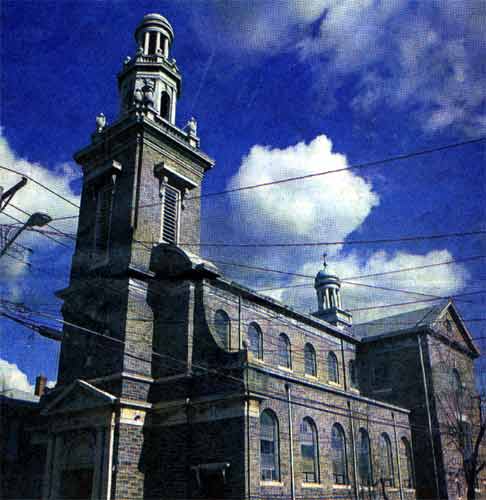
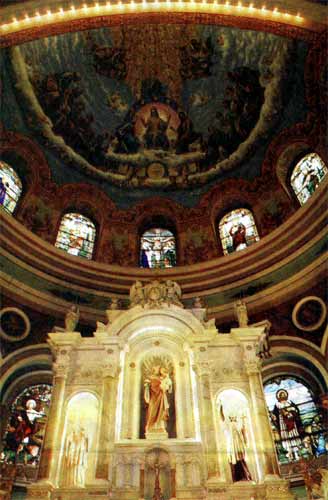
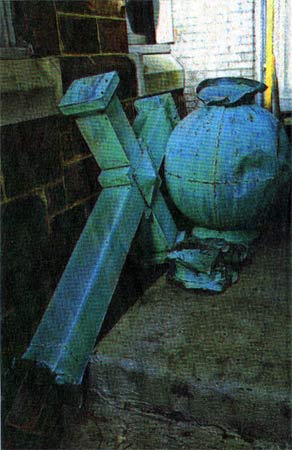
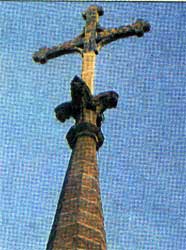
St. Joseph's Catholic Church has a long and wonderful history. The structure itself is a very impressive building, built by skilled artisans, local laborers and religious faithful who helped construct the magnificent features and grand details with a modest budget that was funded by small donations from the congregation. I was always had a good feeling when I entered the church; the wonderful architecture and the magnificent paintings and stained glass windows just uplifted your spirit. The Church Steeple area was built with large amounts of copper material that in its early years had the appearance of new copper pennies but over the years changed to a greenish color the same as the Statue of Liberty. The Church structure was large enough that it could be seen from some distance, especially with the greenish color. I would travel to Philadelphia for a ballgame and long before I was home I could see the Church and know when I would arrive home — it seemed such a beacon, in many respects it had that effect because of the way the faithful were drawn to the Church and kept up the wonderful appearance due to pride and religious conviction. Even during the decline of church attendance and ever-changing environment of the community around the Church, many long time parishioners traveled to support the church. Each Christmas Eve Mass year after year is still held and miraculously the pews are full of people.
Religion played a big part of our Catholic School life, on a day-to-day basis as well as our family Polish Catholic upbringing. Some of my most memorable events took place as we went through our young lives. First Confession and First Holy Communion happened in the second grade. Getting all dressed up and standing up in front of everyone made the kids very nervous. Later in the eighth grade our class had our Confirmation — at that age I was able to handle being up in front of people a lot better. The school attended all the religious holy days and services. The whole school filed into church by grade, girls and boys sat separately — I always felt a great deal of emotion and anticipation before each service. Each year for Ash Wednesday we received our ashes, Palm Sunday the families would receive the holy Palm leaves. We even had a special holy day where everyone would get his or her throat blessed. I especially liked Holy Saturday blessing of the Easter food baskets. Each fall the Church held a Christmas Bazaar in the basement of the old school where our cafeteria was. It was loads of fun and I looked forward to playing the different games and eating the good Polish food. I tried my best to save what I could from money my parents gave me and bought small things to give as presents. The cafeteria was very versatile — it was where the weekly Bingo games were held and it was the scene of our school plays and recitals. A small raised stage in the middle of large room was where all the action took place — I was in a few of them that I recall, the Christmas Story with the Three Wise Men. I was so nervous when my turn to do something came up I didn't want to look bad.
Sometime during the second or third grade I joined the church altar boy service; many of my friends started about the same time including Jacek, Victor and the Perle's. We learned the many different services provided by the church. I had little difficulty learning most of the services, but because we were a Polish Church some masses and services were spoken in Polish, so I had to pay close attention and figure out when to move and do the required service requirements. The services that were performed less frequently during holidays once a year were also somewhat difficult to perform correctly because we did not see them that often. At first the new altar boys served with a more experienced one until they were familiar with all the required procedures. I always listened carefully and followed the priest so I would learn the correct way to do the services. I always enjoyed the Christmas and Easter holidays Church services. The Church would be filled with people in good spirits and in their best attire participating with the mass and its responses for the entire service.
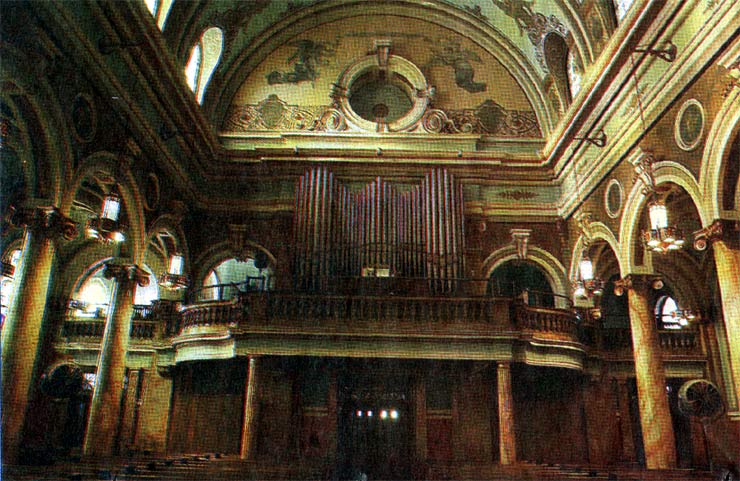
The Choir that sung in St. Joseph's Catholic Church was just spectacular — the beautiful voices just seemed to soar and fill the air, the amazing songs that could be heard for some distance. The songs sung during the Christmas time were always exceptional; I especially liked the services during that period of time. The Church was designed in such a way that the organ music was enhanced and made the gifted singers' voices even more wonderful. Another big contributing factor why the choir sounded so well was the skilled organ playing by the choir director Mr. Rykacheski — he had been in service to St. Joseph's Church for thirty to forty years. I can relate how the music sounded to the religious music in the movie The Sound of Music, very uplifting and joyous. Another thing about the music was that an older Polish woman had one of the most wonderful voices; she was not normally part of the choir but sat in the back of the church — her soaring voice was distinctive, rather deep but could elevate and could even be heard above the choir voices.
Throughout my years growing up and attending church I would often see some of the same ladies at the different services. In the old days the church had mass services each day and without fail each morning the older Polish women would attend the mass and the steady recital of verses by the women was amazing — often in Polish.
Monsignor Strenski was the old venerable priest who continued to do his part for the church and the community late into his life (lived to be 99). I helped to serve mass for him on the side altar; he performed the service mostly by memory and the altar boys assisted him to make sure he did not stumble or get hurt. During his lifetime Monsignor Strenski had accomplished so many things including helping to start the building of the Church and later St. Joseph's High School. He was also instrumental in purchasing land and starting the St. Joseph's Cemetery.
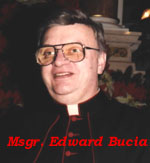
It was always best the new altar boys learned how to perform the services they needed to know as quickly as they could because the priest that was in charge of the Church altar boys was the toughest and most difficult man to deal with. Father Bober was Polish and it tended to be hard to understand some of his English so this must have made him upset. If someone was late or didn't get a replacement for a mass or heaven forbid your cassock was not ironed he would have a fit and take it out on you. He would curse quite often and it would not be unusual to get whacked or have him turn his college ring around on his finger and thump you in your head. My friend Jacek got the treatment many times, not for improper altar boy service but for joking around at the wrong time, which was definitely a no-no. I was very glad when Father Bober moved on and Father Bucia took over the responsibilities.
Father Bucia.
As the altar boys grew more experienced they would be called upon to do services like funerals and weddings — each one normally gave a few dollars for the services so my best friend Jacek and I would offer to perform as many as we could. Funerals served during the school week provided a way to miss at least half a day of school, first the hour for church portion then quite often we would follow and complete the services at the cemetery and be asked to go to the funeral reception at the local catering hall. Some people tend to have problems being around dead people and the unfortunate families that had to deal with it. Unless I knew the deceased or the family, I didn't have much of a feeling at all.
St. Joseph's Church had many different types of services. Novenas were held on Monday night. During the week they held mass twice in the morning and on Sundays at 6, 9, 10 and 11 and 6 pm a last chance mass. Also they had a 7:30 Polish Service mass. The early in the morning masses were actually filled — people wanted to get to church and not wait till late masses. I don't remember what year it was but a big change was adding 6 pm Saturday night mass that was a very well received change and many people took advantage of the services. In addition to the main church having services the small St. Joseph's Annex next to the High School also held services.
I know that the Catholic Church has been plagued by incident after incident about priest misconduct and abuse cases. I can tell first hand that I did not experience or even hear of a case by any of the priests in our parish molesting young boys. They were for the most part, good solid priests and men that served their parish well with dignity and great religious fervor. When my mother passed away in 1973, I was very sad and had a hard time for weeks; Father Bucia was very sympathetic and helpful in my time of sorrow and grief. I have a good recall of the period and remember the time my mother had her service at the Ciechanowski funeral home directly across from the main entrance of the church on South 10th Street. I felt great pain but was somewhat comforted by the large turnout of family, friends and neighborhood people. It was simply amazing how the outpouring of emotion and devotion can occur but I wondered why many of the people had not even spoken to my mother in quite a while — I guess because it is a person's last time to see the deceased that draws us to say goodbye. The Nuns that taught at our school even sung a beautiful hymn; I was very moved by the display.
Most of the friends that I hung out with — including Jacek, Victor and the Perle brothers — were altar boys and members of the school choir. Eventually we would become friendly with the priests and nuns and it was not long before the nuns and priests would ask for some assistance doing odd jobs around the church and school. One of the more difficult jobs was collecting the old monthly church pamphlets and setting out the new ones. The priests paid little money but wanted a very good job done in minimal time. I didn't mind doing this for a while but tried to stay clear of the church around the end of the month so someone else would do the job. Other odd jobs included setting up the religious arrangements and flowers for holidays and whatever came up.
It seemed that my friends and I would do pretty much whatever we could to get money on our own without asking our parents for money, which most of the times they really could not afford to just give us money when we wanted it. Some of my friends got part time jobs at stores cleaning up, mowed lawns or served newspapers.
I had heard the Church Bells throughout my life and felt they were part of the community and a way to let everyone know what was going on with the church. One day I got the opportunity to help ring the Church bells — the guy who was supposed to do it was not there so the priest asked me to help out. With little instruction I was led up to the bell area and took hold of this long rope and started to yank on it as commanded. At first I was fine but as the bell started to ring more loudly, the momentum built up and the violent upheaval became very intense — I was holding on for dear life. After a large tug the bell would literally pick you up in the air (easily five, six feet off the ground) higher and higher until luckily you were finished.
A colorful mainstay character of our St. Joe's Church community was our janitor Frank. I always felt sorry for him because I thought he had a diminished mental capacity. I do not really know the true story for sure why Frank had come by his affliction — I heard he was in World War II and took a bullet in his head that they could not remove. In any case he was very reliable, always showed up early in the morning, walking about a mile and a half from his house every day. He was able to handle cleaning the school and church on his own and complete other odd jobs the priests and nuns needed done. Because Frank could not talk coherently and spoke in a loud abrupt manner he tended to be misunderstood. Children mostly gave him a hard time although all he really wanted to do was his job and do it well. Sometimes kids would do something wrong — a prank or fighting or such — Frank witnessed it but the children didn't worry because they thought Frank's feeble mind would not allow him to get them in trouble. Unknown to them — or at least for a few years — Frank could inform and did so to the Principal or the Monsignor. I really think Frank was just a peculiar individual who might have seemed different and just did not let on what he really could do.
Each morning of my grammar school life I could expect certain things. The class would have morning prayers, stand for Pledge of Allegiance and if a student preferred they could have a couple small cartons of juice or milk. In addition to the expected daily events each day I would see our School Secretary, Mrs. Gorski, in her office or on the first floor somewhere. She was always very nice, helpful and provided a sense of normalcy to the school for many years. I do not know how many years she was there but I know she very seldom missed a day.
St. Joseph's Grammar School had set ways to do certain things that were passed on from class to class, year to year. Each class period of course had its bell rung to start and end periods, but they used a bell system to signal other things also. I do not remember exactly but I believe our recess period was for 45–60 minutes each day. The streets surrounding the school and church complex were blocked off with wooden sawhorses and cross members so the children would have a safe area to play. I am sure the houses and long time residents just dreaded that period of time each day because of the extreme noise level and the lack of mobility through the streets. At the end of our recess the bells would be rung to signal the return to school. Each grade had two classes, which had assigned areas to form rows, girls in front, boys in back. The order which the grades returned to school was 8th grade down to the 1st — if a student stayed in school for the entire 8 years it would be a real feeling of superiority when it was your turn to be the 8th grade class and be the head of the line. The order was reversed when filing into Church for services — the lower grades proceeded in first sitting closest to altar, filling all the pews by grades and classes until the 8th grade was seated in the rear. The normal order of things always had the girls sitting separately — thinking back this was a good thing for some situations but bad for others. Putting all the boys together could only lend to mischief from time to time, even in the solemn and strict atmosphere of the surroundings.
Another part of progressing through school and the responsibilities that the upper grades took was becoming Patrol Guards and School Yard monitors. In the morning the Patrol Guards were assigned certain streets around the school to help make sure the students were able to cross streets safely and proceed to school on time, reporting any problems that might have occurred. For lunch recess the Patrol Guards and Monitors would set up the wooden safety barricades at the end of each block around the school area, patrol the playground to help ensure order and when the lunch recess was finished take the barricades down. Jacek and I were both Patrol Guards — we took the job seriously and did not have any major problems that I recall. One morning while standing on Mt. Ephraim Ave helping some kids cross the street, Jacek took a couple of loaves of Italian bread used for making subs from the corner store and we both ate them — kind of the perk of the job.
Camden Neighborhood Stories
One of the favorite places for young teens to hang out and have a good time was the "Shop," located a block from the rear of the Church down a side street. It was an old working machinery shop that was run by a cool middle-aged guy named Bud, and his assistant — an old ornery bastard that happened to live right next door. From a fairly young age guys would come and meet there and do things that they could not do most other places. Many kids started smoking and drinking there and I'm sure even tried some pot, but as long as the drinking and other activities stayed quiet nothing much was said. I liked to be part of the group and hang out with my friends there, but I really stayed away from the bad influences — I'm glad though because later in life I still do not smoke or drink. In addition, the shop was a perfect place to be used to play sports when the Church area was filled. The whole area was an industrial environment so few windows to break. I really enjoyed playing stickball by the famous "shop" building. The older guys had played the stickball first, and then we slowly played and started challenging them — that's truly the only way you can learn to improve your game by playing more advanced players.
A time came to find some places to go when the weather was really bad outside, so the local kids had starting using the old second floor St. Joe's Gym. It was a very small confined space that the grammar school used for gym class for many years, and the St. Joe's Grammar school team and intramural leagues had utilized too. The area around the court was so limited that it was not really a good court to watch a game. The priests of the parish had deemed the court as unsafe and halted outside activity and limited the use to gym classes and very special occasions. I think they were really just getting tight with money and did not want to pay for lights. Somehow a few of the guys had convinced some of the priests to allow a few of us in to play so we would not get into trouble and we would be safe — bad idea because what would happen once one of the guys got a key and the priest returned to the rectory we would let in all our friends. Most of the time we just played basketball; the priests would check when they heard too much noise but somehow a few of us had pull (Jacek in particular) and would be let in to play with limited groups.
Across from the main entrance of St. Joseph's Church at 1315 South 10th Street was Walt's, a small old-fashioned Malt Shop. Walt and his family had been in business for a long time — the place was great to catch something to eat for lunch or hang out for a while in the cool air during the summer. The food was pretty good and I especially liked the tuna fish hoagies he made, they had a way with it that tasted great. Walt also had a small candy section and sold baseball cards and assorted things almost like a five and ten. They had about four or five wooden booths that had been marked with people's name through the years but still looked nice. Walt's sort of reminded me of Arnold's on Happy Days. I bet in the Fifties and early Sixties the place was hopping and really a happening place to hang out.
Another place that the gang would sometimes get something to eat was Ben's on Mt. Ephraim. He had counter service and some booths — the food was okay but the best thing to get at Ben's was the ice cream; he was very generous with his ice cream cones and packed ice cream — he would give a lot more for the money than other stores. Around the corner from Ben's on Kaighn Avenue was Buddy's Sandwich Shop. For many years they served the best cheese steak sandwiches around. The lady who owned the place had been in business for years; I remember her telling folks that some of her customers enjoyed the food so much that she would send the food by airplane to different places around the United States.
The Polish American Citizens Club (P.A.C.C.) was one of the many social clubs that men would become members. Its members mostly consisted of Polish men and their families but in the later years other groups were able to join. Through the years this was a very active organization — they contributed to the community in many ways. The P.A.C.C. sponsored two teams for the Whitman Park Little League and actively participated in the Pulaski Parade and St. Joseph's Church related functions. The organization had a large two-story building located off Mt. Ephraim Ave behind the Bonsall School. Members held many events in the building including wedding receptions and family funeral gatherings after services. A lively bingo game could be enjoyed weekly along with several dances throughout the year. A highlight of the organization's year was the Annual New Year's Eve Ball, a very festive gala.
I liked the atmosphere and feeling of the place when I was a teen, older gentlemen playing cards, having a nice game of pool on the professional billiards tables. The darts and table shuffleboard games were also available. The history of the organization and its members was evident everywhere — old plaques and trophies of various activities adorned the walls; the building game room area reminded me of how a sports Hall of Fame might be. I know there were other organizations and clubs but I believe P.A.C.C. was one of the better organized and run.
My friend's father was one of the Presidents of the Polish American Citizens Club (P.A.C.C.), Mr. Daniel Ciechanowski. One of his small tasks was to set up the bingo chairs and tables each week and for a time my friends and I helped him set the bingo room up. We would do our best to hurry and complete the job so we could get a fountain soda at the bar and play a game of pool on the nice table or ping-pong.
As time went by and as some members left and older members passed, my friends and I grew up and they became members. I never really joined — just went as a guest to hang out. I had joined the service and could not be an active participant.
My uncle Pete belonged to Woodrow Wilson Democratic Club at 1181 Liberty Street. My father was never a real active member of any one club but he had many friends and he would attend certain events. One of his favorite clubs was the Polish Army Veterans Club at 1306 Mount Ephraim Avenue.
Neighborhood Friends and Memorable People
It's funny how someone will be given a nickname or be known by a certain name, rather than their actual name — our neighborhood was no exception. Another group of friends and neighborhood people are just remembered because of the way they acted or possibly looked.
Frances Anne Kirk — two by four – cruel teen moniker for her that referred to shape of her figure, ironically she grew into a full figured lady. Frances Anne was a very outgoing and fun girl to be with — she was very good at most of the games the guys would play and could be picked to help win a game. Frances Anne had a brother Victor who also joined in on all the neighborhood games; they had some cool parents and I found myself hanging out at their house quite often. From time to time Victor would be allowed to stay over at my house and I would be able to do the same at his, which was pretty great — it was like going on a mini vacation.
Watermelon Head – Name given to a black kid that hung out due to his misshapen head. Don't even know real name; his little brother was Little Watermelon Head or Watermelon Head Junior.
Lucky – I'm not sure why he was given the name, but his father had the same nickname and real names were not used. His family had a fresh produce business in which they would drive around the city in a large open truck and sell their fresh fruits and vegetables.
Donny Oleiwicz – Cinder Block – His misshapen big OLE redhead along with the fact that he seemed slow lent to his nickname. Rather large uncoordinated guy, very strong — always good to have on your side in a disagreement. His head was tested for hardness once by a smaller kid by hitting him in back of head with a small piece of steel, his response was only "OW" — he ran and kicked the other guy's butt. Donny had the only decent large size swimming pool in the neighborhood so I tried to stay on his good side most of the time.
Mark Tainer – Container head – Oddly enough it was not given to him to go with the rest of his name Tainer but given the fact that the whole family had an oddly flat shaped head resembling a container. Mark was one of the better basketball and football players in the neighborhood; he had a lot of talent but did not use what he had to the best his advantage. Could always be heard reciting these strange cheers during games.
Gooch Family – Our version of the Brady Bunch — they had seven kids, 3 girls (Peggy, Mary-Beth, Susan) and 4 boys (Bill, Joe, Tom, Mike). It seemed at least one of the family members was involved with something at one time or another, either our neighborhood games, church and school activities. The family had a large, very mean German shepherd named Baron, which they used through the years to help get their way when problems arose. It was well known that if push came to shove that dog was going to settle any dispute.
Van Dexter Family – They lived on Mechanic Street across from the Church on opposite side of my family and the Gooch family. The Van Dexter's were a large family consisting of Cathy the oldest then all boys (Ricky, David, Vincent and two other boys that I can't remember the names). The kid named David had this unique ability to do the same thing that Houdini was able to do with his stomach — when ready he could tighten and brace his stomach so you could hit him as hard as you could and he was fine.
Joe & John Perle (The Twins) – The two brothers came along just about the time the neighborhood needed a pick me up. I really liked the guys and we became good friends. Since their family was from California the brothers had a few unique ways to say certain words and phrases (i.e. throw the ball — chuck the ball; roof — sounded like ruff; and sneakers were a few different variations). Joe and John were both very athletic and fit right in with all the street games we played along with football and baseball. The Perle's parents were really cool and I liked going over to their house on Atlantic Avenue to talk to the mother and father as I waited for the guys to get ready. I was introduced to the taco at their house; Mrs. Perle could make a mean taco meal and some great iced tea. Mr. Perle was very easy going and from time to time would relate some of his Marine days back during the Korean War and other interesting things. The whole family was diehard Los Angeles Rams and Dodgers fans and kept up with the sports through the years. One thing for certain — where one brother normally was the other would be or shortly after; they were best friends and brothers and good pals to many others.
John and Dennis Delengowski – The brothers were actually twins but really did not look alike at all. Both brothers were tall and lanky, somewhere near 6–4 to 6–6. John was the athletic rough and tough type of guy; Dennis was uncoordinated dorky goofy type of character. The brothers had a rather strange nickname, "LOOMIS," meaning a slow not especially bright person. John and Dennis lived just a few doors down from the Perle brothers on Atlantic Avenue.
Mark Shapiro – One of the guys that I went through all the grades in grammar school till 8th grade graduation. Mark was a nice enough guy but he was one of the biggest momma boys around. In school he became the prototypical nerd and dork; he was the guy the teachers assigned as hall monitor because he went out of his way to tattle on the other kids and liked it.
Dennis Prosinski – Very funny guy who would come up with funny names for people and play gags. Once when my dad was driving a car filled with kids, my dad said a few rather funny phrases to me that the other guys found hilarious and would not let me forget it: "RICHO RED LIGHT — Boy, AND CLOSE BACK WINDOW OR YOU'LL GET PARALYZED." My dad sometimes spoke with a Polish accent, so guys would taunt me with a funny accent. My dad was referring to getting a stiff neck from the strong wind, which he would often get. Dennis had an uncle that was unstable; he would wander around the streets everyday and talk to himself, he was harmless but Dennis liked to mess with him and called him Uncle Whiff.
Many other people came in and out of the group but this was the main portion.
Neighborhood Friends
Kaz Brodowicz
Joey Gooch
Jimmy Porklfka
Rich Brodowicz
Victor Kirk
Dennis Prosinski
Danny Ciechanowski
Frances Anne Kirk
Jacek Rykala
George Ciechanoswki
Donny Oleiwicz
Zenon Rykala
Dennis Delengowski
Joe Perle
Mark Tainer
John Delengowski
John Perle
Tom Tainer
Billy Gooch
Ricky Van Dexter
Memorable Stories: Tioga Street
One summer day while living on Tioga Street my father had bought some nice ripe watermelons and decided to cut them up for my brother and me and some friends. My dad liked to cut the slices very large so the kids would enjoy them. One friend Randy Collins had been enjoying himself and when he was finished he could not talk. Losing his voice after eating watermelon was something that happened with him but he did not say anything.
It is amazing that we actually survived childhood with all the crazy stunts that we did. One thing we did was play a game at night shooting arrows into the air and run to get them first, but at the same time we were running around for arrows more were shot into air. One arrow came down across the street in a lot and stuck in a convertible car roof — when I went over to check it out luckily it had lodged in the roof's edge not in the material. Last time I played.
What kid doesn't like to experiment making different things. John Sweeney was quite a bit older than I was and he read a lot of different books and things. He decided he wanted to make a small explosive — not knowing any better I said what the heck and helped him. Really wasn't that much of a device — he got a pipe and capped the end and we both took some matches and ripped off just the red match end and stuffed them into the 10 to 12 inch pipe. When it was almost full he added something on the top and put a fuse in the end. Next we went over to the old abandoned building we used to play around — it had a chimney stack with an outside door to burn some materials. We stuck the pipe in there, lit it and stood back quite a way and watched. When it exploded it was very loud and almost blew the metal door off the chimney — I could see how that process could get out of hand. After that I didn't bother with such things again.
Memorable Stories: Mechanic Street
One night after dinner when we were having a good game of box in front of the church something happened that is hard to forget. I was on the team that was in the field and the other team was at bat. The kid at bat hit the ball between Tommy Tainer and me — Tom made a try at the ball running full force and he hit the fire alarm box full force with his head. Tom was able to stay alert and he and the whole group ran to the shop where he tried to clean up and later he went to the hospital — I was so afraid that he was going to pass out or something.
Donny Oleiwicz was a very strong guy — someone you would want on your side if you were in a fight; he was not especially quick but if he got a hold of you he could really hurt you. One day a disagreement came up between Donny and one of his next-door neighbors, Mike — a small black kid with a big mouth. One thing led to another and they were ready to fight. Right before the first punch Mike took off his sneaker and held it in his hand; next thing he did was wave it and then tossed it in the air. Donny was looking at the shoe and Mike reached over and hit Donny so hard it stopped him and the fight was over.
One summer afternoon a bunch of kids were hanging out in my backyard and running back and forth between the Gooch's and Donny O's and my yard. One of the kids was Victor Kirk and somehow while running after someone he was bit in the butt by one of the neighborhood dogs. Poor Victor was in pain but embarrassed to show anyone, but Donny O's mother made him show her the bite so she could help clean and check out the severity — what an awkward spot.
My brother Kaz had decided to buy himself a pump action BB gun with some of the money he had from a part time job. At first he was hitting targets he had set up in the backyard — he thought he was getting pretty good. His next thing to try was a moving target, mostly pigeons. He pumped the gun several times and tried to hit the pigeons that used to perch on the school roof about 125–150 yards from our back yard. Kaz actually hit a few but broke quite a few of the school's and some neighbors' windows because it was hard to determine the distance and factor the wind and height.
At the time it was a real big event in my life — the St. Joseph's 8th Grade graduation, June 1974. I liked the idea of getting ready for high school and the next part of my life was just starting to unfold. The two eighth grade classes had scheduled a graduation party in the old gym — it was a real nice setup. Everything was going well, some dancing and mixing up with girls, and then all of the sudden someone got sick. Larry Moser's drink was spiked and he got very ill. The strange thing was the person who got the most emotional was Ben Waters, a guy. He was actually crying — what a weird spectacle.
Brodowicz Family Photo Album
Mom and Dad's Wedding Day, October 1957. Casimir Alexander Brodowicz & Irene Theresa Rogowicz.Mom and Dad's Wedding Day, October 1957.Mom and Dad's Wedding Day, October 1957.Mom and Dad's Wedding Day, October 1957."Grand-dad Rogowicz. My brother Kaz Brodowicz is next to him and I am in his lap." — Rich Brodowicz. The photo is from 1960 or 1961.Rich Brodowicz, about 4 to 5 years old.Easter Sunday 1971 at Godfather Al Sochacki's house, 1336 Jackson Street, Camden NJ.Casimir Alexander Brodowicz. "Dad in kitchen returning from church with Easter food Blessing." — Rich Brodowicz. 1049 Mechanic Street, Camden NJ. 1970 or 1971.Rich Brodowicz — high school graduation picture. Eastern Regional High School, Voorhees NJ, 1978.1979, 306 South Coles Road, Maple Shade NJ. "Picture at my Godfather's [Al Sochacki] house when I first joined the Navy." — Rich Brodowicz."One of the many times my family had gathered to play cards — Uncle Pete Draim, Aunt Eleanor Wojtkowiak, dad and step-mother." — Rich Brodowicz."My individual St. Joseph's Grammar School Class picture, 1974." — Rich Brodowicz.Best friends Jacek and Zenon Rykala in the backyard of the Mechanic Street house, 1971, 1972.Complete St. Joseph's Grammar School Class picture, 1974. Girls 1st Row: Cindy Baylor, Geraldine Zelazny. Girls 2nd Row: Jane Zaremba, Cindy Miles, Rosemary Burgo and Anna Mikawcheski. Back Row Left: Mark Tainer, Steven Kato, Larry Moser, Paul Martin, Richard Skotnicki, Steven Wilson. 2nd From Rear: Ben Watters, Joe Colassi, Jacek Rykala, Joe Perle, Rich Brodowicz, John Raskis, Mark Shapiro. 2nd row with girls left: Richard Wertz; right: James Del Rossi."My Dad and I kicking back at the 1156 Mt. Vernon Street house in Camden while I was on leave from Navy." — Rich Brodowicz.
St. Joseph's Church, December 2003
St. Joseph's Church, 10th and Mechanic Streets, Camden, New Jersey. December 2003.St. Joseph's Church, 10th and Mechanic Streets, Camden, New Jersey. December 2003.St. Joseph's Church, 10th and Mechanic Streets, Camden, New Jersey. December 2003.St. Joseph's Church, 10th and Mechanic Streets, Camden, New Jersey. December 2003.St. Joseph's Church, 10th and Mechanic Streets, Camden, New Jersey. December 2003.St. Joseph's Church, 10th and Mechanic Streets, Camden, New Jersey. December 2003.
As published in the Jewish Community Voice, January 5, 2005.
I am sitting in my den and close my eyes, I see the city as it was in my youth and recall the many people that crossed my path.
I was eligible to go to Kaighns School but my parents didn't want to separate their two children, so my sister and I were sent to Fetters' School. My experiences in Fetters left me a lifetime of memories. I was the only Jewish student in my class and the classmates always reminded me that I was a Jew. Later on I was accepted as a fellow student and my friendships exist today.
My parents purchased a small deli on the 500 block of Kaighns Avenue, a predominately Jewish shopping area bound on the west by Broadway, one of Camden's business streets. I was so thrilled to live here because there were four 5 & 10 stores. There were two movie houses within my walking area and lots of activities. As I look back, I can recall Camden as a very pleasant city to live in.
Starting at Front and Kaighns Avenue, I would take the ferry late afternoons to get fresh smoked fishes for my parents' deli.
The Camden Cold Storage and Coles Lumber Yards were located on Front Street. The 200 block of Kaighns Avenue had Camden Bag and Paper Co., Kaplan & Shupak Pickle Company, Weiner & Cornfield Wholesale Grocery business, and Rochester Clothing Co., owned by the Levin family, on the north side. On the south side was a bar and the Deaconess Home. This Home had a playground and it was here that the neighborhood's young boys learned how to play basketball. Years later, where I practiced podiatry, I found out that the churches in Salem contributed to the Deaconess Home.
On the north side of Third and Kaighns was a wholesale owned by Mr. and Mrs. Ragone (who now live in Haddonfield), Denker's Dry Goods store, Zelnick's shoe store, Levin's furniture store, Greenberg's jewelry store, and Karp's bar supply store. The south side had Dr. Stimns's medical office and his drugstore. Soffer's electrical supply store, Cavallo's feed store, and a printer's shop. On this block, George Norcross, Sr.'s grandparents had a bakery. Mr. Norcross was a prominent union official in the City of Camden.
Harry Pinsky had a grocery on the corner of Liberty Street, Mr. Margolit had a grocery on Atlantic Avenue. Bobby Siris's butcher store was on the same street. The Odlen family had a steel plant and the Cohen family had a roofing business on Atlantic Avenue.
On the north side of Fourth and Kaighns we had Sam and Minnie Butler's dress store, Ruttenberg's furniture store, Dr. Yubas's optometry and optician offices. In this building were offices for Dr. Stanley Hillbroner, a podiatrist, and later on, the first office for my dear schoolmate, Dr. Benjamin Soffer.
There was Grendell Jewelry Store (a partnership between the Greenberg and Mandel families), Quality Drugstore (a chain store operated by Mr. Goldberg), Sugar Bowl Ice Cream Store, Stern's Men's Store, Brown's Ladies Dress Store, and another 5 & 10 store.
On the south side of Fourth and Kaighns there was a corner bar. Next was Emanuel Katz's real estate office, which later became a wholesale grocery business. Gerber's Boy's and Men's store, Aronberg Plumbing Supply, House of Ruttenberg Store (on top of this store was the South Camden Hebrew Association), Dr. Rubin's optometric office, Henry's Plumbing and Building Supplies, Levitsky's Deli, Goldstein's Shoe Store,Friedenberg's Dress Store, a small tobacco store, and Walgreen's drugstore. Mr. Siris had a kosher butcher store and the Barag family had a wholesale grocery business on this side.
On Broadway between Liberty Street and Kaighns Avenue, we had many stores. Around the corner from Walgreen's store was Herman's Sporting Goods store, First National Bank of Camden, Penn Fish Markets and around the corner on Liberty Street was Kravit's Tailoring store. Further down was Oxman's Laundry plant. On the south side of Broadway was Ginsburg Brothers Liquor Store, Harry's Radio and Sporting Goods store, Weinberg's Record Shop, Pinsky's Furniture Store, a hat cleaning business and corner saloon. On Liberty Street we had Katz's Scrap Yard, and the Sietchik Dress Plant. There was a soda water plant and Dora Rose lived on this block. Mrs. Rose was Congressman Charlie Wolverton's secretary for many years.
Dr.Reiter had a dental office on the second floor above Ginsberg's Liquor Store. On the south side of 500 Kaighns, Sarah and William Udell's chicken store, American Restaurant, Robbins Magazine Shop, Pastoris Shoe Repair store, the medical office of Dr. Meyer Segal, Singer's Grocery Store, Joe Fine's Bakery Shop, Aronow's roofing business and home, K & R Baking Store, Zuckerman's Deli, Sye's Dry Cleaning Plant, Leiter's Shoe Findings, Aronow's Bar, Bader's Bar, Segan's Washer Repair Shop, George Sommer's Locksmith Shop, Kumove's Kosher Butcher Shop, Price's Candy Shop, Herman Wienraub's Tailoring Shop, Dobin's Donut Bakery Shop, Copelen's Furniture Shop and Tom's Restaurant and Fox's Fruit Store.
On the north side of the 500 block of Kaighns we had Schulte Cigar Store,and on top was the Milford Beauty Shop owned by Eli Lewis, a barber shop, Andy's Restaurant, Sklaroff's Stocking Store, Klein Jewelry Store, Forman's Hat Shop, Molotsky's Women's Store, Louie's Bargain Store. A small side street called Marion St. was residential. Two of my dearest friends resided there: "Reds" Alfred Pierce, who became the mayor of Camden, and Huck Hunsberger, who was a foreman for PSE&G.
On the corner of Marion and Kaighns we had the little fish and chicken store of Victor Potamkin (who became one of the worlds largest Cadillac dealers), Louies Chinese laundry shop; the Sklars barber shop and Rhodesides grocery store. In the Potamkin store there worked a chicken plucker called Arnold Cream. He became heavyweight champion of the world, Jersey Joe Walcott.
Another small side street called Baring had a mixed population. On the west side was the Levin family, the Cole family, the Yaffa family, Goldstein family, Primas family, Ross family, Soloff family, and the Cabnet family. On the east side was the Morrissey family, Copelen family, the Weiss family, Yeres family, the Barbell family (whose two grandsons practice dentistry in the Cherry Hill area), the Gelman family, Pug Wilson's family (Pug was a motorcycle policeman in Camden) and the Litow family.
The Primas family is a large family in Camden. One of the Primas clan [Randy Primas --ed.] became the mayor of Camden and Dr. Primas was a practicing physician in Camden. On the corner of Baring and Kaighns was Lundy's Kosher Butcher Store.
Sixth and Kaighns on the north side had a bar, Camden Glass Shop, Weinberg & Steinberg Used Truck Sales, Camden Fire Station, Talmud Torah housed a religious school and a large coal yard. On the south side, we had Siedel's Gasoline Service Station, a building that housed a kosher slaughterhouse for chickens, Shane's Furniture Store, Caplans Furniture Store and Malamed Auto Repair Shop, which later became the Victory Garage. The Pennsylvania-Reading Seashore Railroad ran through Seventh and Kaighns. On the north side of Seventh and Kaighns were the Green Goose Bar, small stores, the African-American Elks club, Elkins Dry Cleaning Plant, Lerman's Men's Store, Grossman Grocery Store, and the Naden Furniture Store.
On a small side street called Sycamore we had Singer Grocery Store and the Levin Grocery Store. Eighth and Sycamore was the Orthodox Congregation Sons of Israel Synagogue. Rabbi Riff was our beloved spiritual leader. There was one residential house on Kaighns Avenue, a large house for the prominent Tarter family. The Naden Furniture Store was a prominent business in Camden.
On Eighth and Kaighns we had two business establishments, Waples Funeral Parlor and Chinese Restaurant. There were residences including the home of Mrs. Mary Naden, the owner of Naden Furniture Store.
Ninth and Kaighns had one Establishment, Ed Rosen's Victory Garage. Behind the Victory Garage were several cigar factories. On Tenth and Kaighns the north side had a patent drug and notions store, and Polish bakery. The south side had Rosen's meat market and a photography studio [Walter Lange's studio --ed.]. The Artis family had a store and their son became a dentist, a food market owned by Mrs. Feldman, Rubins paperhanging store, the Horwitz family had astore, a restaurant owned by the American Restaurant.
In the 1100 block on the north side we had Plaskys Food Market, a physicians office, a Camden public school, and some residential homes. On the south side we Butlers Drugstore and Dr. Butlers medical offices with entrances on Mount Ephraim Avenue, Wolperts Confectionary Store, and Praissmans Dry Goods Store. This was a long block with several homes.
In the 1200 block of Kaighns on the north side we had Stomel's Confectionery business, Shane's Insurance and Auto License and Registration store, and Sol's Drugstore. This drugstore was a popular hangout for the young Jewish community of Parkside. On the south side was Puro Men's Store, Cassetts Jewelry Store, Markowitz Kosher Butcher Store, and Bell's Drugstore. Kaighns Avenue ended at the Airport Circle. On the north side at the circle was Neil Deighan's nightclub. On the south side was Central Airport Swimming Pool. Central Airport was a busy aviation terminal in Camden. Philadelphia didn't have a satisfactory airport. All planes landed in Camden and passengers were transported to Philadelphia by jitney. Next came the section of Camden called Parkside. This was mostly residential and the majority of residents were Jewish. There was a synagogue called Beth El on Park Boulevard. Camden High School was on Park and Baird.
The Kaighns Avenue immigrants who came to America and settled in Camden were hardworking entrepreneurs. These business people raised their families in Camden and now we have second and third generations living in Cherry Hill and in New Jersey. These children and grandchildren are all educated in many occupations. In Florida there is a Camden Club that meets during the months of January arid February. It's a warm feeling seeing old Camdenites and hearing familiar names. The names I hear bring back pleasant memories of their parents and grandparents. I treasure my roots of Camden.
Some of them are: Rabbi Riff, Judge Mitchell Cohen, Judge Joseph Varbalow, Benjamin Asbell, Dr. Charles Kutner, Dr. Joseph Stein, Dr. Ulysses Wiggins, Judge Benjamin Dzick, Carl Auerbach, George Aaron, Maurice Clyman, Gov. William T. Cahill, Camden Mayor Alfred Pierce, Meyer Adelman, Ellis Goodman, Louis Katz, the Heine family, the Ruttenberg family and Dr. Charles Brim.
If I have omitted some business or prominent names, please excuse my memory. I have spent 73 years in South Jersey and in my adolescent years, the city of Camden was a great place to live in.
Bulletin of the Camden County Historical Society - February 1960
The Man who Shot the Man who Shot Lincoln
by Arthur D. Pierce and Howard R. Kemble
The year was 1870. The address was 308 Mechanic Street, Camden, New Jersey. The occupant of the house was the man who shot the man who shot Abraham Lincoln. His name was Boston Corbett.
Corbett's residence in Camden for the best part of a decade is known to few, just as Corbett's brief but blazing day in the sun has been largely forgotten. Yet the man was a hero to millions, and had he not been more than slightly cracked he might have become a figure familiar in history books to this day. His career was fantastically colorful, and he possessed the faculty of creating excitement wherever he went.
Most of the period Corbett lived in Camden he was pastor of the Memorial Methodist Protestant Church, located on the west side of Broadway below Kaighn Avenue. By that time, however, his erstwhile glamour had worn thin and he was so far removed from the public consciousness that newspapers began to publish stories about his death. Like Mark Twain's, it was "greatly exaggerated," said the West Jersey Press, on April 3, 1872:
"The papers are incorrect. Mr. Corbett is a resident of Camden, is in good health, and has as fair a prospect of long life as any of those who have been pronouncing his death."
Born in England, reportedly in 1832, his parents named him Thomas P. Corbett, and he was but seven years old when the family removed to Troy, New York. Young Corbett later became a hatter - and soon indeed, a mad hatter! He is recorded as having had jobs in various cities of the East. While he was in New York he married, presumably while quite young. Little is known of this marriage save the fact that his wife died during delivery of a stillborn daughter.
This tragedy, however, unhinged Corbett's mind. First he took to drink; then he "got religion" when the Salvation Army converted him on the streets of Boston. But so extreme was his conversion, so loud, incoherent and vehement his exhortations to others, that he embarrassed his fellow-evangelists. They finally persuaded him to carryon elsewhere, and alone. Before leaving town, however, Corbett felt that he should commemorate the city of his conversion. So he abandoned the "Thomas P." and took the name "Boston."
Corbett was equally embarrassing to any hat-makers who gave him jobs. Let a fellow-workman mention taking a drink, or utter some careless oath, and Corbett would disrupt the assembly line, get on his knees, and make a long and fervent prayer.
Came the Civil War and Corbett lost not a moment in joining up. The Union Army little dreamed what it was getting; but its officers soon were to find out. Shortly before his induction Corbett preached a wild sermon. He startled the women in his audience by declaring his intention not only to enlist, but to shoot any Southerner on sight. Declared Boston: "I will say to them 'God have mercy on your souls, and then pop them off."
In his excellent book Myths After Lincoln, Lloyd Lewis tells of a day of drilling in Franklin Square, New York, when Colonel Butterfield, commanding his regiment, burst out with profanity over the awkwardness of the raw recruits. Corbett stepped out of line and saluted:
"'Colonel, don't you know you are breaking God's law?' asked the private firmly but kindly.'"
"Take him to the guardhouse," howled Butterfield. They took Boston to the guardhouse. But that bothered him not at all. He liked martyrdom. Soon he was shouting hymns in a loud voice. When the infuriated Colonel gave orders to stop, Corbett merely sang louder. Baffled, Butterfield finally sent word that if he would apologize for insulting his superior officer he would be released. Corbett sent back a message that "I have only offended the Colonel, while the Colonel has offended God, and I shall never ask the Colonel's pardon until he has asked pardon of God." Butterfield threw up his hands. Corbett was freed.
In one famous encounter Corbett alone held twenty-six Confederates at bay, until his ammunition ran out. At that point stories differ. One says he hid in a well where the enemy found him, coolly eating a sandwich. The other holds that after his guns were useless he started at the Confederates with clubs, swinging wildly while the enemy colonel, Mosby, looked on in astonishment and admiration.
Captured, Corbett was sent to the notorious Andersonville prison. Characteristically, he escaped, only to be recaptured by bloodhounds. Later he was exchanged, when the Confederates thought he was a physical wreck. Yet after only a month's rest he was back in the fray and it does not seem at all surprising that he should turn up among the twenty-seven Union men who were surrounding a barn on the road to Bowling Green, Virginia. In that barn was trapped John Wilkes Booth, the man who shot Lincoln.
Strict were the orders. No one was to fire without command. Planned were a great public trial and a ceremonious hanging. The whole nation would be shown, in Booth's punishment, what fate awaited assassins. Boston Corbett, however, took orders only from God, and he had ignored so many orders from the Army that this one probably did not impress him very much.
After Booth refused to surrender, and tried to play for time by endless talk from within his hideout, the barn was set afire. Corbett had been stationed some thirty feet from the barn and through a large crack in the wail he could see, in the light of the flames, the trapped prisoner moving about in hope of escape.
Suddenly a shot was heard above the crackling of the burning wood. Booth fell to the floor. Some thought he had shot himself. But Boston quickly corrected that impression. Boston said he had fired the shot, and it had struck Booth in almost the spot where Booth's bullet had hit Lincoln. While the murderer of tile President was being carried from the blazing barn, Colonel Conger summoned Corbett and said: "Why did you fire against orders?" Boston replied: "The Almighty directed me."
Separated from the service, with some $1600 reward money in his pocket, Boston took to the lecture platform, as so many heroes have before and since. Religious and patriotic societies clamored to hear him- but none clamored more than once. Instead of telling his eager audiences what they wanted to hear- how he shot the man who had shot Lincoln - Boston gave them long, incoherent talks on religion, talks so wild they bored his audiences and sent people hurrying for the doors. Soon his fame had vanished, a job in the hat-business vanished also - and Boston Corbett turned up in Camden, as pastor of the little church on Atlantic Avenue.
Apparently Camden had a calming effect on Corbett, for he lasted a number of years as pastor and remained in the city almost a decade, a longer: stay in one place than any he had made up to that time.
On July 25, 1877, the West Jersey Press noted:
"Boston Corbett, whose other name is 'The man who shot Wilkes Booth,' and who has been heard of from one end of the country to the other, is now in very destitute circumstances at his home on Pine Street below Fourth in this city.' He is completely broken down in health, and without friends or money. For some years he has labored as a local Methodist preacher, but his remuneration from that source has been absolutely nothing. He is a hatter by trade, but can obtain no employment. Is it not sad that, after what he did for his country, he should be left to suffer in a Christian community?"'
After various wanderings, of which little is known, Corbett, in 1886 was given a job as doorheper for the Kansas Legislature. This had been arranged by the G. A. R. In February 1887, however, on a drowsy day when the legislators were debating at leisure, Boston quietly locked the door, and brought out two large—and loaded—revolvers. Telling the Legislators that God demanded their lives, Boston let loose with both guns at once. Twelve blasts went in all directions. The frantic solons dived under chairs, hid behind trash baskets, and tried to butt open the doors. But Boston's aim was not what it had been on the night he shot the man who shot Lincoln. Nary a Legislator was hit.
So, once again Boston Corbett made headlines. The West Jersey Press quoted the following from the Sioux City (Iowa) Times:
"Poor Corbett! He ran with McDowell, fortified with McClellan, charged with Hoover, fought it out under Grant, and shot Booth on his own account. But the talk of the Kansas Legislature was too much for his endurance, and now he is crazy."
Corbett may have lost his aim, and he may have lost his mind. But he had not lost his gift for escaping his captors. On May 26, 1888, while marching along a road with other inmates of an asylum, Boston spotted a horse tied to a post. Dashing from the line he quickly climbed into the saddle and rode off in a cloud of dust.
Corbett's days thereafter are befogged with mystery.
Reports of his "discovery" in one place after another were noted as late as 1905, but none was definitely confirmed. There is some evidence that he made his way to Oklahoma, was therein 1901, and passed this remaining days in the state. In his "Indian Trails and Early Paths," however, Charles S. Boyer states that Corbett perished in a snowstorm near the Soldiers' Home in Leavenworth. Kansas. He gives no date. In any case, Boston finally found peace at the end of a turbulent trail.
EDITOR'S NOTE: For decades after Booth's death, the role of Boston Corbett was not seriously questioned. However, certain latter-day historians have been arguing that Boston did not shoot Booth after all. Yet beyond that conclusion even the "revisionists" disagree. Some have argued that Col. Conger shot Booth; others that Lieutenant Baker shot him; still others that Booth shot himself. Neither the "revisionists" nor the authors of this article were on hand to see who shot whom. But the following facts are beyond dispute: Corbett is the only man who admitted shooting Booth. He admitted it on the scene; and he admitted it again on the witness stand. Conger specifically denied firing the shot. So did Baker. And the shot was fired at an angle which makes suicide seem improbable. That Conger himself believed Corbett fired the shot is evidenced by the fact that he took him to Washington for court martial, on charges of disobeying orders -the orders being NOT to shoot Booth. Finally, when Secretary of War Stanton dismissed the charges, he said: "The rebel is dead - the patriot lives. He has saved us continued excitement, delay and expense. The patriot (Boston Corbett) is released."
RESEARCH CREDITS
Myths After Lincoln. by Lloyd Lewis; 1929, New York, Harcourt, Brace & Co., Inc.
Indian Trails and Early Paths by Charles S. Boyer, 1938, Camden, N. J., The Camden County Historical Society.
Various contemporary newspapers, particularly the West Jersey Press.
St. Joseph's Church Keeps in Touch with Men and Women in Armed Forces; Four Sons Killed and Two Missing
By FRANK SHERIDAN
With many of their loved ones and relatives either killed, starved or reduced to slavery by the Nazi invaders of Poland four years ago, 1154 mothers of this city have given sons and daughters to fight for defense of the United States.
They are members of St. Joseph's church, Tenth and Mechanic streets. Four sons were killed in line of duty, two others are missing and another is reported a prisoner of the Japs.
The mother of Staff Sgt. Roman Drapinski, 1468 South Tenth street, killed by a dynamite blast, is somewhere in Poland, but her name is honored equally with other mothers by the parish.
Names on Honor Roll
Others on the honor roll are Mrs. Stella Dziengowski, 1476 Louis street, mother of Sgt. Gustave Dziengowski; Mrs. Antonia Koscinski, 966 Bulson street, mother of Pvt. Walter J. Koscanski; and Mrs. George Lozowski, 1143 Sheridan street, Mother of Pvt. John Lozowski, killed in line of duty; Mrs. Jessie Piotrowski, 1343 Chase street, mother of Machinist Mate Joseph S. Piotrowski, and Mrs. Boleslau Poduszezak, 1105 Lowell street, mother of Second Lieut. Leopold Poduszezak, missing in action; and Mrs. Frank Ulak, 914 Atlantic avenue, mother of Lieut. Bruno Ulak, prisoner of the Japs.
A service bureau set up by the church keeps in contact with those in the armed forces. Letters and gifts keep flowing, and those in the service reply. An index system shows the thoroughness of the records directed by Rt. Rev. Msgr. Arthur B. Strenski and his assistants, Rev. Leon S. Winowicz, Rev. Lawrence Faber and Rev. Henry Blaszczynski. They are aided by members of the parish in keeping the records.
Sergeant Dziengowski was the first member of the parish to give his life. He was killed in an airplane crash near White City, Kan., on Jan. 12, last. Ten others were killed. They were on a trial trip in a flying fortress.
Brother Seized in Poland
Drapinski entered the service in September, 1941, and was attached to the Twelfth Armored Division. He came to this country from Poland five years ago and worked with his brother, Adam. Another brother, Stanislau, is a prisoner of the Germans. He was captured during the invasion of Poland. His father died in Poland two years ago and the whereabouts of his mother in Poland is not known.
Private Lozowski died in an airplane accident near a Marine base at Atlantic Field, N. C. The plane was on a trial trip and fell into a bay. Four days after the accident on April 4 the body was recovered and sent back to his parents. It was buried with military honors after a Solemn Requiem Mass at the church.
Lozowski was 20 and was a graduate of Woodrow Wilson High school. He was employed by the Radio Condensor Company before his enlistment last November.
Piotrowski, who was 22, survived the attack on Pearl Harbor, but was reported lost when the cruiser Helena was sunk in the battle of Kula Gulf early in July. Admiral Jacobs, chief of Navy personnel, notified the mother of the young seaman of his apparent death.
Father Served in Army
Piotrowski was a graduate of Camden High school. He worked with his brother, Henry, in the interior decorating business before joining the Navy four years ago. He was last home on leave in April, 1942. He has another brother, Edward, and sister, Irene. His father, John, who died several years ago, served in the Polish Army in World War I, joining a volunteer force organized in Canada. He also served as a commander of Laskowski-Wojtkowiak Post, American Legion.
Lieutenant Poduszezak was reported missing in action since July 26, when he participated in an air raid over Hanover, Germany. He enlisted in the Army Air Corps in 1941.
Enlisted in Air Corps
The sergeant was a graduate of Camden High school and starred in both basketball and football. He was employed 12 years by Public Service and enlisted in the Army Air Corps on April 7, 1942. He received his wings on Nov. 21, 1942. He was home for two days last May before going overseas. He attended Camden schools and also studied in Poland from 1932 to 1936. His brother, Richard, is a corporal in the Army Air Corps.
Lieutenant Ulak was taken prisoner by the Japs at Corregidor. He was a reserve Army officer when the war broke out and was called into active service. Ulak was born in Camden and attended St. Joseph's school, Camden High school and was graduated from Lehigh University. He has three brothers and two sisters, besides his parents. A brother, Alfonse, is an Army sergeant in California. Other brothers are Adolph and Rudolph. The sisters are Mrs. Wanda Romanowski and Adella.
Private Kosciański, brother of Adam Drapinski, died in action in the African campaign. Several letters sent him by the service bureau were returned unclaimed. The War Department notified his mother he was killed in Algeria on Feb. 6, last. His body was buried between two sergeants and white crosses were erected over their graves.
He worked for the Camden City Parks Department as a truck driver for five years before he was inducted June 4, 1942. He was in the Signal Corps and was driving a truck when killed. He was sent overseas two months after his induction.
Sergeant Drapinski, brother of Adam Drapinski, died July 18, last, from injuries received in the premature explosion of dynamite at Camp Campbell, Kan. Drapinski, who was 23, was giving instructions to a group of recruits when the explosion occurred. His body was buried at St. Joseph's cemetery, Chews Landing, with military honors after a Solemn Requiem High Mass at the church.
Four Sons Killed and Two Missing
By Frank Sheridan
With many of their loved ones and relatives either killed, starved or reduced to slavery by the Nazi invaders of Poland four years ago, 1154 mothers of this city have given sons and daughters to fight for defense of the United States.
They are members of St. Joseph's church, Tenth and Mechanic streets. Four sons were killed in line of duty, two others are missing and another is reported a prisoner of the Japs.
The mother of Staff Sgt. Roman Drapinski, 1468 South Tenth street, killed by a dynamite blast, is somewhere in Poland, but her name is honored equally with other mothers by the parish.
Names on Honor Roll
Others on the honor roll are Mrs. Stella Dziengowski, 1476 Louis street, mother of Sgt. Gustave Dziengowski; Mrs. Antonia Koscianski, 966 Bulson street, mother of Pvt. Walter J. Koscianski; and Mrs. George Lozowski, 1143 Sheridan street. Mother of Pvt. John Lozowski, killed in line of duty; Mrs. Jessie Piotrowski, 1343 Chase street, mother of Machinist Mate Joseph S. Piotrowski; and Mrs. Boleslau Poduszczak, 1105 Lowell street, mother of Second Lieut. Leopold Poduszczak, missing in action; and Mrs. Frank Ulak, 914 Atlantic avenue, mother of Lieut. Bruno Ulak, prisoner of the Japs.
A service bureau set up by the church keeps in contact with those in the armed forces. Letters and gifts keep flowing, and those in the service reply. An index system shows the thoroughness of the records directed by Rt. Rev. Msgr. Arthur B. Strenski and his assistants, Rev. Leon S. Winowicz, Rev. Lawrence Faber and Rev. Henry Blaszczynski. They are aided by members of the parish in keeping the records.
Sergeant Dziengowski was the first member of the parish to give his life. He was killed in an airplane crash near White City, Kan., on Jan. 12, last. Ten others were killed. They were on a trial trip in a flying fortress. He was buried at St. Joseph's cemetery, Chews Landing, with military honors after a Solemn Requiem High Mass at the church.
Brother Seized in Poland
Drapinski entered the service in September, 1941, and was attached to the Twelfth Armored Division. He came to this country from Poland five years ago and worked with his brother, Adam. Another brother, Stanislau, is a prisoner of the Germans. He was captured during the invasion of Poland. His father died in Poland two years ago and the whereabouts of his mother in Poland is not known.
Private Lozowski died in an airplane accident near a Marine base at Atlantic Field, N.C. The plane was on a trial trip and fell into a bay. Four days after the accident on April 4, the body was recovered and sent back to his parents. It was buried with military honors after a Solemn Requiem Mass at the church.
Lozowski was 20 and was a graduate of Woodrow Wilson High school. He was employed by the Radio Condensor Company before his enlistment last November.
Piotrowski, who was 22, survived the attack on Pearl Harbor, but was reported lost when the cruiser Helena was sunk in the battle of Kula Gulf early in July. Admiral Jacobs, chief of Navy personnel, notified the mother of the young seaman of his apparent death.
Father Served in Army
Piotrowski was a graduate of Camden High school. He worked with his brother, Henry, in the interior decorating business before joining the Navy four years ago. He was last home on leave in April, 1942. He has another brother, Edward, and a sister, Irene. His father, John, who died several years ago, served in the Polish Army in World War I, joining a volunteer force organized in Canada. He also served as a commander of Laskowski-Wojtkowiak Post, American Legion.
Lieutenant Poduszczak was reported missing in action since July 26, when he participated in an air raid over Hanover, Germany. He enlisted in the Army Air Corps in 1941.
Enlisted in Air Corps
The sergeant was a graduate of Camden High school and starred in both basketball and football. He was employed 12 years by Public Service and enlisted in the Army Air Corps on April 7, 1942. He received his wings on Nov. 21, 1942. He was home for two days last May before going overseas. He attended Camden schools and also studied in Poland from 1932 to 1936. His brother, Richard, is a corporal in the Army Air Corps.
Lieutenant Ulak was taken prisoner by the Japs at Corregidor. He was a reserve Army officer when the war broke out and was called into active service. Ulak was born in Camden and attended St. Joseph's school, Camden High school and was graduated from Lehigh University. He has three brothers and two sisters, besides his parents. A brother, Alfonse, is an Army sergeant in California. Other brothers are Adolph and Rudolph. The sisters are Mrs. Wanda Romanowski and Adella.
Private Koscianski died in action in the African campaign. Several letters sent him by the service bureau were returned unclaimed. The War Department notified his mother he was killed in Algeria on Feb. 6, last. His body was buried between two sergeants and white crosses were erected over their graves.
He worked for the Camden City Parks Department as a truck driver for five years before he was inducted June 4, 1942. He was in the Signal Corps and was driving a truck when killed. He was sent overseas two months after his induction.
Sergeant Drapinski, brother of Adam Drapinski, died July 18, last, from injuries received in the premature explosion of dynamite at Camp Campbell, Kan. Drapinski, who was 23, was giving instructions to a group of recruits when the explosion occurred. His body was buried at St. Joseph's cemetery, Chews Landing, with military honors after a Solemn Requiem High Mass at the church.
Service Flag Unfurled by St. Joseph's Church at Impressive Rituals
Sacrifices being made by Camden citizens of Polish descent were emphasized yesterday when a service flag was unfurled by St. Joseph's Church, Tenth and Mechanic Streets, with 1150 men and women in the service being honored.
A year ago a service flag with 450 stars was unveiled. Yesterday Mayor Brunner pinned gold stars on five mothers and one brother of men who had made the supreme sacrifice. Also honored was the mother of a seventh service man, a Japanese prisoner.
Tears trickled down the cheeks of men, women, and children as the master of ceremonies, Adolph Kmiec, called the roll of six mothers and a brother. Four youths of the parish are known to have lost their lives; two are missing in action and another is a prisoner of the Japanese.
The record reads:
Sgt. Gustave Dziengowski, son of Mrs. Stella Dziengowski, 1476 Louis Street, killed in an airplane crash near White City KS, January 12, last.
Pvt. Walter J. Koscianski, son of Mrs. Antonia Koscianski, of 966 Bulson Street, killed in action on February 6, last in North Africa and buried in Algiers.
Pvt. John Lozowski, U.S. Marine Corps, son of Mr. and Mrs. George Lozowski, of 1143 Sheridan Street, killed in an airplane crash, marine Base, Atlantic Field NC, April 8, last.
Staff Sgt. Roman Drapinski, brother of Adam Drapinski, of 1468 South 10th Street; died of injuries received in premature explosion of dynamite at Camp Campbell KS on July 18; father died of starvation after German invasion of Poland, mother somewhere in Europe, another brother prisoner of the Nazis.
Joseph Piotrowski, U.S. Navy, Machinist Mate First Class, son of Mrs. Jessie Piotrowski, of 1343 Chase Street, survivor of Pearl Harbor attack by Japs. Listed as missing on the cruiser Helena in the Battle of Kula Gulf in July.
Second Lieutenant Leopold Poduszczak, U.S. Air Corps; son of Mr. and Mrs. Boleslaw Poduszczak, 1105 Lowell Street, missing in action since July 26 when he participated in an air raid over Hanover, Germany.
Lieutenant Bruno Ulak, son of Mr. and Mrs. Frank Ulak, of 914 Atlantic Avenue. Nothing is known of his whereabouts. He was taken prisoner by the Japs at Corregidor.
Also honored by the mayor were mothers with four and five sons in the service.
Congressman Wene, of the Second Congressional District, joined with the mayor in paying tribute to the war mothers. Wene spoke of the atrocities heaped upon Poland and its people when it was invaded by Hitler's hordes four years ago next Wednesday.
The flag made by the Sisters of the church, was unfurled between the church and the parochial school after a Solemn High Mass was celebrated in the church, which was crowded to the doors. Priests officiating at the mass were Rev. Leon S. Winowicz, Celebrant; Rev. Lawrence Faber, Deacon; Rev. Henry Blaszcynski, Sub-deacon; Rev. Aloysius Busch, Master of Ceremonies; Joseph Budniak, Thurifer. The sermon was preached by the Right Reverend Monsignor Strenski, pastor of the church.
Monsignor Strenski also blessed the flag before it was raised by Private S. Szymanski.
The choir sang the National Anthem before unfurling the flag. Fathers Winowicz and Faber assisted in the flag raising.
One mother and a mother and father were called forward as being the parents of five sons in the services. One group included Joseph, Frank, Chester, Edward, and Walter, sons of Mrs. Frank Matyjasik, of 1407 South 10th Street. Another group comprised these sons of Mr. and Mrs. Anthony Matera: Chester, Edward, John, Joseph, and Sigmund.
Four-star parents included Mrs. Mary Kopakowski, of 1452 Mount Ephraim Avenue: Edward, Raymond, Thomas, and William; Stanislaus and Angela Niedzwiecki, 1206 Morton Street: Joseph Edward Stanley, and John; Joseph and Sophia Kwoka, 1258 Mechanic Street: Frank, Walter, Stanley, and Edmond; Michael and Antonia Skedzielewski, of 1443 South 10th Street: Edmund, Michael, Karl, and Francis.
Wojkowiak-Laskowski Post, American Legion color bearers, stood at attention throughout the exercises. Walter Uliase, attorney, recalled that a group of Polish citizens came to Camden about 70 years ago to found the present Polish colony. He said 20 years later they founded St. Joseph's Church. He pointed out that the Poles had a free government before the Magna Carta and their original constitution was similar to the Four Freedoms enunciated by President Roosevelt and Prime Minister Churchill in their Atlantic meeting at the beginning of the war.
Tribute to Parish
Uliase paid tribute to the parish for its sacrifices to help win the war. He said one-tenth of the membership is in the armed forces and hundreds more have gone into civilian defense. He lauded the skilled mechanics of Polish descent who are working in Camden industries. He said they are doing everything possible to build ships and other equipment to beat the Axis.
Mayor Brunner prayed for a free Poland. He said the Polish people are happy to think they have a God-given free country here.
“The day of retribution is not far away,” the mayor declared. “The gangsters will have to pay for the suffering they brought upon the entire world. I feel proud as mayor of our Polish section of the city. It has always been peace loving. Your people are thrifty. They are buying their homes. They don't buy war bonds and sell them. They struggle to keep up their payments.”
“We are on our way to victory. We hope the job will be well done. Camden has a quota of $5,000,000 for the third war bond drive, which begins September 9. We are going to exceed that quota. It will be with the help of you men, women, and children buying bonds and stamps to make sure that we bring about that victory for which we are hoping and praying.”
“It will be four years next Wednesday when the world was startled and Poland momentarily stunned by the realization that an enemy who ever before the onslaught, posing as a friend, pounced upon a peaceful people with weapons and military might,” Congressman Wene said.
“The invasion of Poland cost that nation 2,500,000 dead. The same proportional loss to our country would be 9,700,000. Another 500,000 have been deliberately starved to death. Since 1939 more than 2,000,000 Poles have been sent to Germany in forced labor. Another 1,600,000 have been uprooted from their homes and sent into ‘no mans land.’ Some 1,500,000 were deported to Soviet territory. So the total casualties number 8,000,000 victims.”
Camden Courier-Post, December 4, 1940View transcription
MRS. KOBUS TO ASK MORE COPS, FIREMEN FOR CITY NEXT YEAR
New Appointment Return Forces to 1938 Status; Defense Increases Need
Appointment of 22 patrolmen and 10 firemen by City Commissioner Mary W. Kobus during the past three months has brought the personnel of the public safety department to approximately 1938 figures.
That announcement was made yesterday by Commissioner Kobus, who expressed the hope the city could afford additional members to both departments in the near future as a safety precaution because of the great national, State and local defense programs in which we must participate.
Appointments Listed
The new policemen appointed by Commissioner Kobus were:
Joseph Caputo, 422 Mt. Vernon street; Joseph M. Carroll, 427 Linden Downs avenue; Roland Comerford, 1046 Cramer street; Vincent Conley, 423 Beideman avenue; James Eskridge, 331 North Second Street; Joseph Hooven, 501 Beideman avenue; Julius Kaunacki, 1183 Sheridan street; William E. Kelly, 713 Line street; Francis J. Nelson, 903 Chestnut street; John E. Opfer, 323 North Second street; Cecil Picou, 1237 Cooper street; Earl Quinton, 687 Jefferson avenue; Harry W. Tatem, 226 Mt. Vernon street; Harry Tracy, 2003 Federal street; Harold I. Vecander, 1026 North Twenty-sixth street; John H. Watkins, 2348 Constitution road; Edward Watson, 1848 Haddon avenue; Donald R. Watson, 861 Spruce street; George T. Weber, 1211 North Thirtieth street; Stanley Zuckowicz, 1157 Thurman street.
The new appointees to the fire department are:
Philip H. Farrow, 529 Newton avenue; Anthony W. Bretschneider, 1621 Louis street; John Gryckiewicz, 810 North Front street; Thomas Winstanley, 329 Kaighn street; William Palese, 900 South Fourth street; Anthony Dzinski, 1230 Atlantic avenue; Joseph R. Guarino, 419 Tasker street; Martin Nelson, 561 Spruce street; William Cleary, 407 Sullivan street; and Otto Kaiser, 904 North Twenty-sixth street.
New Appointment Return Forces to 1938 Status; Defense Increases Need
Appointment of 22 patrolmen and 10 firemen by City Commissioner Mary W. Kobus during the past three months has brought the personnel of the public safety department to figures comparable to 1938.
That announcement was made yesterday by Commissioner Kobus, who expressed the hope the city could afford additional members of both departments in the near future “as a safety measure and because of the great national, State and local defense programs, in which we must participate.”
“Camden is rapidly taking its rightful place as one of the greatest industrial centers of the entire nation. Thousands have been added to the payrolls of our various great industrial plants. Houses are at a premium within the city, and it is natural for the public safety department to keep in step with the times,” the commissioner stated.
“We have hundreds of new traffic problems confronting us today, that never existed back in 1931, when the police department was manned by 247 regular members and 83 special policemen and investigators.
Comparable to 1938 Figures
“Today the personnel of the police department totals 194 men, with no special investigators. This is comparable to 1938, when we had a total of 192 members of the department. Since 1938, 12 policemen have died and eight others requested to be placed on pension, after long and honorable service to their city.
“No replacements were made until a civil service examination was held and a list of eligible men provided. I have appointed 22 policemen from that list and 10 men as members of the city fire department, which had nine vacancies due to deaths and retirement.
“I will ask that sufficient money be placed in my budget for next year to appoint a few additional policemen, due to the defense measures which have been set up, and in which the public safety department is expected to participate.”
All of the new police and fire appointees must serve for one year at a salary of $1500. The second year they receive $1560, with their salaries going to $1680 for the third year and $1800 for the fourth year.
Normally they would have received $2040 for the fifth year, when they become full-fledged members of the department, but a referendum approved by the voters at the last general election sets the salary of police and firemen at $2400 annually after 1943.
As it will be after that year the present appointees will reach the end of the five-year period during which they receive annual increments in their pay, it was indicated they would jump to $2400 after their fourth year in the two departments.
Appointments Listed
The new policemen appointed by Commissioner Kobus were:
The Monday morning washday blues yesterday landed three South Camden neighbors in Police Court in a futile effort to decide who hit who with what clothes prop.
It seems that Mrs., Sophia Anyzek, of 1013 Atlantic avenue, hung out her wash bright and early Monday. Just as bright and early as Mrs. Helen Pepiak, 1011 Atlantic avenue, who decided to beat her rugs.
Well, the wind was in the direction from rugs to wash and things became pretty tense between the families Anyzek and Pepiak. Somehow Mrs. Anyzek's husband, Stanley, got in the argument.
According to Mrs. Pepiak's version to Judge Mariano, it was Mrs. Anyzek who wielded clothes props, whanging her in the back with the ungainly weapon.
That didn't gee with Mrs. Anyzek's version. It was Mrs. Pepiak who swung the prop and she (Mrs. Anyzek) simply ducked. The prop hit a clothes pole and broke, said Mrs. Anyzek, and a flying fragment struck Mrs. Pepiak in the back.
Mariano thought he had a solution when he suggested that both families move away from the neighborhood. But then it developed that they owned their own homes and the best he could propose was $500 bonds for all hands to keep the peace.
A roller-skating child bride who thought her 19 year old husband "too old" for her was well on her way to being divorced yesterday by Al Daidone, 29, of 424 Clinton street.
Advisory Master Knight recommended a decree for Daidone. His wife, Fannie, lives near Scranton, Pa., with their child, Catherine, nine. Mrs. Daidone is now 25. They were married when she was not yet 15 and he only 19, Daidone testified. But instead of settling down, he said, his wife was roller skating day and night, and complained that he was too old. She deserted him, he said, in the Fall of 1928.
Knight also advised a decree for Mrs. Clara Zoeller Wall Safford, of 1269 Atlantic avenue, from Robert H., also known as Cornelius J. Linskey. They were married Feb. 10, 1923 and he deserted her in December, 1929, she said. World war bonus papers came to him in the name of Linskey, Mrs. Safford testified, but he never explained why.
A decree was recommended for Mrs. Edna N. Richards MacNeece from William G. McNeece of Baltimore. They eloped to Elkton, Md., March 9, 1935, and he deserted her less than three months later. She lives at 728 Woodland avenue.
A husband who celebrated St. Patrick's Day, 1932, by singing I'll Give You Something to Remember Me By and handing his wife a swift left to the chin, lost a divorce action yesterday.
Charging extreme cruelty was Mrs. Minnie Alfred, of 444 Atlantic Avenue, Camden. Advisory Master in Chancery William J. Kraft recommended an absolute decree and the custody of her two children, Willard, 5, and Elwood, 2.
Alexander Alfred, the husband, lives at 244 Cedar Avenue. The couple were married June 30, 1923, by the Rev. E. A. Miller, in Camden. Mrs. Alfred said that the time of extreme cruelty began in October, 1930, and continued until March 18, 1932 when she was compelled to leave.
Mrs. Alfred said her husband often choked her, telling her over and over that he was going "to choke her to death." In speaking of the St. Patrick's Day altercation, she charged her husband "knocked her cold."
Willard Appleton, the woman's step-father, declared that a fight always followed any suggestion by Mrs. Alfred that her husband get up out of bed. Appleton also said that Alfred disliked any suggestion that he should go out and look for work.
Appleton told Kraft that the lives of Mr. and Mrs. Alfred were "one fight after another" with the woman coming out the loser, black and blue marks all over her head, face and shoulders. The decision quickly followed.
Alfred did not contest.
Editor's Note: The original article identified the last name as "Alford" which is incorrect. "Alfred" is the correct spelling.
A South Camden man received cuts of the legs and hands when his car turned over in an intersection collision at Eighth Street and Atlantic Avenue shortly before noon yesterday.
The injured man is Harry Katz, 25, of 1100 Baring street. He was taken to West Jersey Homeopathic Hospital by Edwin Kelly, of 1603 Louis Street, driver of the other car. Both cars were damaged.
Six meetings, three in the city and three in the county, will be conducted by Democrats tonight in the interest of A. Harry Moore, gubernatorial candidate, and local candidates on the Democratic ticket.
Philadelphia Inquirer, December 4, 1917View transcription
Charged With Larceny
Grant Alston, 50 years old, of 417 Atlantic avenue, was yesterday held in $500 bail by Recorder Stackhouse in Camden, charged with the larceny of sixty pounds of brass. Alston was employed by Louis Katz, a junk dealer, at 1416 South Third street.
Grant Alston, 50 years old, of 417 Atlantic avenue, was yesterday held in $500 bail by Recorder Stackhouse in Camden, charged with the larceny of sixty pounds of brass. Alston was employed by Louis Katz, a junk dealer, at 1416 South Third street.
Philadelphia Inquirer, November 11, 1914View transcription
Real Estate Transfers
COLLINGSWOOD—Lot 11, plan of Frank B Pyram—Turner E McMullin to John M Starr, $1.
CAMDEN—N side Atlantic, 220 ft E Norris—Rudolph Detwyler to Max Schoemen et al, $350.
CAMDEN—1129 Penn—Frank H. Smith to Mary Facht, $875.
CAMDEN—W side 35th, 220 ft N Herrison—Alfred Cramer, Jr. et als, excrs. to Charles W Lang et ux. $200.
CLEMENTON—Six acres, Emily Hawkes et al to Mary Carless, $400.
COLLINGSWOOD—Cor of Atlantic and Dayton—J Edward Fagen to Frank A Knight, $1100.
HADDON TOWNSHIP—S W cor Wyoming & Pine—Charles Bauer to Tillie Lieberstein, $4500.
CAMDEN—845-847 and 849 S Third—G Frank Travis to Joseph Palese. $13,000.
CAMDEN—321 Cherry—Rocco Fanelle to Domenico A Loscalzo, $1180.
GLOUCESTER CITY—S side Market, 60 ft E Third—Annie E Powell to Mary Lynch. $1650.
WINSLOW—10 acres—Joseph Torrieri to Seraffino Angeline et ux, $1.
COLLINGSWOOD—Lot 11, plan of Frank B. Byram—Turner E. McMullin to John M. Starr, $1.
CAMDEN—N side Atlantic, 220 ft E Norris—Rudolph Detwyler to Max Schoemen et al, $350.
CAMDEN—1129 Penn—Frank H. Smith to Mary Facht, $875.
CAMDEN—W side 35th, 220 ft N Herrison—Alfred Cramer, Jr. et als, excrs., to Charles W. Lang et ux, $200.
CLEMENTON—Six acres, Emily Hawkes et al to Mary Carless, $400.
COLLINGSWOOD—Cor of Atlantic and Dayton—J. Edward Fagen to Frank A. Knight, $1100.
HADDON TOWNSHIP—S W cor Wyoming & Pine—Charles Bauer to Tillie Lieberstein, $4500.
Bridgeton Evening News, September 25, 1902View transcription
The Camden police authorities were informed that a number of human bones had been found on the meadows near Fourth street and Atlantic avenue. Detective Hart and Captain of Police Stanley learned that the bones had been left in a building by a medical student.
The Camden police authorities were informed that a number of human bones had been found on the meadows near Fourth street and Atlantic avenue. Detective Hart and Captain of Police Stanley learned that the bones had been left in a building by a medical student.
Philadelphia Inquirer, December 31, 1898View transcription
STRIKERS' THREATS
Camden Police Notified That Wagner Glass Works Were in Danger of Being Burned
TROUBLE OVER WAGES
Police Take Precautions, But There Is No Sign of Lawlessness—New Hands Being Hired
There is a strike on at the Wagner Glass Works, Atlantic and Ferry avenues, Camden. Yesterday a representative of the firm called at the City Hall and told a rather startling story of a plot, or at least threats, to burn the works. He asked that policemen be detailed to protect the company's property.
The glass workers went out last Wednesday. The strike is due to the firm ordering a change from time work to piece work, and presenting a scale under which, the firm claimed, the employes could make as much money as they had been getting. The workmen claimed that their wages would be reduced, and refused to accept the new scale. They are union men, and, it is said that the firm engaged non-union men and proposed to start up the works to-day. This became known to the strikers, and it is alleged that threats were made of burning the works if "scabs" were employed.
Chief of Police Foster sent Captain Stanley to the Wagner Glass Works to see if a strong police detail was needed. The captain found a few groups of strikers near the entrance to the works, but there was no symptoms of lawlessness. He talked with some of the glass workers, and they denied that there was any need of police protection. Captain Stanley posted an officer at the works, and arranged to have a reserve force ready for call if it was needed. Trouble is looked for if an attempt is made to start up the plant with new men to-day.
Philadelphia Inquirer, December 31, 1898 — page 2
Camden Police Notified That Wagner Glass Works Were in Danger of Being Burned — Trouble Over Wages — Police Take Precautions, But There Is No Sign of Lawlessness — New Hands Being Hired
There is a strike on at the Wagner Glass Works, Atlantic and Ferry avenues, Camden. Yesterday a representative of the firm called at the City Hall and told a rather startling story of a plot, or at least threats, to burn the works. He asked that policemen be detailed to protect the company's property.
The glass workers went out last Wednesday. The strike is due to the firm ordering a change from time work to piece work, and presenting a scale under which, the firm claimed, the employes could make as much money as they had been getting. The workmen claimed that their wages would be reduced, and refused to accept the new scale. They are union men, and, it is said, the firm engaged non-union men and proposed to start up the works to-day. This became known to the strikers, and it is alleged that threats were made of burning the works if "scabs" were employed.
Chief of Police Foster sent Captain Stanley to the Wagner Glass Works to see if a strong police detail was needed. The captain found a few groups of strikers near the entrance to the works, but there was no symptoms of lawlessness. He talked with some of the glass workers, and they denied that there was any need of police protection. Captain Stanley posted an officer at the works, and arranged to have a reserve force ready for call if it was needed. Trouble is looked for if an attempt is made to start up the plant with new men to-day.
Philadelphia Inquirer, June 2, 1885View transcription
Coroner H. H. Davis held a view yesterday on the body of Mrs. Matilda Scholl, of No. 271 Atlantic Avenue, who was killed on Friday by being struck by an engine on the West Jersey Railroad, in the Eighth ward. A verdict of accidental death was rendered.
County Boundary, Board of Education, Sunday School Convention and Other Items
Ex-Judge Pancoast, Henry Fowler and John O. Clement, the commissioners appointed by the Supreme Court to ascertain the boundary line between Burlington and Atlantic counties, which is in dispute, met at No. 100 Market street yesterday and examined several old residents as to their knowledge of the line. They decided to adjourn until the 18th instant, when charts, &c., will be presented to assist the commissioners in their task.
The census takers appointed by the board to ascertain the number of children of school age for the eight wards reported as follows: First district, 4388; Second district, 3219; Third district, 4000; Fourth district, 3159; total, 11,973. Each district comprised two wards. The Committee on Accounts reported favorably bills amounting to $6,000.58. The board adjourned, to meet on the 18th instant.
At the monthly meeting of the Camden Board of Education last evening the treasurer reported having paid out during the past month $11,852.05, which overdrew his receipts $361.87.
The third annual convention of the New Jersey Sunday School Association for the Fifth district, comprising Cape May, Cumberland, Gloucester and Salem counties, will be held in the Presbyterian Church at Salem on Wednesday and Thursday evenings, June 17 and 18.
Articles of incorporation were filed in the county clerk's office at Camden yesterday by John Wanamaker, William H. Wanamaker, John F. Hillman and William Skidebottom, of Philadelphia, and Samuel S. Hillman, of Haddonfield, for the incorporation of a company, with a capital stock of $190,000, divided into 4000 shares, for the manufacture, buying and selling of clothing, furnishing goods, &c., in Camden. The company will commence business with a capital of $30,000 cash and $270,000 in merchandise.
Articles of incorporation of the Anderson Preserving Company were filed in the County Clerk's office yesterday. The incorporators are Abram Anderson, Leander W. Goulhy and John I. Cox. The capital stock will be $250,000. Their object is to can vegetables and preserve fruits.
Camden will be electrically lighted next Friday.
Coroner H. H. Davis held a view yesterday on the body of Mrs. Matilda Scholl, of No. 271 Atlantic avenue, who was killed on Friday by being struck by an engine on the West Jersey Railroad, in the Eighth ward. A verdict of accidental death was rendered.
Philadelphia Inquirer, May 30, 1885View transcription
Mrs. Matilda Shull, a middle aged lady, residing on Atlantic Avenue, near Third, in the Fifth ward, Camden, was struck and instantly killed yesterday morning by an express train on the West Jersey Railroad. Coroner H. H. Davis took charge of the remains and will hold an inquest. She with her husband were walking down the tracks, and in endeavoring to get out of the way of the outward bound train got into the way of the morning Bridgeton express, with fatal results.
A War Trophy — Senator Sewell's Departure and Other Camden Items
Coroner Green, of Woodbury, assisted by Prosecutor of the Pleas of Gloucester county, Belmont Perry, yesterday held at Paulsboro the inquest on the death of Henry Day, who was drowned off the sloop Ella on the 19th instant. Several witnesses were examined, who testified that the crew of the sloop, while in Chester, had been drinking freely. Samuel Cox and Joseph Featherstone, fishermen, were in the vicinity of the sloop when Day was drowned and testified to seeing a fight on board. A man in a white hat (William Campbell), was scuttling with Day. They saw him strike Day, who fell overboard. The captain lowered a boat, which capsized and before the witnesses could render assistance he sank out of sight. The jury retired and, after a short deliberation, rendered the following verdict: "That Henry F. Day was drowned off the sloop Ella, lying in the Delaware river in the Jersey channel, near 'Elijah's' dock, opposite the shore of and in Logan township, Gloucester County, May 19, caused by being knocked overboard by a short man wearing a white hat, and by the evidence designated as 'Billy' Campbell, and that Samuel Tuttle and Thomas A. Joslyn were accessories thereto." The prosecutor ordered the prisoners to be kept in confinement at Woodbury for trial, Campbell on the charge of manslaughter and Joslyn and Tuttle as accessories after the fact. Application will be made on Monday to have the prisoners released on habeas corpus.
John Evans, Register of Deeds of Camden county, has presented Hatch Post, No. 37, G.A.R., a handsome rebel flag captured by him during the late rebellion.
United States Senator William J. Sewell, vice president of the West Jersey Railroad Company, left Camden yesterday for Jersey City, where he intended remaining over night. This morning he will take the steamer Westernland for Europe, where he intends making a three months' sojourn.
Mrs. Matilda Shull [sic], a middle aged lady, residing on Atlantic avenue, near Third, in the Fifth ward, Camden, was struck and instantly killed yesterday morning by an express train on the West Jersey Railroad. Coroner H. H. Davis took charge of the remains and will hold an inquest. She with her husband were walking down the tracks, and in endeavoring to get out of the way of the outward bound train got into the way of the morning Bridgeton express, with fatal results.
Charles Scholl and Matilda, his wife, residing at No. 287 Atlantic avenue, were walking along the tracks of the West Jersey Railroad toward the ferry this morning shortly after nine o'clock. They saw a train approaching on the south-bound track and stepped out of its way. The Bridgeton train due at the depot at 9.22 came flying back of them and before Mrs. Scholl could escape the engine struck her and hurled her, a lifeless being, into the ditch beside the track, before her husband's eyes. The train was instantly stopped and the body was placed in the baggage car and brought to the depot. Poor Scholl, a hard-working German laborer, sober and industrious, was almost wild with grief.
Coroner H. H. Davis was notified and took charge of the case. The body was removed by undertaker Jefferies and the Coroner will hold an inquest.
A German Woman Struck by a Train While Walking by Her Husband
Charles Scholl and Matilda, his wife, residing at No. 287 Atlantic avenue, were walking along the tracks of the West Jersey Railroad toward the ferry this morning shortly after nine o'clock. They saw a train approaching on the south-bound track and stepped out of its way. The Bridgeton train due at the depot at 9.22 came flying back of them and before Mrs. Scholl could escape the engine struck her and hurled her, a lifeless being, into the ditch beside the track, before her husband's eyes. The train was instantly stopped and the body was placed in the baggage car and brought to the depot. Poor Scholl, a hard-working German laborer, sober and industrious, was almost wild with grief.
Coroner H. H. Davis was notified and took charge of the case. The body was removed by undertaker Jefferies and the Coroner will hold an inquest.