North Camden
North Camden is a neighborhood that one could easily say has been abandoned by business and government. Once a thriving neighborhood with businesses and factories, North Camden was for all intents and purposes cut off from the rest of the city after the Delaware River Bridge was built and the Admiral Wilson Boulevard became a multi-lane expressway through town. When the factories and shipyards that were located in North Camden left, the neighborhood went into a long, slow decline.
This page collects articles and pictures about the past and present of North Camden.
See the Streets of Camden, NJ for a block-by-block walk down many North Camden streets, filled with buildings, people, and events.
Thanks to Joe Clawges, Earl Crim, Jim Bessing, Floyd Miller and Ray Becoskie for photos of North Camden, and to John Ciafrani & Maryanne Mingle for remembering just about everything!
Maps of North Camden
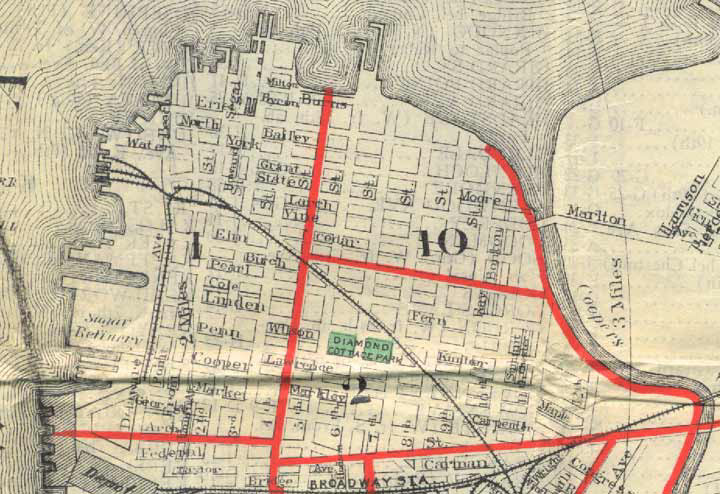
North Camden map, published in 1914
View transcription
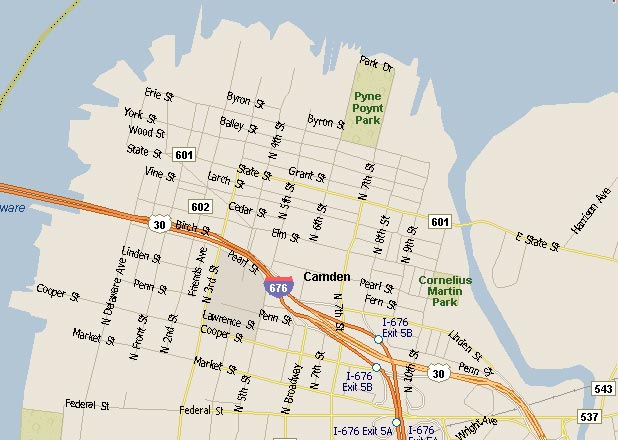
North Camden map, published in 1914, showing the neighborhood before the Ben Franklin Bridge was built and the highways cut it off from the rest of Camden. Diamond Cottage Park is now part of the Rutgers Campus. Note that Pyne Point Park and the park at 2nd and Cooper Streets are not shown.
North Camden map, 2003
View transcription
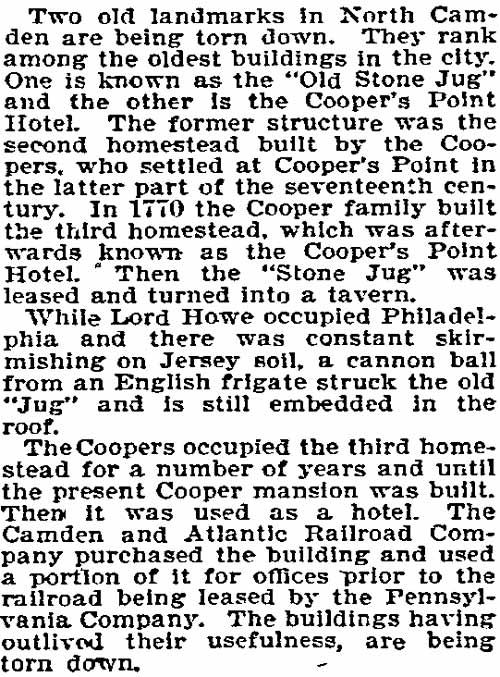
Two Old Landmarks in North Camden Being Torn Down
Philadelphia Inquirer, July 12, 1896
View transcription
Read the article: Two Old Landmarks in North Camden Being Torn Down
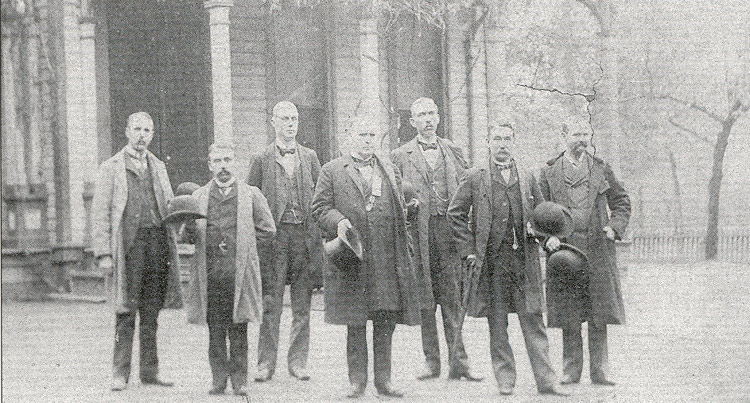
President McKinley at Ebener's Hotel, circa 1900
President William McKinley, senators and other officials in front of Albert Ebener’s hotel — The Victorian House at Camden Gardens, Point and Erie Streets — circa 1900.
Highland Woolen Mills Weavers Return to Work
Philadelphia Inquirer, January 24, 1900

View transcription
Read the article: Highland Woolen Mills Weavers Return to Work
Second Street, South of Linden — About 1900
Second Street, south of Linden, about 1900. 300 Block — Millwood Truscott’s home at 310 N. 2nd Street is behind trees on left.
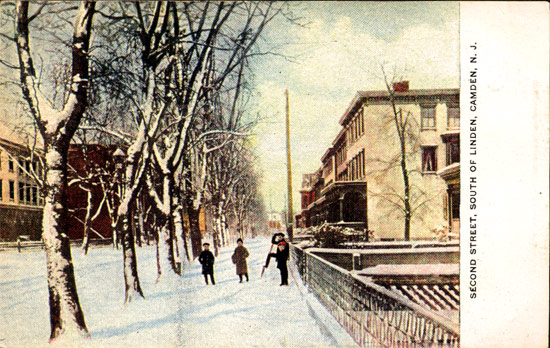
View transcription
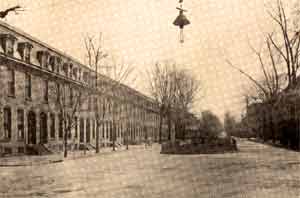
Linden Street, 1914
Linden Street. Photograph published in 1914; it was probably taken a few years earlier. This upper middle-class neighborhood was razed to make room for the Bridge Plaza.
9th and Pearl Streets — 1895 and 2003
Looking northwest at North 9th and Pearl Streets, 1895
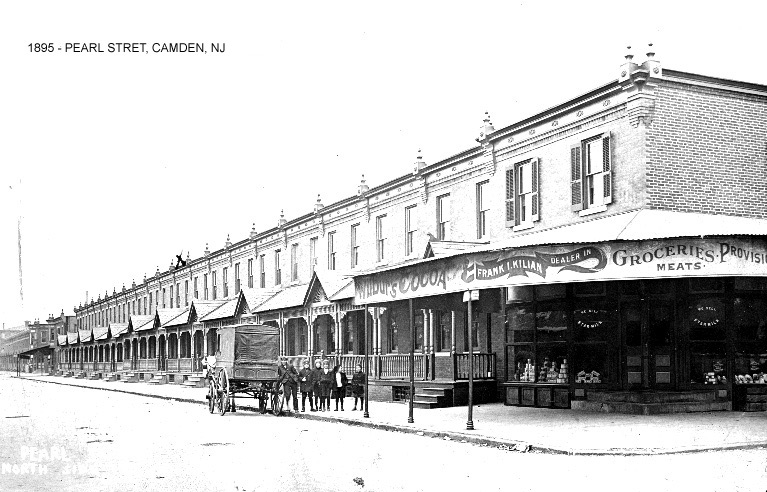
View transcription
Looking northwest at North 9th and Pearl Streets, May 3, 2003
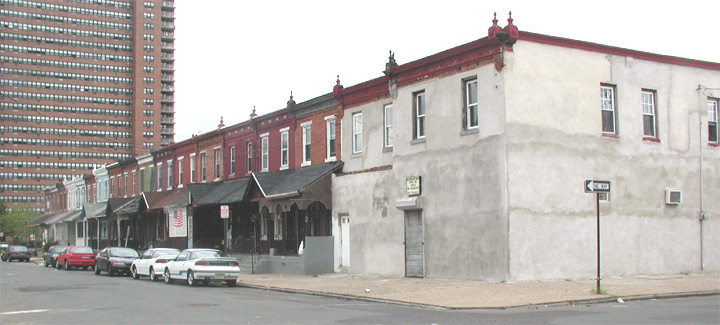
View transcription
The Relic — 546 North 8th Street
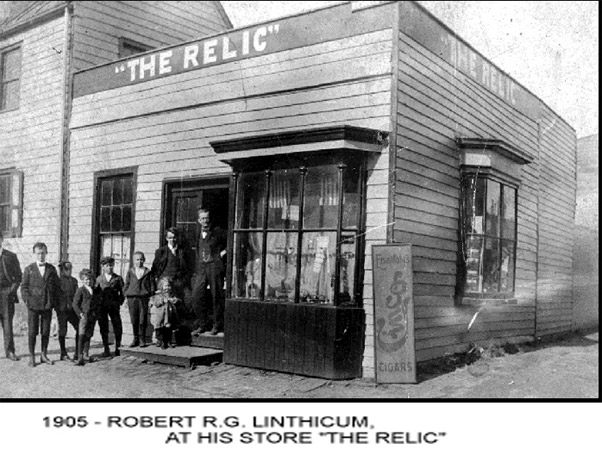
Robert R. G. Linthicum at his store The Relic, 546 North 8th Street, Camden, 1905
View transcription
Robert Linthicum operated his delicatessen and grocery at 546 North 8th Street, the corner of 8th and Birch Streets, at the time of the 1920 census. The address was still a grocery as late as 1947.
555 York Street, 1911
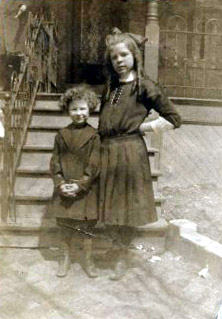
555 York Street, 1911, home of Jack and Grace O’Connor
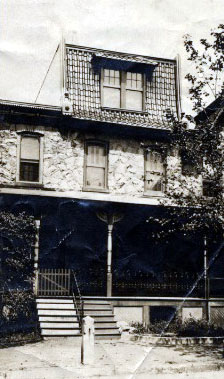
555 York Street, 1911 — Jack and Grace O’Connor in front of their home.
A Pair of North Camden Churches
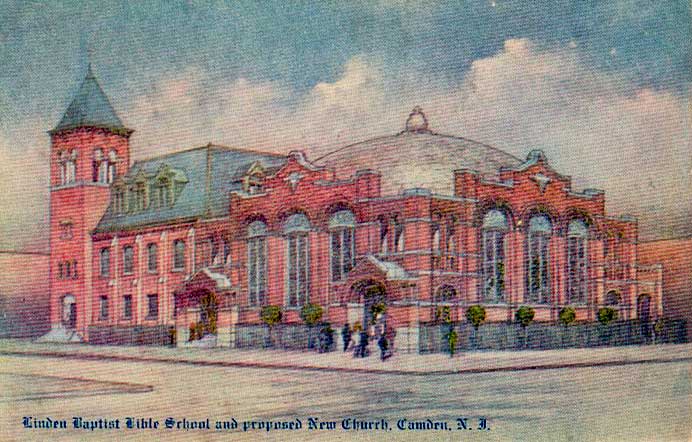
Linden Baptist Church — Northeast Corner of 9th & Linden Streets (opened October 3, 1909). Designed by Arthur Truscott.
View transcription
North Baptist Church — 316 Linden Street.
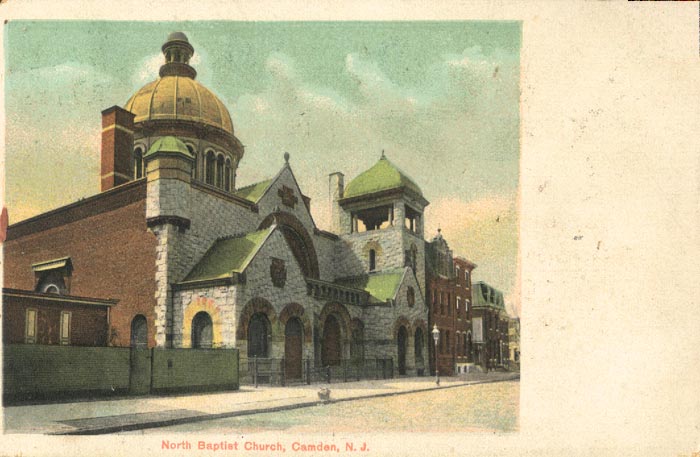
View transcription
Pictures from the Cyclone of 1912
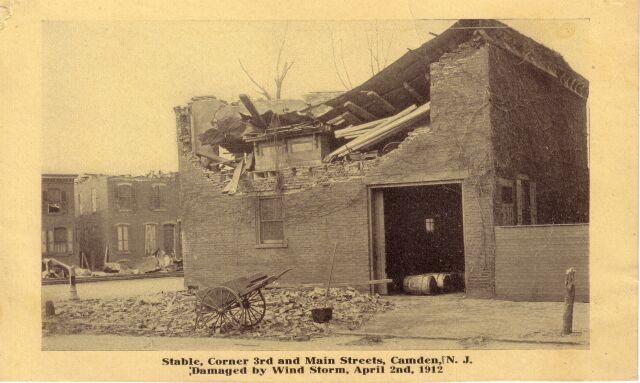
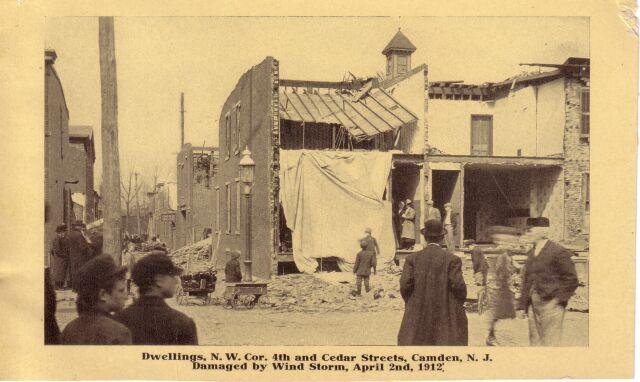
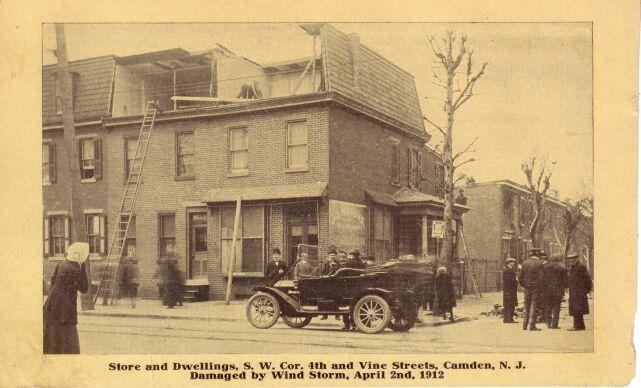
Tornados struck Camden in 1885 and 1912. The term “cyclone” was commonly used to refer to tornados in those times.
Wind storm damage in Camden, 1912. Stable, Corner 3rd and Main Streets, Camden, N. J. Damaged by Wind Storm, April 2nd, 1912.
View transcription
Wind storm damage in Camden, 1912. Dwellings, N. W. Cor. 4th and Cedar Streets, Camden, N. J. Damaged by Wind Storm, April 2nd, 1912.
View transcription
Wind storm damage in Camden, 1912. Store and Dwellings, S. W. Cor. 4th and Vine Streets, Camden, N. J. Damaged by Wind Storm, April 2nd, 1912.
View transcription
Wind storm damage in Camden, 1912. Dwellings, Vine Street, above 4th Street, Camden, N. J. Damaged by Wind Storm, April 2nd, 1912.
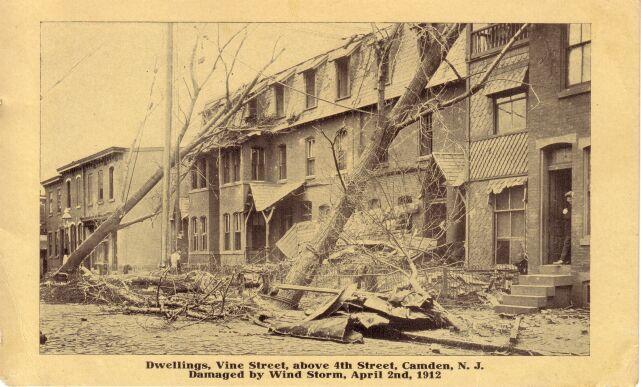
View transcription
Dwellings, Nos. 215 and 217 Elm Street, Camden, N. J., damaged by wind storm, April 2, 1912
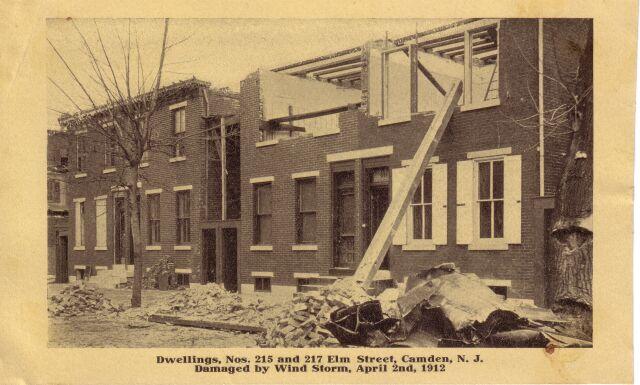
View transcription
Store and Dwellings, S. E. Cor. 4th and Vine Streets, Camden, N. J., damaged by wind storm, April 2, 1912
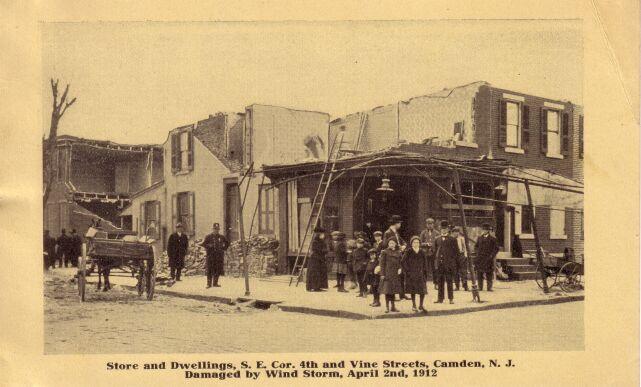
View transcription
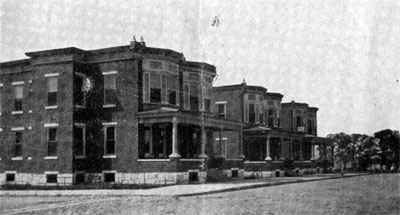
Building North Camden, circa 1910
From a real estate advertising brochure titled “An Historic Spot in Camden Interesting to You,” advertising new construction in North Camden around 1910.
York Street houses in process of construction.
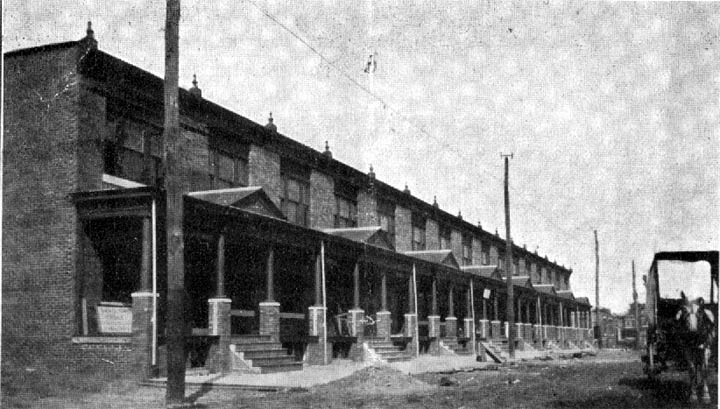
Sixth Street houses adjoining park — 929 to 939 North 6th Street.
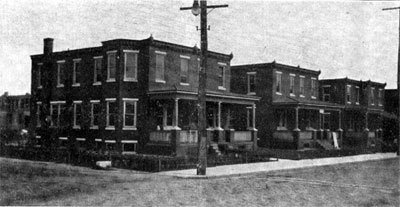
Sixth Street houses facing the park — 1001 to 1011 North 6th Street.
Delaware River Bridge Construction, 1925
Delaware River Bridge construction and North Camden, 1925
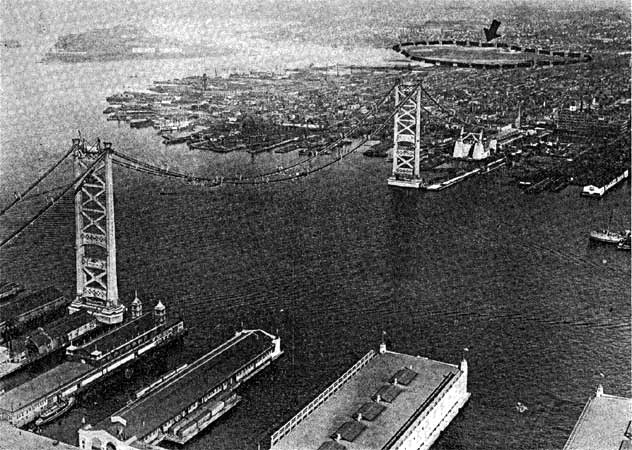
1925 — Delaware River Bridge construction and North Camden. The circled area is the Harrison Avenue garbage dump. In 1925 the site was considered as a location for an airport to serve Camden and Philadelphia. The site has remained undeveloped and in need of environmental cleanup. In the fall of 2003 plans were announced for a cleanup and conversion of the site for use as a golf course.
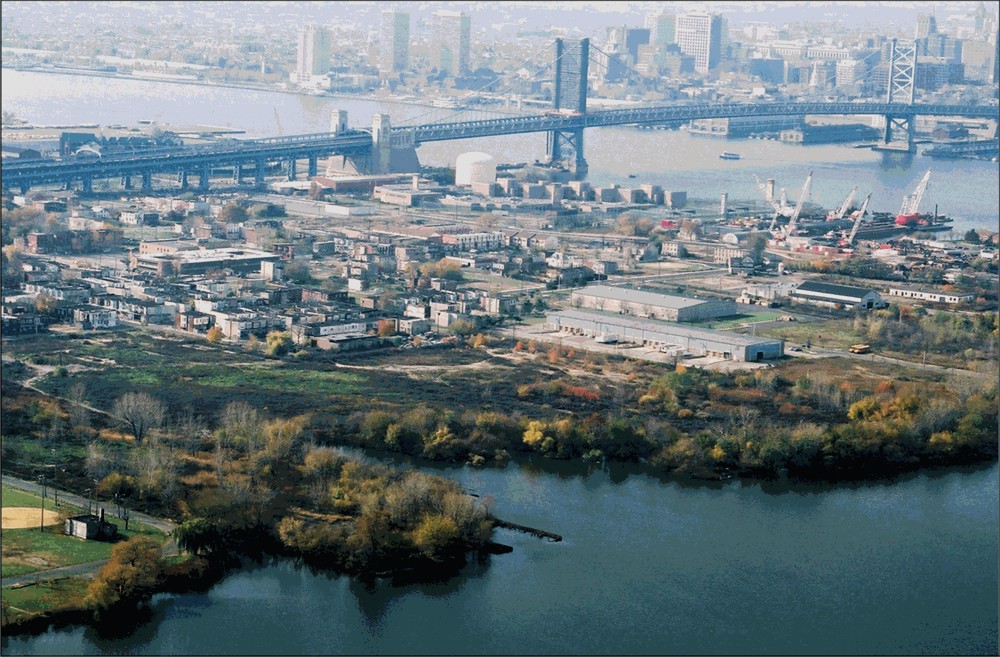
North Camden, 2008
North Camden aerial view, 2008
Schools in North Camden
| Cassady | Cooper & U.S. Grant | Northeast |
| Powell | Read | Sewell |
| Pyne Point Jr. High |
North Camden Bars
| Address | History |
|---|---|
| 245 Erie | 1936 Brady’s 1947 International Fur & Leather Workers Union Local 206 CIO |
| 800 Fern | 1908 John McGovern 1918–1921 Catherine McGovern 1926–1936 Hugh P. Reilly 1939–1949 Clancy’s Cafe 1956 New Mill Bar & Grille 1959 Stew’s Bar & Grill 1963–1968 Fern Grille 2004 Gone |
| 800 Linden | 1906–1947 Daly’s Cafe 1952–59 Linden Grill Gone |
| 125 Main | 1900–1913 Dan McConnell’s Oyster Saloon |
| 127 Main | 1935–1936 Harry Wieland |
| 505 Main | 1883–1884 Joseph Zanner 1906 William Oberman Sr. 1918–1928 Mrs. Tekla Oberman 1931–1943 William Oberman Jr. 1947 Walter E Gross Main Cafe 1956 Main Street Cafe 1959–1964 Ann’s Tavern Gone by 1966 |
| 900 N 2nd | 1931 James O’Donnell 1936–1943 William E. Morgan Morgan’s Cafe 1947–1949 Caesar Campana Sr. 1956 Tony’s Supper Club 1959 Happy Landing Bar 1964–1966 Tuggie & Squeal’s Bar 2003 Gone |
| 940 N 2nd | 1918–1921 James McAninley 1947 Vacant 2003 Gone |
| 609 N 3rd | 1940 Mancine’s Bar 1956–1970 Mancine’s Bali Club 1977–2004 Mancine’s Liquors |
| 901 N 3rd | 1915–1920 Harry Rodenbeck No bar by 1922 1931–1947 A&P Grocery |
| 938 N 3rd | 1908–1966 Lynch’s Cafe 1990s R&R Bar |
| 939 N 3rd | 1918–1931 Brady’s 1935 Clem Bridgeman A grocery store since the 1940s |
| 636 N 5th | 1918–1919 William Eckenhoff 1947 Max Greenberg’s Grocery Store |
| 519–521 N 7th | 1897 John & Kate Daly –1905 George Gmeiner 1920–1980 Nittinger’s Tavern 1920–1921 Irvin Nittinger 1926–1931 Louise Nittinger |
| 423 N. Front | 1918–1921 John T. Whelan 1926 Joseph L Manderfield |
| 524 N. Front | 1918–1921 Mrs. Mary Kenney |
| 601 N Front | 1918–26 Charles E. Snyder 1927–1947 Clara C. Snyder 1954 Cooper Tavern 1959 Sally’s Cafe 1964–1966 Sam’s Cafe |
| 641–643 N Front | 1908–1949 Joseph Dowling 1959–1970 Dowling Inc. 1977 Gone |
| 952 N Front | 1918–1947 Eugene Widman 1949 George Engel 1956–1959 Erie Cafe aka Frontier Playhouse, closed in mid-1960s |
| 5 Northgate Plaza | 1964–1978 Lamplighter Room 1980–1982 Pegasus |
| 100 Pearl | 1936–1943 William F. Gannon Gannon’s Bridge Cafe 1947–1970 Reese W. Gannon Gannon’s Tavern 1977 Gone |
| 601 Pearl | 1918–1921 Matthew Geoghegan 1926–1928 Edward A. Welsh 1939–1964 Big Ed’s Place 2003 Gone |
| 623 Pearl | 1931 George Murray |
| 941 Pearl | 1939–1947 Harry G. Wells Harry’s Tap Room 1949–1977 Ford’s Cafe |
| 600 Point | 1936–1943 Caesar Campana Sr. Caesar’s Sandwich Shop 1946–1970 Johnny Moore’s |
| 901 Point | 1888–1889 Charles Moore 1890–1891 Albert E. Kayser 1918–1919 John Lewis Dungan Not a Bar after Prohibition enacted in 1919 |
| 943 Point | 1880–1891 Albert Ebener 1918–1919 Jacob Blankenhorn 1928 Anchen Szurlej 1929–1931 John Davish |
| 69 State St | 1910 Conrad Ahrens 1918–1940 William Pfeiffer 1947 Frederick Weldon 1959–1970 Kelly’s Cafe 1977 Gone |
| 226 State | 1939–1943 Charles F. Miller 1947 Lee & George’s Bar, Mrs. Theresa Doris 1954–2004 State Bar |
| 304 State | 1939 Capt. H.G. Sparrow Ship No. 1269 VFW |
| 201 Vine | 1908–1939 Daly’s Bar 1939 Daly’s Cafe 1943–early 1970s Daly’s Tavern |
| 600 Vine | 1966–1980 Ann’s Tavern Closed by 1982 |
| 45 York | 1918–1921 Frank Ziemski 1926–1931 Mrs. Annie Ziemski 1936 Baker’s Bar & Grill 1939–1969 Joe’s Joe Zawitkowski |
Pyne Poynt Athletic Association, July 4, 1926
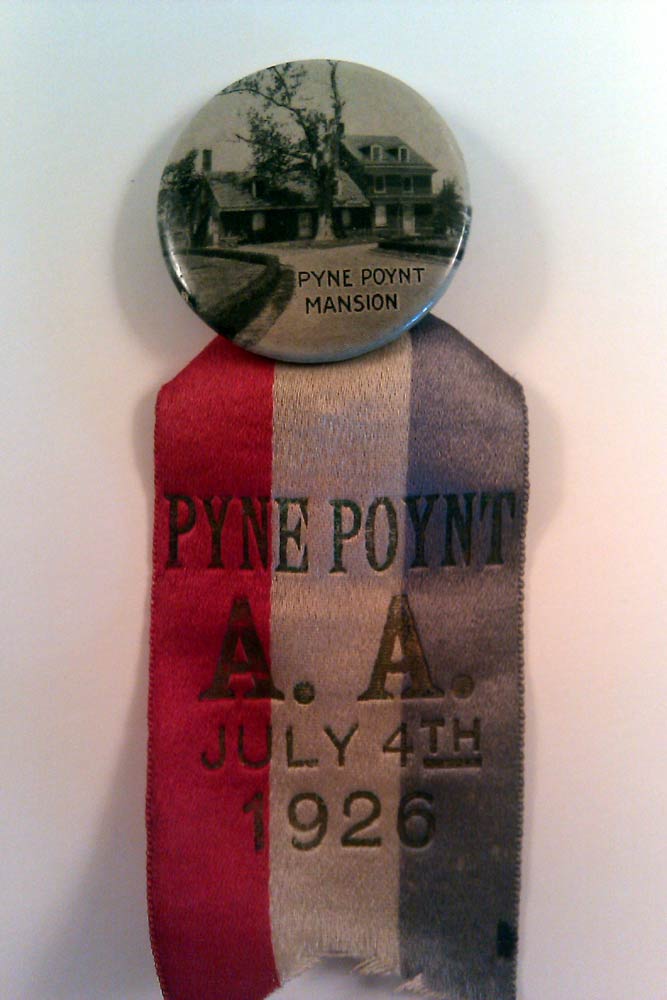
View transcription
Delco Defeats Civic to Remain Unbeaten
Camden Courier-Post - October 13, 1931
Delco A. A. continued to hold sway with local minor teams when they kept their unscored on record intact yesterday afternoon when they defeated the strong Civic A. A. at Tenth and State Street, to the tune of 19 to 0.
The feature of the game was when Ed Fish of the winners intercepted a forward pass and ran thirty yards for a touchdown.
Coach Jack Fitzgerald wishes all the Delco squad to report at the club Wednesday at 7:00 p. m.
Yacht Club Burns In North Camden; One of Landmarks
Camden newspaper, March 21, 1932
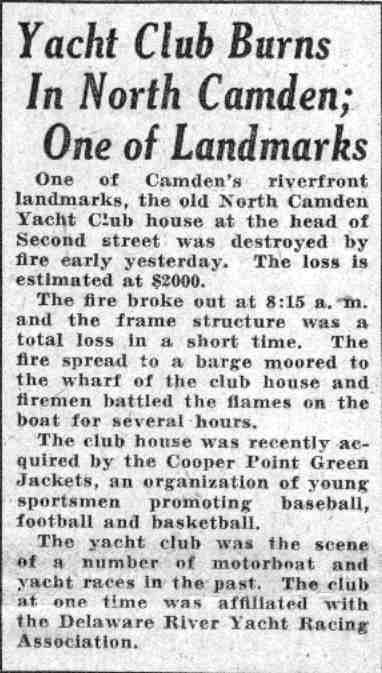
View transcription
Camden Courier-Post, March 21, 1932 — North Camden Yacht Club.
Holy Name Card Party Arranged for Friday
Camden Courier-Post - February 8, 1933
A card party and social will be held at the Holy Name auditorium, Fifth and Vine Streets, Friday night by the parish amusement committee. Tables will be arranged for the various card games, which will start at 8:30 PM, and attractive prizes will be awarded high scorers. The committee comprises Mrs. Anna Higgins, Mrs. Miriam Wilkins, Mrs. Agnes McCracken, Mrs. Edward Moran, Mrs. Charles Henle, Jr., Mrs. Catherine Hambach, Miss Marie McDonough and Mrs. Teresa Hale.
Head of Pyne Poynt Garden Group Says Relief Job Needs ‘More Heart’
Camden Courier-Post - June 4, 1933
Read the article: Head of Pyne Poynt Garden Group Says Relief Job Needs "More Heart"
11 Families Cook in Yards; 35 Children Suffer Until Paper Guarantees Gas Bills
106, 108 and 110 State Street, Camden Courier-Post, June 4, 1933
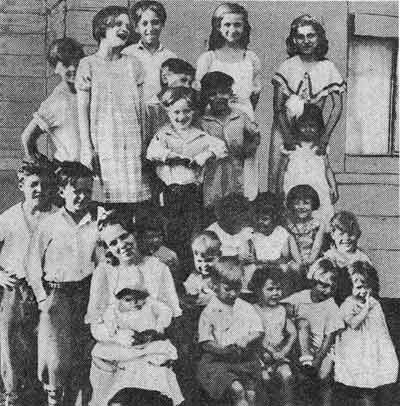
Read the article: 11 Families Cook in Yards; 35 Children Suffer Until Paper Guarantees Gas Bills
Camden's Gardens Are Prospering Inspection Shows
Camden Courier-Post - June 9, 1933
Improvised Water Supply Used on Majority of Plots — Police to Meet Monday
The 20 groups of Camden City Gardens are making excellent progress, with several groups enjoying improvised water supplies, an inspection showed yesterday.
The two-hour inspection trip was made by Arthur M. Taylor, of the Emergency Relief Administration; Capt. Charles F. Hettinger, supervisor of city gardens; Walter S. Agin, publicity chairman; Isaac Kyler, secretary of Pyne Poynt Garden Club, and Joseph Corden, vice-president of the latter club.
The Pyne Poynt Garden Club has installed 1200 feet of water pipe, with 12 outlets, from which water is sprinkled on the gardens in dry weather. At the Marine Terminal Gardens, near Clinton Street, the gardeners have dug eight wells, 12 feet deep, with 24-inch pipe, for their water supply. The Fairview Gardens are furnished with water by 1500 feet of old fire hose donated for the purpose. Hundreds of hills of potatoes are growing there, from potatoes salvaged from city dumps.
At the Taylor Gardens, on Taylor Avenue, the name of the gardens has been worked out in string beans planted on the Taylor Avenue side of the plot. The garden police will meet Monday night in the court house with Chief Roy Adams. City Garden club chairmen and their committees will meet next Wednesday evening. The South Camden section will meet next Friday night in the Wilson school, Ninth street and Woodland Avenue.
The East Camden section will meet June 20 in Woodrow Wilson Junior High School.
Taylor announced that the Campbell Soup Company during the past week has contributed 1,150,000 tomato plants to the City garden movement.
Fatal Collapse of 2 Houses Laid to Vandalism
Camden Courier-Post - June 20, 1933
Read the article: Fatal Collapse of 2 Houses Laid to Vandalism
Cops Nab 14 Nudists After Criticism for Vandalism, Bathing
Camden Courier-Post - June 23, 1933
Read the article: Cops Nab 14 Nudists After Criticism for Vandalism, Bathing
Pyne Poynt Plans July 4 Program
Camden Courier-Post - June 23, 1933
Read the article: Pyne Poynt Plans July 4 Program
Route Announced for Fourth Parade
Camden Courier-Post - June 25, 1933
Hundreds of Children Will Join Organizations in Pyne Poynt Program
Route of the annual Fourth of July parade of the Pyne Poynt Athletic Association was announced last night. The event, one of the outstanding Independence Day programs in South Jersey, promises to surpass any previous undertaking of the association.
Hundreds of school children and organizations are planning to march. The line will form on Erie Street, west of Seventh, turn south on Seventh street to York, east on Eighth, south to State, east to Ninth, south to Vine, west to Eighth, south to Elm, west to Sixth, north to State, west to Fifth, north to Grant, west to Fourth, north to York, east to Fifth, north to Bailey, east to Sixth, north to Byron street and then enter Pyne Poynt Park.
Named as parade marshal is Isaac Kyler, while John R. Schultz again will have charge of school children. William Hughes and George Zeitz will serve as assistant marshals. The Pyne Poynt Garden Club is planning to march and compete for a share of the 250 prizes to be awarded. Among the awards will be a token for the best decorated home in the Tenth Ward. A meeting of the committee in charge is to be held at 7.30 p. m. tonight at 939 North Fifth Street, to discuss plans for raising funds in the First Ward.
Fourth of July in North Camden in the 1930s and 1940s
Penny scramble at Lynch’s Bar, Erie Street, Fourth of July, North Camden. Photo courtesy of Jack Sizemore
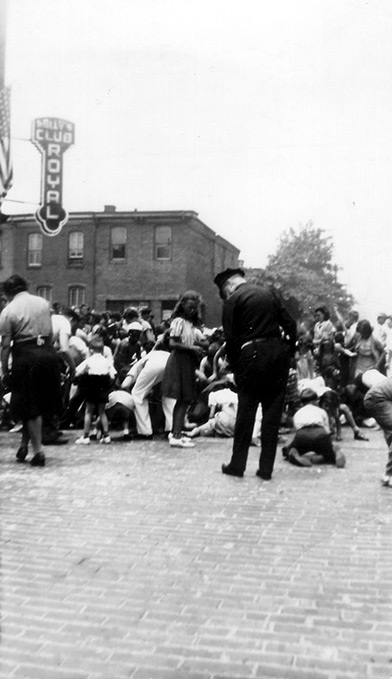
View transcription
…about the penny scramble that took place at Lynch’s Bar at 3rd and Erie St on the 4th of July.
I can remember going in the bar with my Dad as a young boy and the patrons would throw their extra change… which wasn’t a lot… on top of the shelf unit behind the bar, that all the bottles would be on. It was a large fancy unit that ran along the wall behind the bar. The unit went up all but about a foot or so to the ceiling.
On the 4th of July all the money that was up there was put in a big flag and a person named Russ the Ice Man would throw all the money out of the second floor window on to Erie Street to all the kids in the neighborhood. The 4th of July was a great day in the neighborhood with BIG parade parties all over, the penny scramble for the kids, then fire works at night at Pine Point Park. Great time and fine memories.
— Bill Stefanko, December 4, 2004.
2 Opponents Slashed in North Camden Fight
Camden Courier-Post - June 25, 1933
Two colored men were under arrest last night following a cutting affray in North Camden. Each charges the other with atrocious assault and battery.
They are Herman Langston, of 332 Summit Street, near whose home the brawl occurred, and Emory B. Ball, 30, of 1028 Admiral Wilson Boulevard. Langston was treated at Cooper Hospital for cuts on the head and back. Ball was cut on the hand.
3 Hydrant Showers Dedicated; Segal Street Youngsters Happy
Camden Courier-Post, August 8, 1935
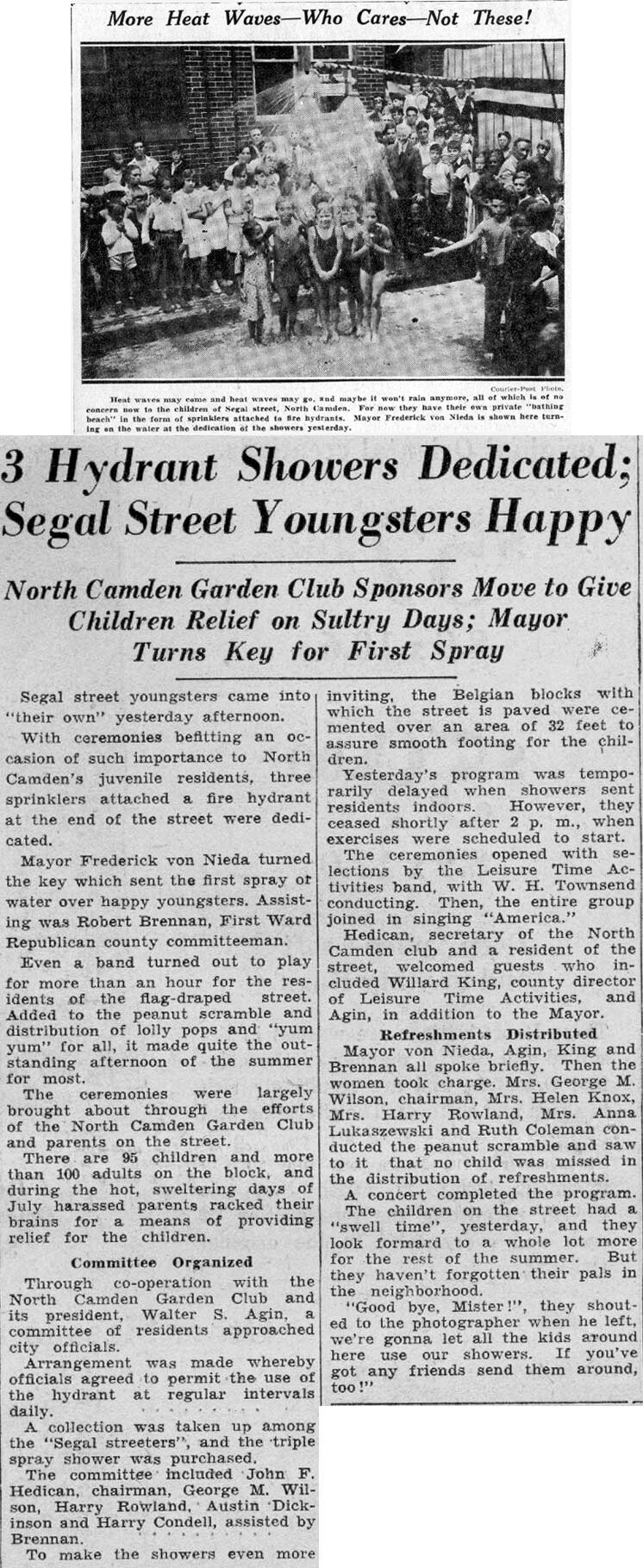
View transcription
Read the article: 3 Hydrant Showers Dedicated; Segal Street Youngsters Happy
5 Bitten by Mad Dog in North Camden Treated for Rabies
Camden Courier-Post - February 17, 1936
Read the article: 5 Bitten by Mad Dog in North Camden Treated for Rabies
P.T.A. Applauds Brunner's Beautification Project
Camden Courier-Post - February 19, 1936
To the Editor:
Sir — Hats off to you, Mr. Brunner!
We congratulate you on your courage to really do something for the benefit of city dwellers who must stay near home.
By careful and wise planning of your park beautification project, you can at the same time give the children as well as the grown folks places for safe and healthful recreation which, if thoughtfully and carefully supervised, will not only do much toward taking the children out of our traffic-ridden streets, but will give them their birthright, the opportunity of becoming healthy, happy and law-respecting future citizens.
This should save the taxpayers of Camden a considerable amount of money by the large reduction of costs for detention homes, juvenile courts, prisons, etc., not mentioning what it will do by preventing much anguish and heartaches. We have definite plans for Pyne Poynt Park and vacant lots in North Camden which we and other organizations are going to submit to you within a week and hope that you will consider them before you pass out your plans for starting work.
Northeast–Sewell P.T.A.
Mrs. Elsie P. Robertson
Chairman Child Study Group and Safety Committee
Anniversary Held by Pyne Poynt A.A.
Camden Courier-Post - February 24, 1936
Number of Out-of-town Members Among 60 at 25th Banquet Session
More than 60 members of the Pyne Poynt Athletic Club joined celebrating the club’s twenty-fifth anniversary at a banquet and entertainment Saturday night at the organization’s headquarters 939 North Fifth street. Commissioner Frank J. Hartmann, Jr., one of the club’s former presidents was among the speakers. Chester Vissel, board of education member also attended.
The group was entertained by John Devlin, “Irish Ambassador,” and engaged in a Monte Carlo contest under direction of George Townsend of Collingswood. Three of the members now living at Washington, D. C., journeyed back to the club from the national capital. They are William Brandt, R. George Rheinbold and William Begg.
Among other out-of-town members attending were Arthur Messler, Westwood; Harry Edginton, Milford, Del.; William Cann and Howard Hurlock, both of Wilmington, Del., and Alfred Heap, Haddonfield, one of the organizers.
Harry F. Walton, first president, was toastmaster. Albert Ross, Jr., house director was in charge of banquet preparations. Officers of the club are Edward H. Winters, president; Alexander Kahnweiler, vice president; Hamilton H. Batten, recording secretary; Frank Kelley, financial secretary; Harry F. Walton, treasurer, and George E. Ash, director-at-large.
Home Reception Held by North Camden A.A.
Camden Courier-Post - February 24, 1936
The North Camden Athletic Association yesterday held a reception at its new home, 325 State Street.
The club was organized January 12 with 36 First Ward boys as members by William Fridell and Joseph Gorman, Democratic county committeeman.
The officers are Edward Young, president; Roy Wood, vice president; John Garrity, treasurer, and Elmer C. Leibfried, secretary.
Young said the club will sponsor baseball, basketball, swimming and amateur boxing. Garrity is a son of Willie Davis, also known in fistic circles years ago as San Diego.
Pyne Point Park
See the Pyne Point Park web page for more about the park’s history.
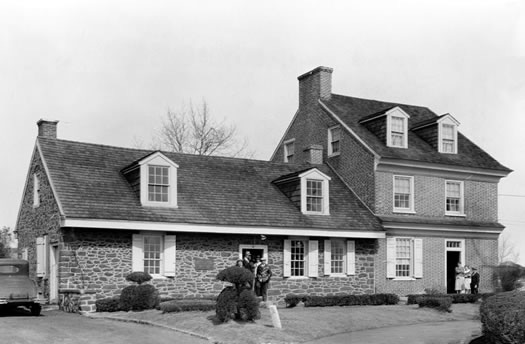
Pyne Point Park, 1936
Water Carnival Set at Pyne Poynt Pool
Camden Courier-Post, August 5, 1936
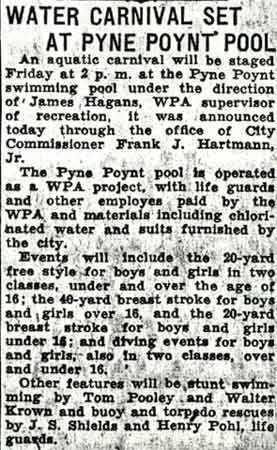
View transcription
Pyne Poynt Club Arranges Banquet
Camden Courier-Post - February 5, 1938
Annual Get-Together of 27 Year-Old Organization Set for February 26
Frank Kelley, Camden Courier-Post, February 5, 1938
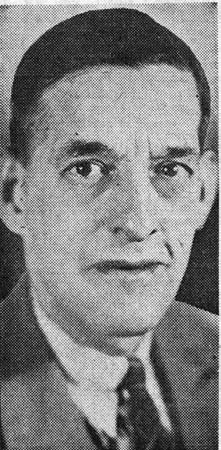
Frank Kelley — Chairman of the committee which is arranging the twenty-seventh annual banquet of the Pyne Poynt Social Club, which is to be held Saturday night, February 26.
Twenty-seven year’s ago a group of North Camden young men banded together to promote sports.
Since that time an enviable record of achievements has been set up as the result of that meeting in the home of Albert R. Heap, 544 Bailey Street, in the latter part of January, 1911.
There, it was that the young men formed themselves into the Pyne Poynt Social Club. They met there for about three weeks, then moved to the Southwest corner of Fifth and Erie Streets; which has been the headquarters since.
The original group and those who joined in the years which immediately followed the organization meeting have scattered, many of them have moved out of the city, but each year they get together at a banquet.
The time now is approaching when the annual banquet will be held. It is scheduled for Saturday night, February 26, in the headquarters of the organization.
It is the gala occasion to which the older members look forward through the year — the opportunity to reminisce on the days that have gone and to recount the things they have done to promote sports. And, while the years have piled up for them, individually, there’s not one of the group of about 60 members, who will attend the banquet, who is not just as peppy as ever in his interest for the original undertaking of the club.
“It will be the twenty-seventh annual banquet,” said Frank Kelley, chairman of the banquet committee, “and the boys will be coming home for the get-together. They’ll come from Washington, from Illinois, Delaware, several sections of New Jersey and Pennsylvania. Old friendships will be renewed, old times and the affairs of the Pyne Poynt Social Club of bygone years will be discussed. It will be a night that will be enjoyed by everybody.”
It seems fitting, members pointed out, that the principal speaker should be a man well versed in sports, from the marble games of boyhood, through baseball, football, championship fights — everything in sports. The speaker will be Gordon Mackay, member of the editorial staff of the Courier-Post Newspapers.
Mackay, through his 40 years in newspaper work, will recount his experiences in sports — and Mackay knows sports and those who have made history in its various phases.
In addition to Kelley, the banquet committee is composed of Hamilton Batten, George Ash, Alfred J. Ross, Jr., Jacob Dreher, Ellery Caskey, Nick Adezio, Edward H. Winters, Alex Kahnweiler and Harry F. Walton. As chairman of the entertainment committee, Ross will be assisted by: Robert Johnson, William Huber and Caskey.
Banquet Arranged by Pyne Poynt Club
Camden Courier-Post - February 11, 1938
27th Annual Event Expected to Break Record on Night of Feb. 26
The twenty-seventh annual banquet of the Pyne Poynt Social Club promises to be the most successful and best attended in the history of this North Camden sports and social group.
From different parts of the country acknowledgments are coming in to Frank Kelley, chairman of the banquet committee, from members that they will be present at the dinner to be held Saturday night, Feb. 26, at the club’s headquarters, corner of Fifth and Erie streets.
“We are striving to make this affair the best in the history of the club,” said President Ed H. Winters, “and we believe it will far out measure our fondest expectations in the matter of attendance and the good time that everyone there will have.
“The club, in the years that it has been in existence, has occupied a prominent place in the sporting and social affairs of North Camden. It has been the means of making and holding friendships, and the friendships so established are cemented further each year by the annual banquet. The members look forward to it.”
This year the principal speaker will be Gordon Mackay, member of the editorial staff of the Courier-Post newspapers. Mackay, who has been associated with newspapers for the last 40 years, will talk of sports, on which he is an acknowledged authority.
Among those who already have said they will attend are William Brandt, of Washington; George A. E. Rheinhold, also of Washington; William N. Cann, of Wilmington; Howard Hurlock and Louis Schwaiger, of Philadelphia; Robert Johnson, R. K. Dawrinson, Victor J. Paxson, Walter Adams, Harry McKinney, Fred Schwaiger, Ralph T. Githens, William Oberst, Clarence Rudolph and Arthur Messier, of Westwood; Herbert Schaeffer, of Bloomfield; Harry Edginton, of Milton, Del.; Thomas Kerr, of Bogota; Ren Plum, of Mt. Ephraim; J. Russell Taylor and Ed D. Crosley, of Buffalo, and Arthur Truitt, of Bridgeport, Conn.
Since the organization of the club, in the latter part of January, 1911, the following have been presidents: Harry F. Walton, 1911 and 1912; Cecil Battle, 1913 and 1914; George Townsend, 1915 and 1916; Frank Boyer, 1917; John Begg, 1918; Frank Haines, 1919, 1920 and 1931; John R. Taylor, 1921; Alex Kahnweiler, 1922; Ed. H. Winters, 1923, 1924, 1925, 1926, 1927, 1928, 1929, 1930, 1935, 1936 and 1937; Richard Barry, 1932 and 1933; and Frank J. Hartmann, Jr., now city commissioner, in 1934.
Vice presidents have been: Willard Fox, 1911; Battle, 1912; Barry, 1913 and 1931; Begg, 1914, 1915 and 1916; Arthur Messier, 1917, 1923, 1925, 1926, 1927, 1928 and 1929; Haines, 1918; Winters, 1919; Schaeffer, 1921; William Benecke, 1922; W. E. Baird 1930; Barry, 1931; Otto H. Braun 1932, and Kahnweiler, 1933, 1934, 1935, 1936 and 1937.
Cassaday School Pupils Hail Merry Outing at Knight Park
Camden Courier-Post, June 29, 1939
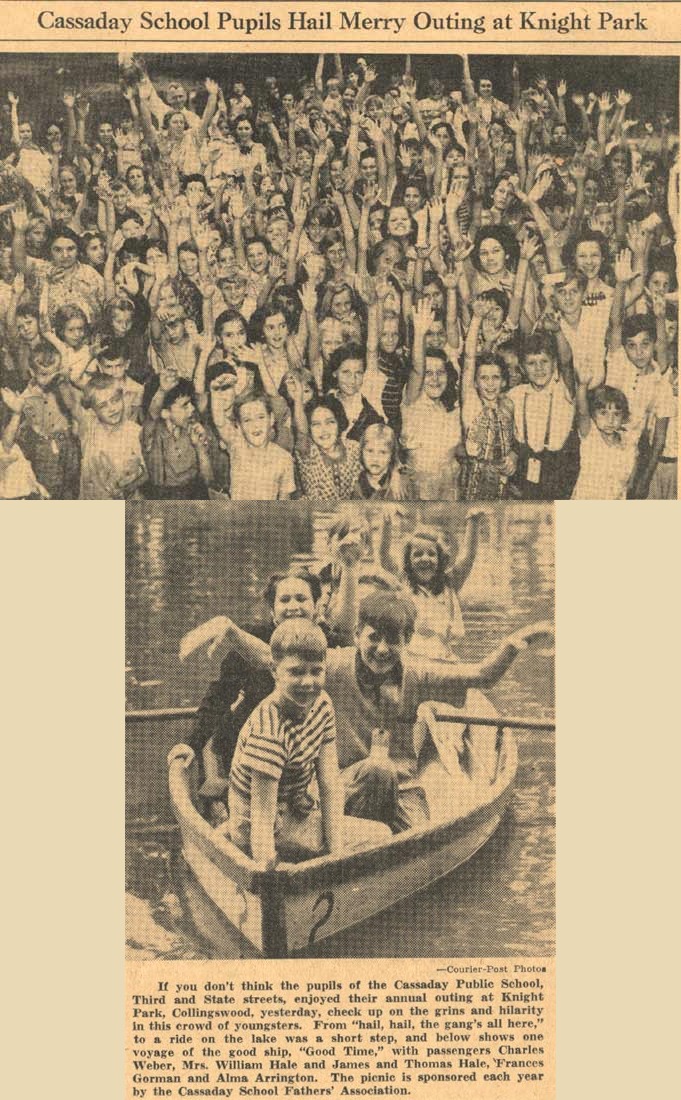
View transcription
Read the article: Cassaday School Pupils Hail Merry Outing at Knight Park
Cassady Block Party to Continue Tonight
Camden Courier-Post, June 23, 1939
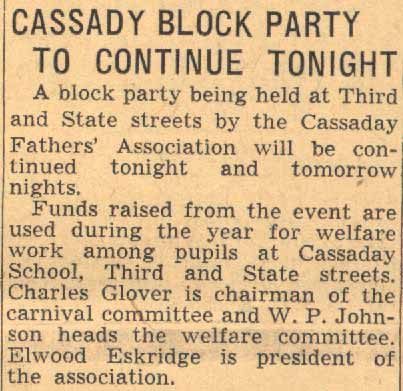
View transcription
Read the article: Cassady Block Party to Continue Tonight
What often is overlooked when recalling the glory days of Camden’s past is that a lot of what made Camden great was its PEOPLE! Neighborhood, social, religious, and fraternal organizations contributed to the social fabric of the city.
North Camden Streets, 1939 and 1940s
Looking east on York Street from 2nd Street, early 1950s. “Dianna & Marilyn Luggi, & Jim Bessing Jr.” — courtesy of Jim Bessing Sr., May 2004.
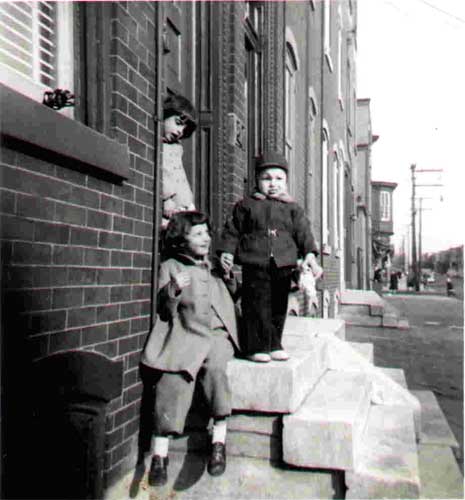
203 Grant Street, June 23, 1939
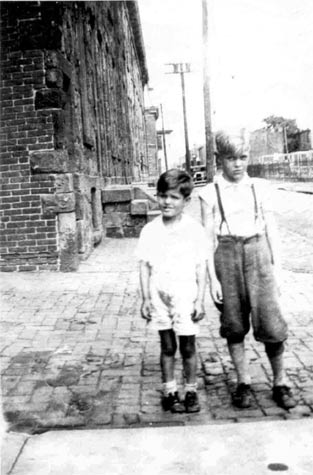
Looking east from 2nd Street on Grant Street. Gene Edwards (at left) & Jim Bessing Sr., June 23, 1939. “…I read about Cassady School block party and decided to send this picture of me and my little cousin. The block party stands can be seen just over my left shoulder. The look on my face was caused by my mother forbidding me to go to it. The year, 1939. I’m 10 yrs. old.” — Jim Bessing, March 2004.
Looking east on York Street from Howard Street, Gene Edwards and Jim Bessing Sr.
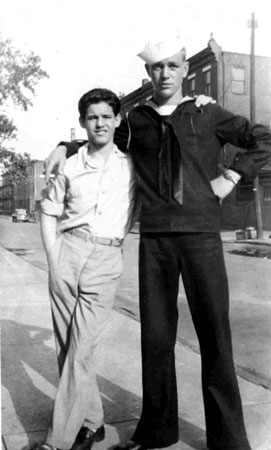
Looking east on York Street from Howard Street, Jim Bessing Sr., 1940s. Maxie’s Candy Store at North 2nd and York is visible in the background.
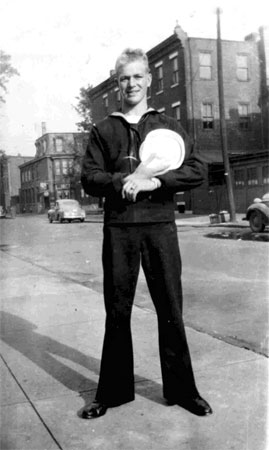
Seven years later — looking east on York Street from Howard Street. Gene Edwards & Jim Bessing Sr. (left); Jim Bessing Sr. (right). Maxie’s Candy Store at North 2nd and York is visible in the background, just beyond the parked car.
Noms de Plume
By John B. Moullette
John B. Moullette grew up on North 2nd Street. He wrote about growing up during the 1930s and early 1940s in North Camden in June of 2007.
Nom de Plume One: Spaghettee Moullettee
The title of this section might well have been: “Growing Up In Camden, New Jersey.” North Camden — my section of that industrial city of 200,000 — was just across the Delaware River from Philadelphia. Sometimes, we referred to it as “East Philly.” North Camden was a residential section of mostly three-story brick houses not more than 12 feet wide and 30 feet deep. They housed the workers of the shipyards that lined the river or who worked at Campbell Soup, RCA, and the Pennsylvania Railroad.
The Delaware River Bridge connected “East Philly” with Philadelphia. Between my house and “the bridge” was “Little Italy” — a nice neighborhood of hard-working Catholics, daisy wine, and good-looking, dark-complexioned girls. Spaghetti and tomato pies were common there long before Pizza Hut. It was from this influence that I got my first nom de plume — Spaghettee:
“Johnnie Moullettee ate a spaghettee and that’s how he got the name Moullettee.” The boys in that neighborhood were tough and it was from them that I learned how to street brawl: Stand and fight or suffer the consequence of being called “coward.” The best fight I ever had was in Little Italy. I was whipped but I stood; and my self-respect rose and I felt good about me. That battle was to pay dividends in the years to come.
The river — like all rivers — was an attraction. It started somewhere in New York State and emptied into the Atlantic Ocean between Cape May, New Jersey, and Lewes, Delaware. In it, we learned to swim and to fish (not too successfully). By it, we dreamed of far-off places signaled by the national flags of the ships that delivered wares to the Ports of Camden and Philadelphia. And, we dreamed of being sailors — some of us even realized that dream.
Three landmarks stand out in my memory of North Camden: The railroad marshalling yards, the mansion or cow-lot [this was the Augustus Reeve mansion], and Pyne Point Park.
It was at the marshalling yards that the greatest excitement took place. For here, almost every day of the Great Depression, came the hoboes — those wandering, homeless and unemployed men of the ’30s who were seeking a new life just over the horizon. They camped there, slept in the box cars or in tarpaper shacks, cooked in cans over open fires, shaved by looking into broken mirrors (seven years bad luck) and cleaned their clothes in the river or by holding them over a fire to kill the lice, or by scraping packed dirt with a knife.
They were kind and friendly and, mostly, they were interesting. They always had a story for those of us who were brave enough to approach them. We ran errands for them, watched out for the yard dicks, brought them meager rations of food from home and listened to their stories — stories of the American West, the Plains, the mountains, the lakes, the endless fields of grain and cotton, and — of course — the big cities: New York, Chicago, St. Louis, Kansas City, Denver, San Francisco, Birmingham and New Orleans. My first determination to travel came from these men — never did I believe that I would see each and every one of those cities as well as the major cities of Europe and the Orient.
And some of the men had stories of the Great War. Some showed us their wounds and their medals. From them, we had first-hand accounts of trench warfare, hand-to-hand combat with the Boche, gas attacks, and that wonderful “Mademoiselle from Armentieres.”
Compared to those stories, school in North Camden was terrible. Not the schools but the tedium of the subjects taught. For some of us whose homes were unheated, lighted by kerosene lamps, or without adequate plumbing, the schools — Cassady and Cooper — were warm, cheerful and cozy. This was especially so in winter and on rainy days. We looked forward to the rainy days as we usually were dismissed for the afternoon.
I loved my first grade teacher, my second grade teacher, my fourth grade teacher and the “roving” art teacher, who later became a lieutenant in the Women Marines (the BAMS). In common, these teachers were interesting, imaginative, enthusiastic, and understanding. They were also “young,” not like “old lady so-and-so.”
My favorite subjects were geography, history, reading and spelling. Math I dreaded, and to this day I carry the burden of not being able to tackle any job that requires arithmetic beyond adding, subtracting, multiplying and dividing. Much later in life, I passed — just — statistics in my doctoral program; by perseverance mostly. Plane and solid geometry held some promise for me. As I was later to learn, the establishment of a hypothesis and the step-by-step solution to proving the hypothesis suited my linear way of thinking.
The Mansion or “cow-lot” between Point and Front Streets and York and State Streets and adjacent to the river and marshalling yards was our “fields of Eton.” Here we played pick-up football (tackle without gear), softball (not slow-pitch) and hard-ball baseball. If you didn’t have a mitt you caught the balls bare-handed. If you had a ball, you automatically were the pitcher and, if you had a bat, no one could keep you out of the game.
The lot had been a 19th Century Mansion and pasture that became a derelict — it was abandoned, razed and leveled. At night, we used it to build fires to roast potatoes, cook marshmallows, and to set around — watch the flames — and tell stories. After the Christmas holidays, we used it to build massive bonfires with abandoned Christmas trees. During World War II the mansion lot became a parking yard for defense workers’ cars.
Pyne Point Park was a lovely community park with hundreds of deciduous trees, a water fountain, concrete walkways, a gazebo, a bandstand (Um-pah! Um-pah!), a wading pool, a swimming pool, and baseball diamonds. We gathered there for most sports and events — mostly to meet girls as we became teenagers. Fourth of July was the major event at the park:
Parades, games, contests, band music, plenty of free ice cream and cotton candy. And, later at night when it was plenty dark, fireworks (Ah! Oh! Beautiful! Clap-clap!).
Later (during the war) the Army came to Pyne Point Park and they brought their anti-aircraft guns. They took over the pool, camped on the diamonds, and wired off the open spaces where they placed their guns, listening devices, search lights, and ammo bunkers. That was the end of the park as I knew it and I never returned there after the war.
Somewhere around the age of 12, I began to pal around with a gang. That’s when I became known as “Spaghettee.” We joined the Scouts, camped out at Palmyra hills and Woodcrest woods. We hopped trains, tried to sneak into the movies, skipped school, fought the Bubsi Besoe gang on Fourth Street, hid in the corner sewers, experimented with sex in junior high school, smoked a few cigarettes and drank a little beer. The beer made me dizzy and the cigarettes made me throw up. I never smoked a cigarette after my first one.
At age 11 or 12 I had a job in a corner grocery — stacking shelves, getting raw sauerkraut (good stuff) from the cellar, and delivering orders. The tips were good — about two dollars per week — not bad during the Depression and just enough to take a girl to a movie, buy her a sundae at the corner drug store and keep some for spending. Life was simpler then.
I huckstered — sold fruit and vegetables from a horse-drawn wagon (“Yo, tomatoes, fresh ripe Jersey tomatoes! Yo, peaches, fresh ripe Alberta peaches! Watermelon? Cantaloupe?”) Huckstering required me to get up at 4 a.m. during the summer to try and wake the owner (impossible), feed and water the horse (Sylvester), hook up the wagon, and lead it to Henry’s house. After waking him (barely), we plodded on to Cooper’s Point Ferry, crossed the river by ferry to Philadelphia, rode up to Dock Street, shopped for and purchased our commodities for the day’s sales, ate a hot dog (a Frank), drank a hot cup of coffee from a Dock Street vendor, and returned the way we came to Camden and to our homes for a breakfast that would last us all day. After breakfast, a long day of selling commenced and didn’t end until we were nearly sold out. At the end of the day my reward was 10 cents and a basket of mixed vegetables and some fruit (both getting ripe). I kept the dime and my mother welcomed the vegetables and the fruits — after all, those were Depression days.
The memories of those days are all good ones. We didn’t expect much in those days and we relied very little on our parents for anything beyond home and hearth. We made our own entertainment (radio shows notwithstanding), earned our own money in order to attend a Saturday matinee, bought our own Scout uniforms and our meager sporting equipment, and — in most cases — our own clothes (how proud we were to buy that first pair of trousers).
To get money I shined shoes (walking from one bar to another — standing on the corner didn’t work), sold magazines (“Liberty” and “Saturday Evening Post”), ran errands, and cleaned cellars and yards. Eventually I worked as a stock boy, a curb service attendant, and as a bus boy in a restaurant and lounge (where I fell in love with my first woman — a torch singer — “My Sweet Little Alice Blue Gown”). But my big job in the shipyard was yet to come — just before I joined the Marines.
My dad worked as a switch tender — very difficult with one leg off and half of one hand gone. He became active in politics — the Socialist Party then the Democratic Party — and eventually he became a Deputy Mayor of Camden. My mom worked as a waitress in a Philadelphia chain restaurant (Linton’s) during the Depression. During the war she did volunteer work — Red Cross — and was always available to help the down-and-out during the Depression.
We kids had a code: Ruffians we might have been, but there was a code and the code prevails:
— Don’t embarrass the family or bring dishonor to the family name.
— Obey your mother and make her proud.
— Stand up to your father; let him know you are a man, too, but do it with respect.
— Respect another’s sister.
— Respect all grownups — even the teachers you dislike.
— Call a man a “son-of-a-bitch” only if you are prepared to fight to the death.
— Never allude to incest by a son with the son’s mother.
— Be loyal to your country and be prepared to defend it without question and without hesitation.
War came to North Camden as it did to all America. Some of our neighbors’ and friends’ brothers were killed at Pearl Harbor or captured or killed at Wake Island, Guam and in the Philippines. Others were to die later around the world — in the Pacific Islands, the jungles of Burma, in the deserts of North Africa, on the plains of Europe, at sea, and some in the air over Berlin and Tokyo.
Many — those who served in the Civilian Conservation Corps (CCC) and the Federalized National Guard — became the nucleus of the wartime Army. Enlistments in both 1939 and 1940 brought the promise of twenty dollars a month and food. This money was needed at home to help mom and dad raise the brothers and sisters. The “kids” gladly gave most of their monthly earnings to help the other “kids.”
Those were the good old days — the days of semi-classical but popular music (Glen Miller’s “String of Pearls”), heartwarming movies (“Casablanca”), tragedy (the kidnapping of the Lindbergh baby), excitement and pride (Joe Louis defeats Max Schmeling with a knock-out blow in the first round), and the end of an era (the Japs bombed Pearl Harbor).
On to high school I went, but I hated it! I would rather have worked and I did — until my dad caught up with me:
— He said, “You have a decision to make — school or work.”
— “Work.” I said.
— “Leave home, tonight.” he said.
— “Now, without dinner?” I asked.
— “Yes” he replied.
And, so I did. I walked out with my gym bag in my hand (surely he’s kidding and he’ll ask me back — not so!) and with the delicious smell of my mother’s homemade beef stew in my nostrils (how can they do this to me?) and by the witness of my favorite uncle (how we laughed about this episode in my life — years later).
I spent that first night at the “Y” [the YMCA on Federal Street] and many nights thereafter (a dollar a night, five dollars a week with clean sheets every week and a communal toilet). The next day I went to work at the shipyard as a cleaner — sweeping up after the welders, carpenters, pipe fitters and electricians. It was hard and dirty work, but it was exciting to watch a ship being built from the keel up, be launched, make her trial run down the river, be outfitted, and sailed away to deliver supplies to our fighting men around the world.
In November 1943 the Marines hit Tarawa — a small island in the Pacific.
The casualties on the coral reef surrounding the island were high and terrible; the fighting on the island was bitter. It was too much to stand by and watch — I had to go. So I “doctored” my birth certificate to read 1926 instead of 1927 and marched off to the recruiting station in the Custom House at Second and Chestnut Streets in Philadelphia. There I presented my birth certificate to a Gunnery Sergeant: “You’re not 17, you son-of-a-bitch, but if you want to go, you’re going.” I went! I was on my way to the biggest adventure of my life — an adventure I would never forget and one I would never regret.
And, I would lose naïveté and the first of my noms de plume — Spaghettee — and pick up a new one: Chick. That’s another story.
North Camden Bachelors Social Club
A part of city life that is all but forgotten in 2003 was the social, athletic, and fraternal organizations that were common in days gone by. While the fraternal organizations such as the Masons, the Elks, and the Moose were and are national (and international), there were many clubs that were simply local groups. North Camden had its share, prominent among those the Pyne Point Athletic Association and the North Camden Bachelors Social Club.
Dr. Dumbleton Heads Survivors of Early Century Sportsmen
Camden Courier-Post, January 25, 1950
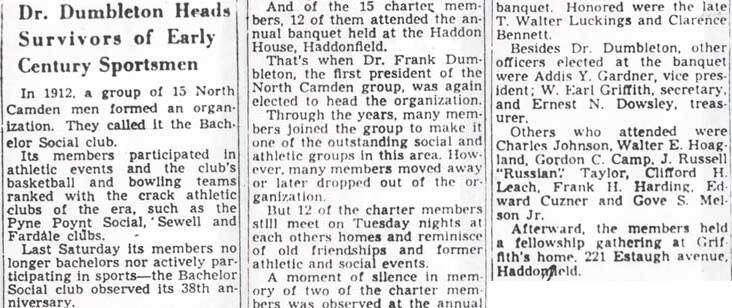
View transcription
Read the article: Dr. Dumbleton Heads Survivors of Early Century Sportsmen
Pyne Poynt Officers on Committee To Aid Moose Minstrel Show Plans
Camden Courier-Post, April 15, 1950
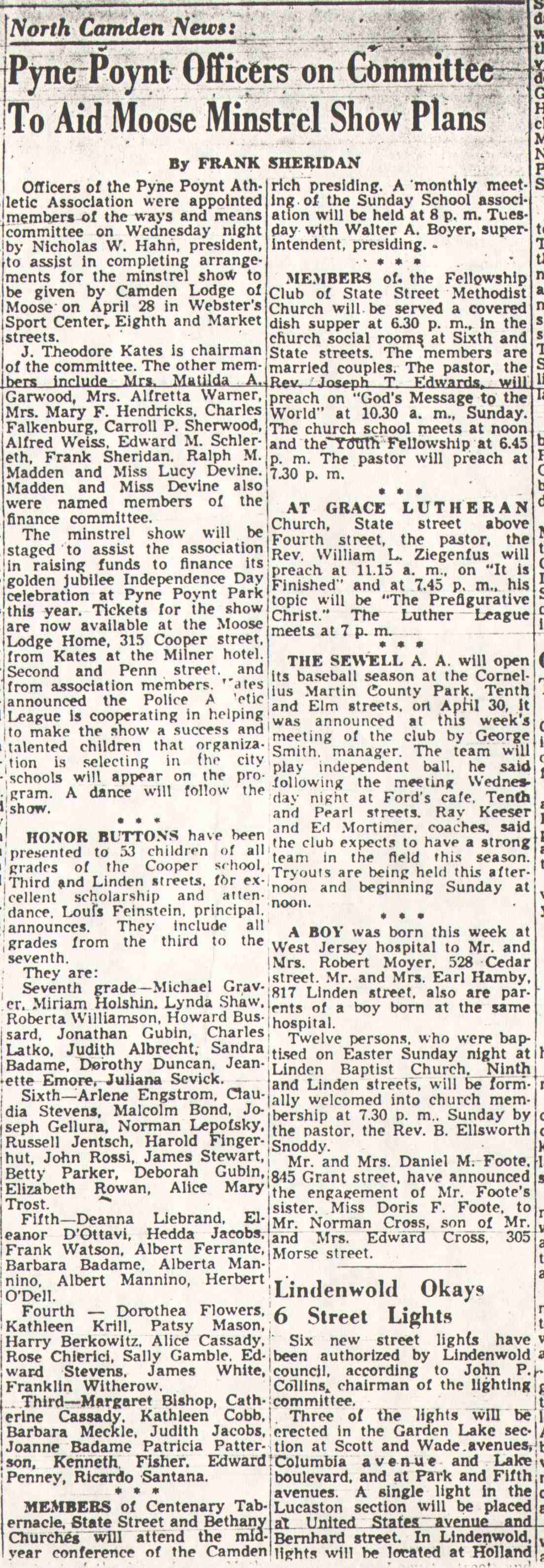
View transcription
Read the article: Pyne Poynt Officers on Committee To Aid Moose Minstrel Show Plans
Boy Sees Accident, Asks Traffic Light
Camden Courier-Post - July 8, 1950
By Wilbur Morse Jr.
Boy Sees Accident, Asks Traffic Light
Front and State Streets, North Camden, July 1950 (Camden Courier-Post, July 8, 1950)
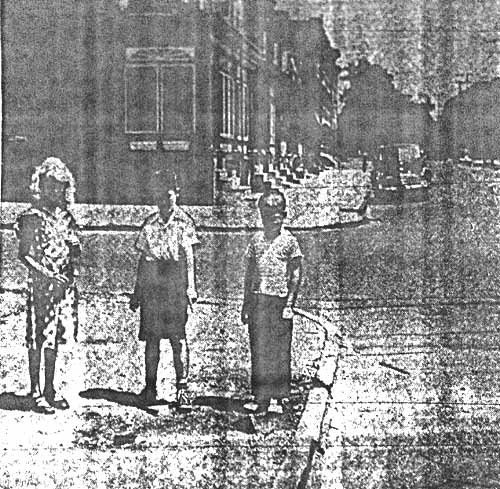
Read the article: Boy Sees Accident, Asks Traffic Light
Workman Injured Seriously in Cave In at Camden Plant
Camden Evening Courier - July 28, 1951
One workman was trapped and seriously injured, while two others scrambled to safety when a seven-foot pipeline trench collapsed Thursday in the yard of the Kind & Knox Gelatine Co., Fifth and Erie Streets.
Lewis Edwards, 45, of 834 North 2nd Street, was buried up to his armpits by tons of earth when the cave in occurred at 3:00 PM. Doctors at Cooper Hospital said he suffered several cracked ribs, shock, and possible internal injuries.
The Fire Department Rescue Squad from Fifth and Arch aided company employees in digging Edwards out after more than ten minutes of partial entombment.
Dr. Thomas B. Downey, vice president of the company, said the accident occurred while a new pipeline in the plant was being laid on the Fifth Street side.
“The side walls undoubtedly were caused to collapse by vibrations set up by several heavy trucks which were using the street at the time,” Dr. Downey said.
The two other workmen in the trench with Edwards were not immediately identified, but both scrambled to safety before the crumbling earth caught them.
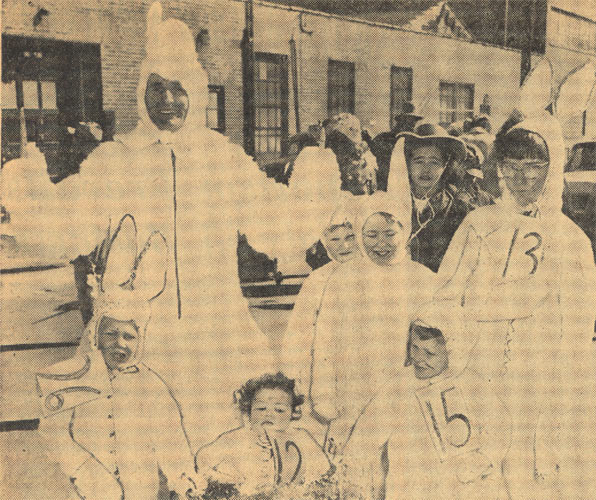
Throngs See Gala Parade In N. Camden
Camden Courier-Post, March 23, 1959
View transcription
Camden Courier-Post, March 23, 1959

View transcription
Camden Courier-Post, March 23, 1959
View transcription
Camden Courier-Post, March 23, 1959
View transcription
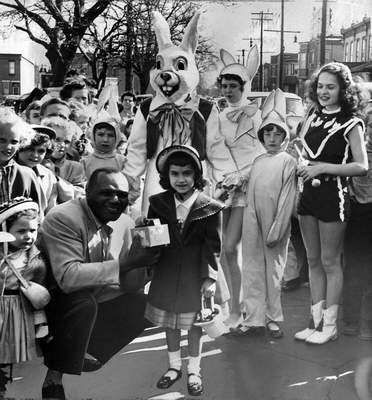
Easter Bunny and Jersey Joe Walcott at North Camden Easter Parade
Mr. and Mrs. Easter Bunny (rear), portrayed by Mary Topolewski and Edward Wicker, look on as Jersey Joe Walcott presents a prize to Sylvia Riley, 8, of National Park, for an egg hunt which climaxed the third annual North Camden Easter parade.
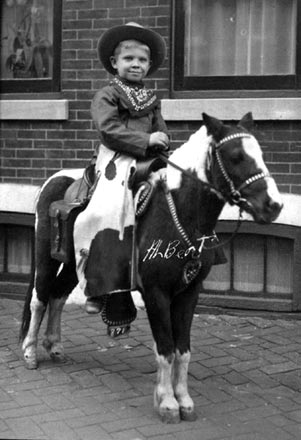
Albert Bass on a Shetland Pony — State Street, 1950s
Albert Bass on a Shetland Pony, State Street, 1950s. Picture and notes courtesy of Earl and Janet Crim.
View transcription
Albert Bass on a Shetland Pony, State Street, 1950s. Oscar M. & Dorothy Bass lived in North Camden, at 715 North 10th Street in the late 1940s and at 615 North 6th Street by the fall of 1956. Young Albert on the pony was later known as Big Al. The other children were Clara, Dottie, Junior (Oscar Jr.), Gus, and Roy. Picture and notes courtesy of Earl & Janet Crim.
North Camden Factories
Surrounded on three sides by water, North Camden was destined to become an industrial neighborhood at the beginning of the Industrial Revolution. By 1920 North Camden was fully built up, and between factories, residences, shops, and public buildings, just about the only piece of open ground was Pyne Point Park!
| C. Howard Hunt Pen Co. | Knox Gelatine / Protein Products Company | Highland Worsted Mills |
| Haddon Bindery | RTC Shipyard | U.S. Cocoa |
| R.M. Hollingshead Corporation | John R. Evans & Company — Leather Factory | U.S. Gasket Company / Garlock Industries |
| American Dredging Company (Weeks Marine Dredging) | John H. Mathis Company — Shipyard | Flexitallic Gasket Company |
Growing Up in Camden
By William C. Thompson
I grew up in Camden, and when I am at our Camden campus, the memories of a childhood in the city come streaming back.
I loved those Campbell Soup tomato trucks — the smells, the sounds, the sights, even the taste, when some baskets “fell” off the trucks. We carried salt shakers for just such occasions. Every city block was exciting. We had the truck from New York delivering exotic vegetables to the Chinese family who ran the dry cleaners, and the savory smell of salmon cooking in Mr. Molotsky’s grocery store.
When I was very young, I would wait for my grandfather after he left work at the Hollingshead factory, and we would go to Nittenger’s Tavern. His drink of choice was Camden Beer, and for me, they made great sandwiches.
There were wonderful hot summer nights with families telling stories and kids hearing what we weren’t supposed to, like what Mr. Unruh did in the barbershop where my uncle took my cousins. The cousins were supposed to have been there that day — “might’ve been killed,” we heard.
I could leisurely ride my bike around the bridge plaza, and wait for my mom to come home from work at the Walt Whitman Hotel. I loved that hotel. For my 10th birthday, she arranged for me to be a guest. The elevator operator called me “Sir.” I had my own room key. There was a TV and they delivered my lunch.
My formal education began at all-boys Sewell School, which was across the street from all-girls Northeast. Having us separated gave me a reason to look forward to attending the new coed Pyne Point Junior High. When I got there, besides girls, we had a new school that looked just like one on TV, and movie-like “rumbles” combining south and north Camden turf.
Pyne Point Park also had a factory that made gelatin out of bones, which was creepy and mysterious. Close by was Petty’s Island with rumored hidden pirate treasure.
Downtown we had elegant J.C. Penney’s and the less chic Woolworth’s, where my aunt sold candy, with the best counter lunch. For fun, I could run to the top of the “milk bottle building” (City Hall), ride the Lit Bros. store escalators, or run across the bridge toll plaza. We had the Savar or Stanley movie theaters for wide-screen popcorn spectaculars and the Midway for all the horror we could handle.
There were pep rallies for the vaunted Wilson High/Camden High Thanksgiving football rivalry. If I rode my bike to East Camden, I found a TV world of white-steepled churches, lawns with roses surrounded by glistening white conch shells, and plastic lawn decorations.
My Camden was magical, and I loved it. I am proud I was born there. It captivated me in my youth and it is those memories that have pulled me back.
Why is Camden invincible? Because each new generation redefines it and creates its own memories. Working now at the college, where the Walt Whitman Hotel once stood, I am excited to again be part of the city that gave so many so much and now is poised to give great memories to another generation.
William C. Thompson is a vice president at Camden County College.
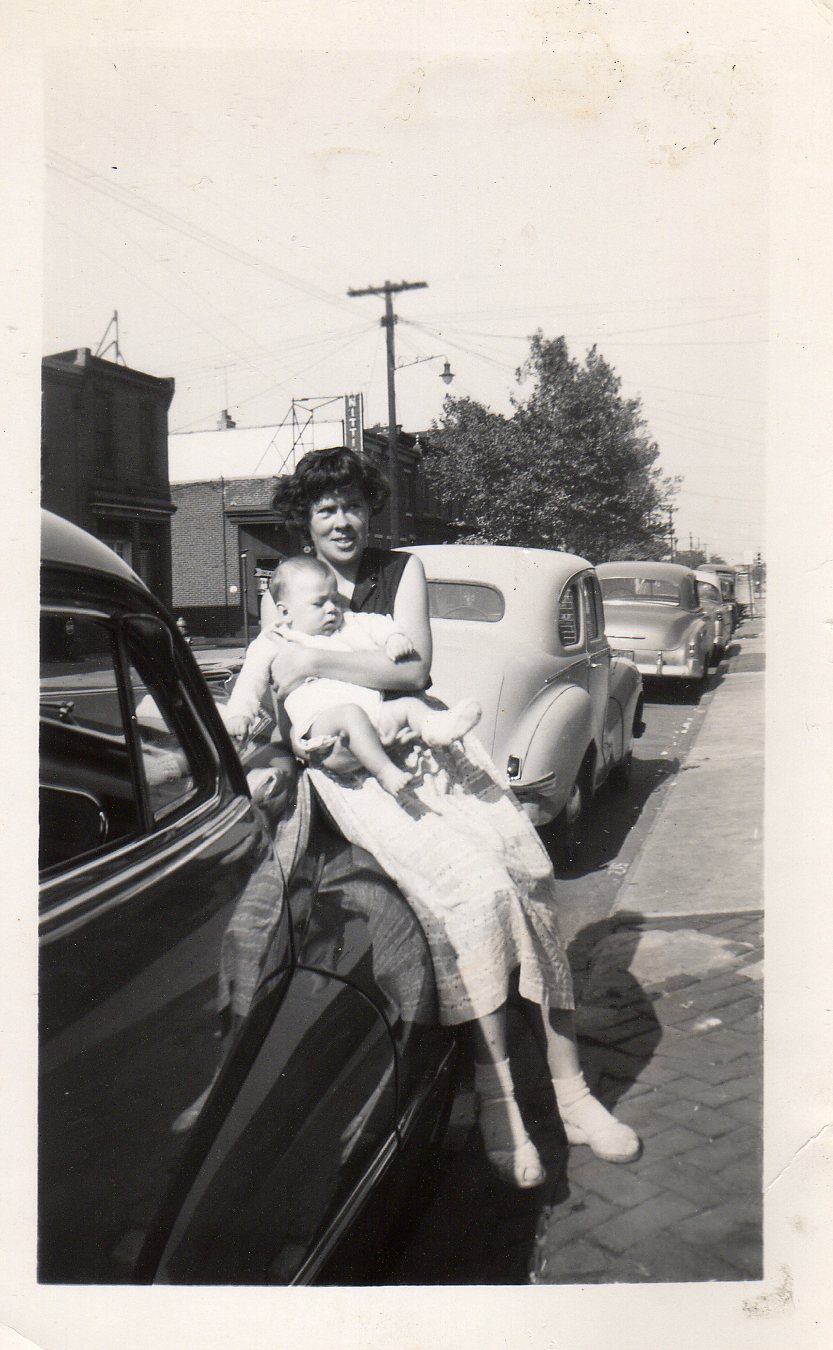
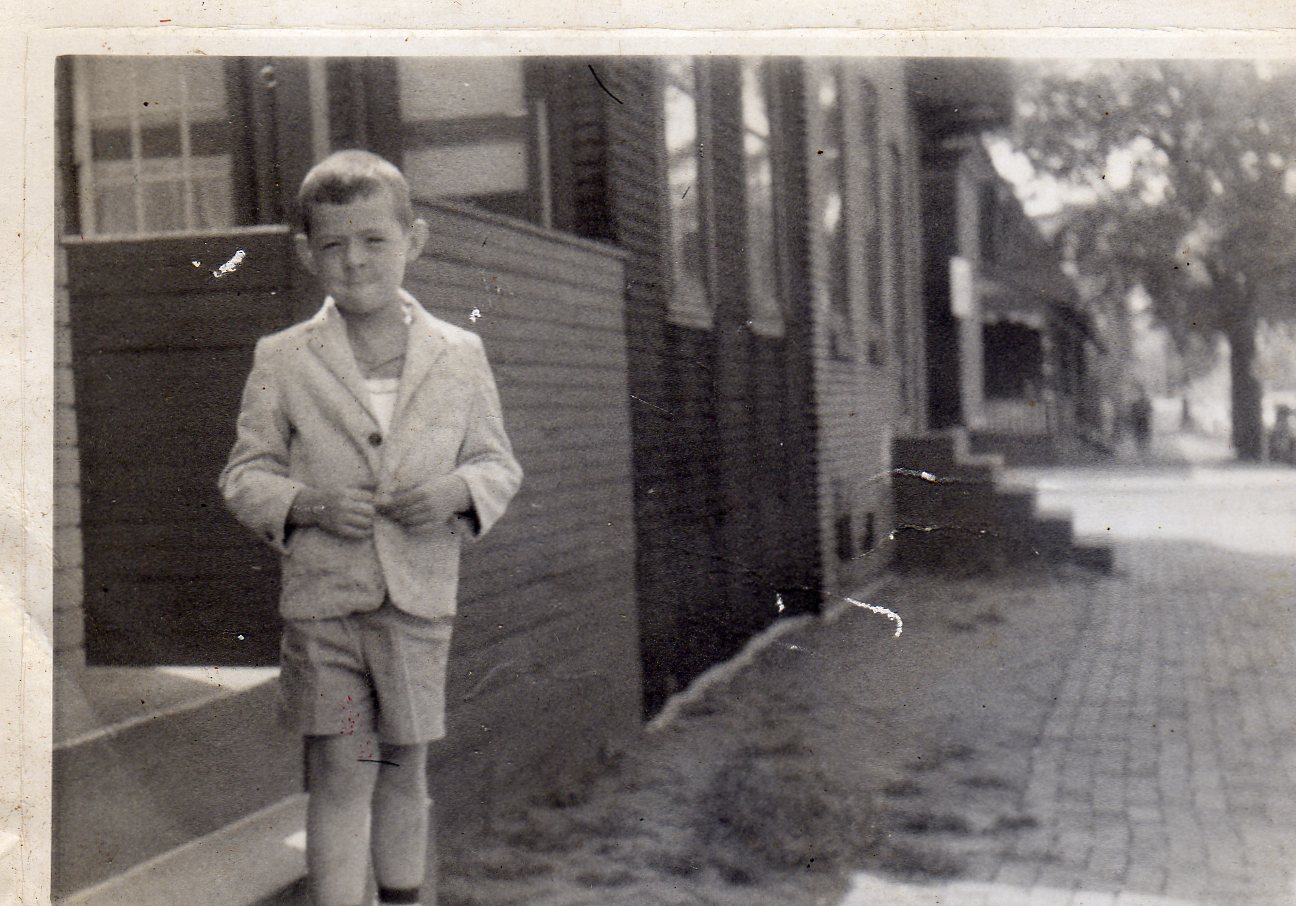
Life in North Camden: The Raymond & Mary Becoskie Family
Ray & Mary Becoskie at Christmas, 1960.
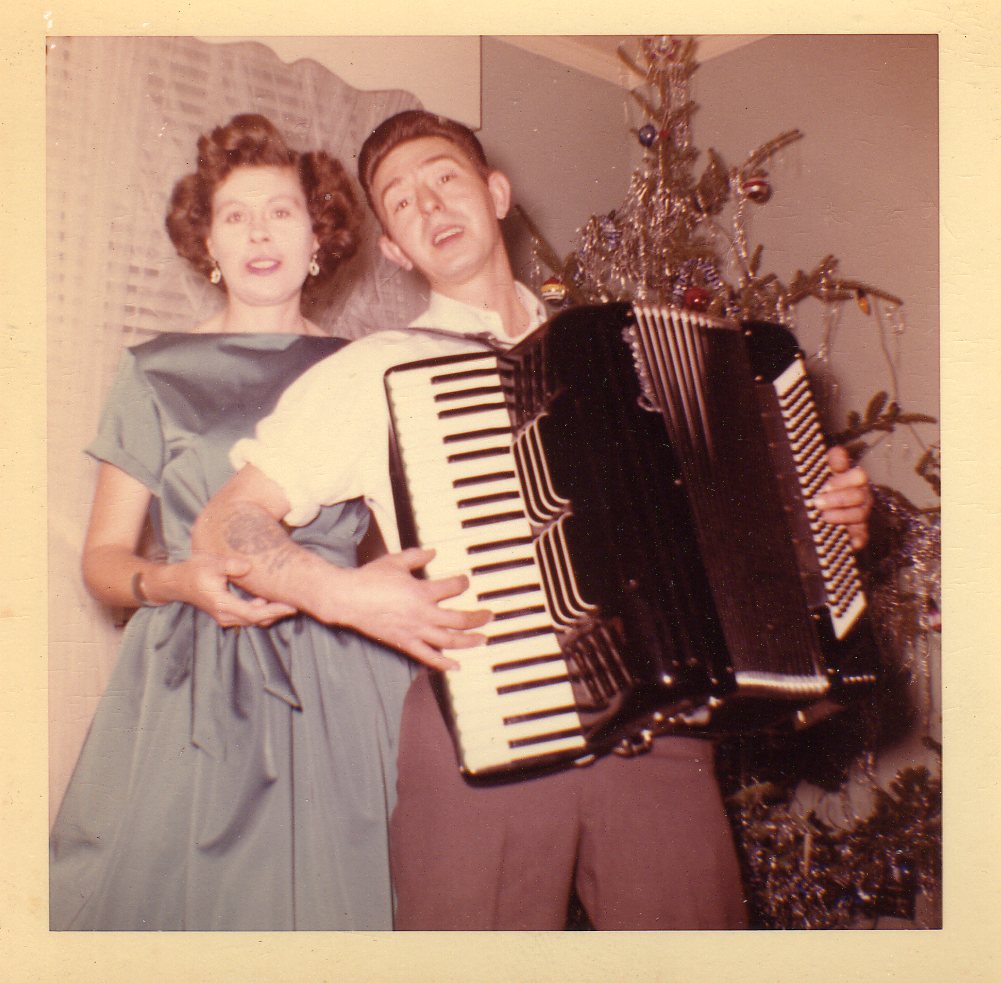
Mary Becoskie with children Raymond, Michael J. and Linda C.
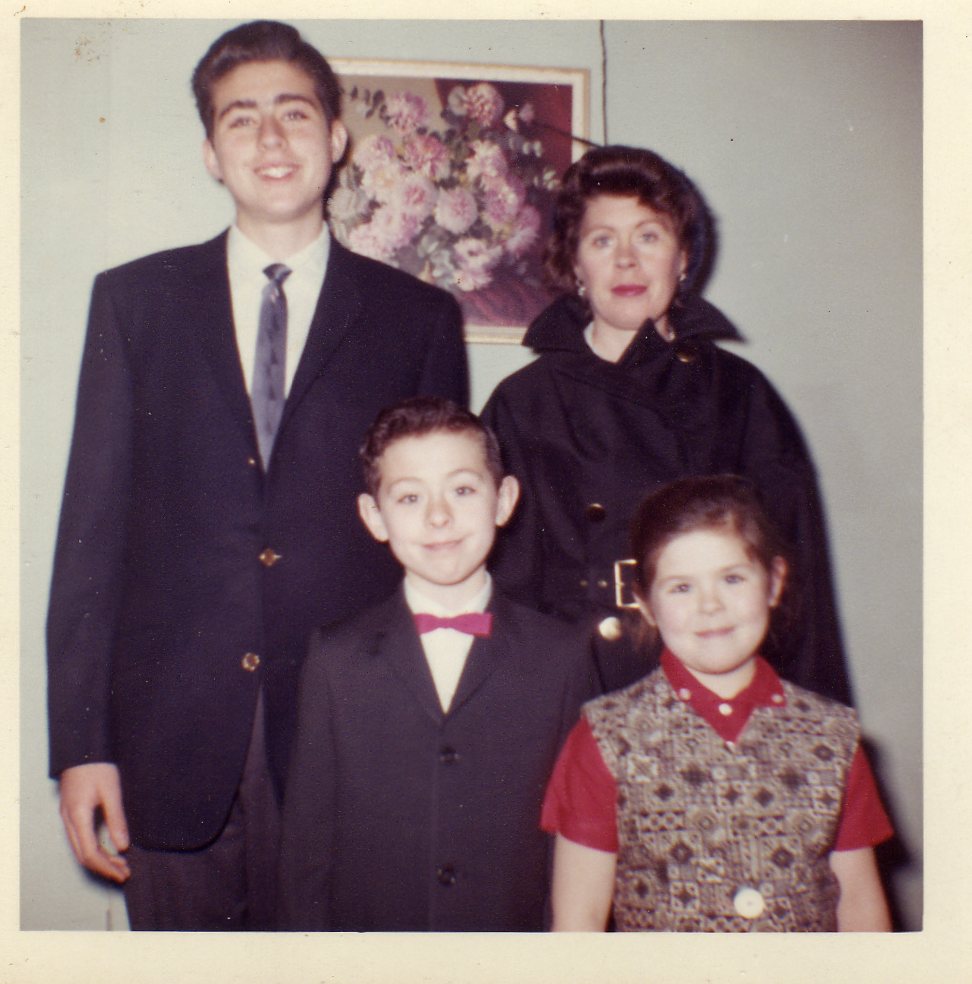
Raymond & Michael Becoskie with The Great Garloo Christmas toy.
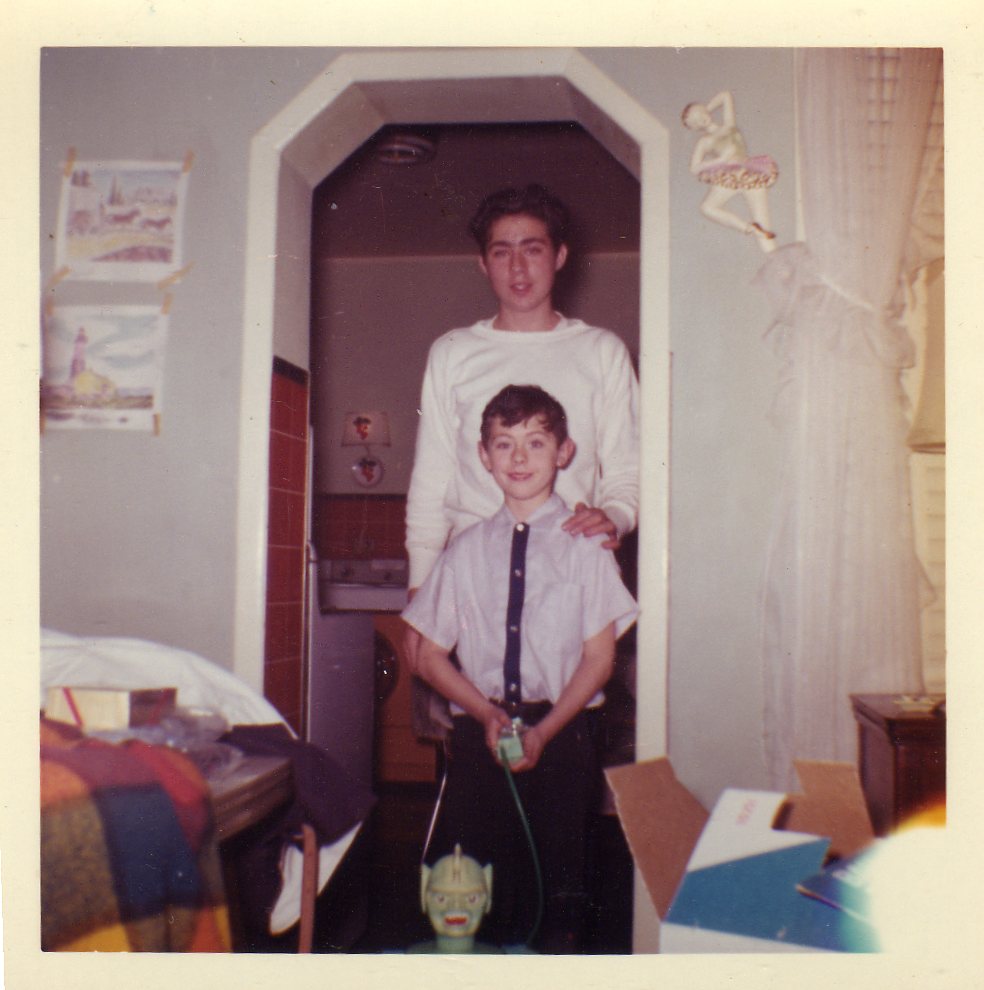
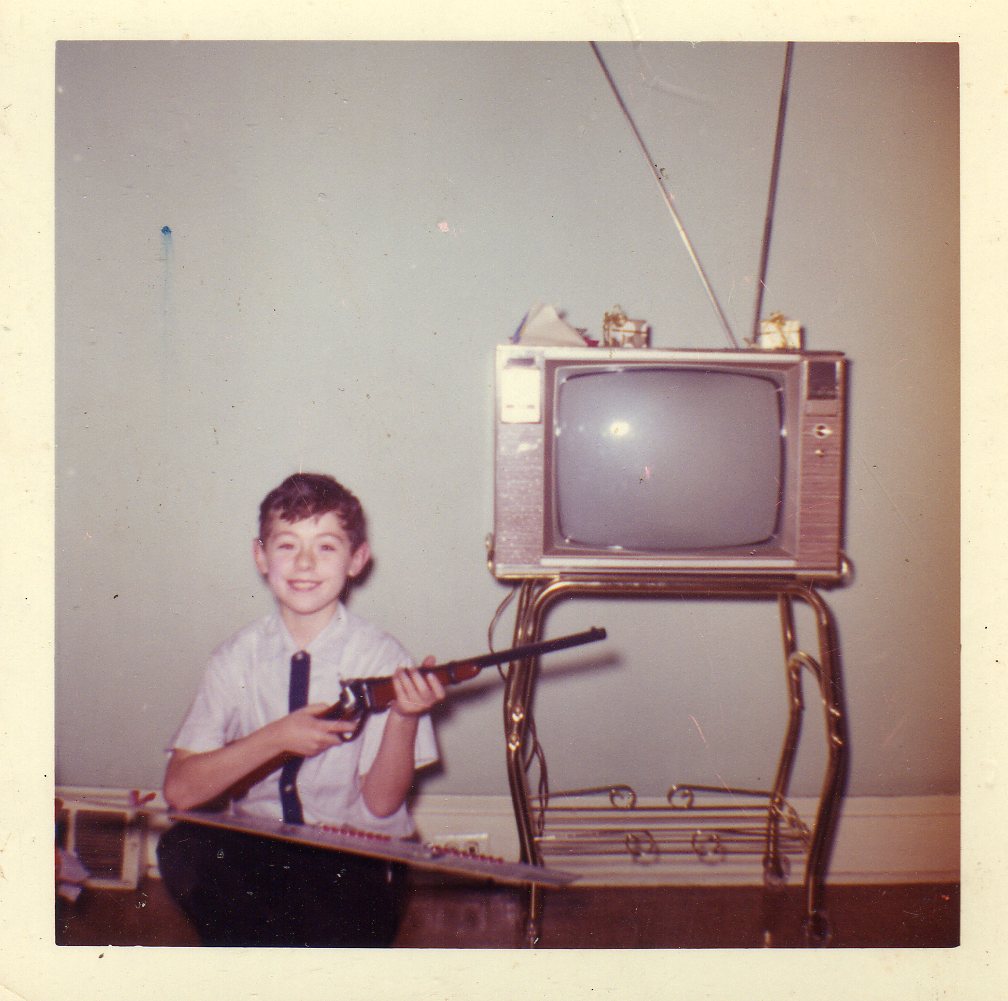
Michael Becoskie with Christmas air rifle in dining room.
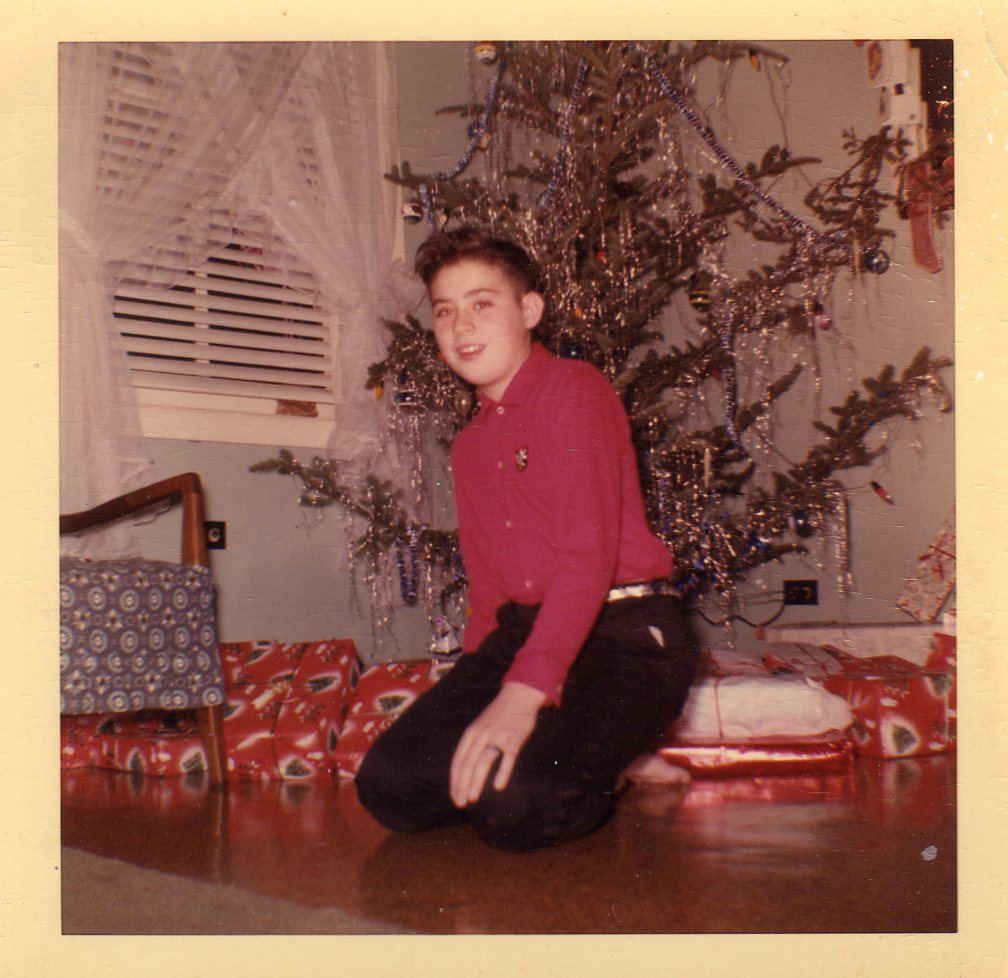
Raymond Becoskie next to Christmas tree from Litwin Brothers market.
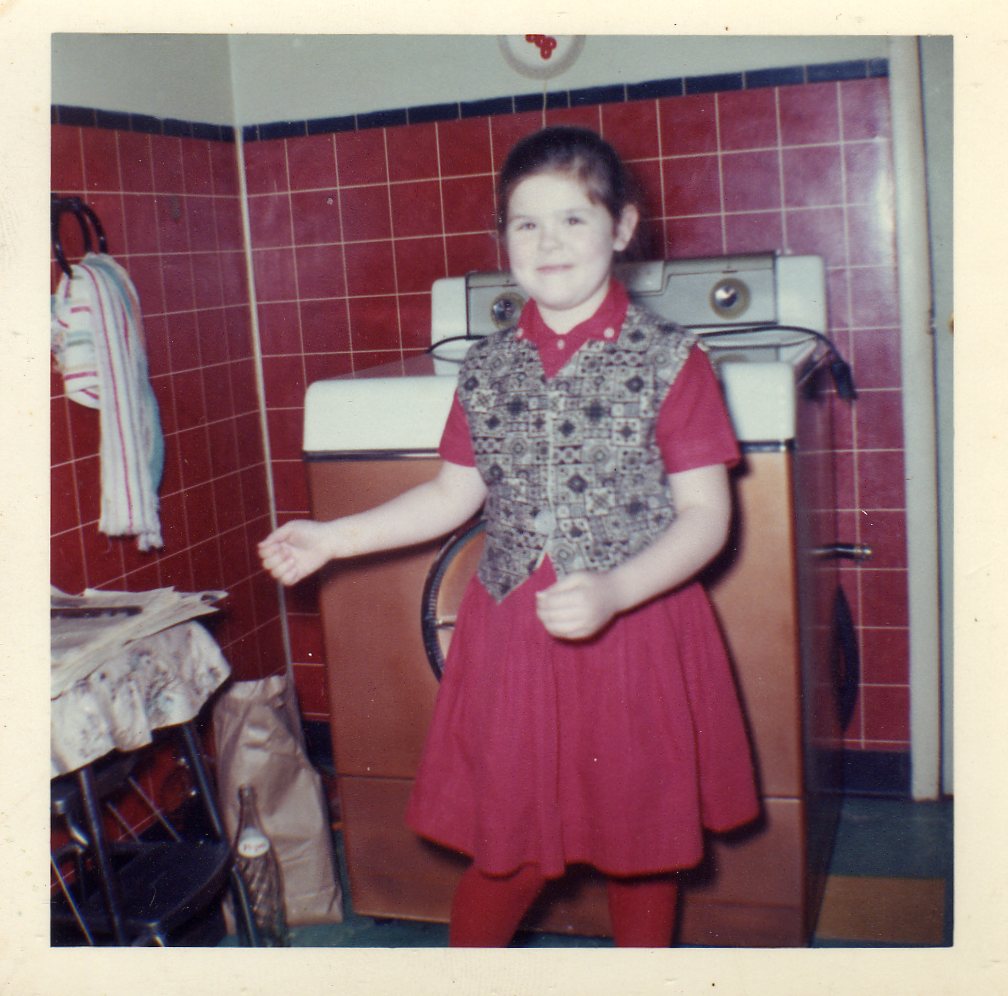
Linda Becoskie in front of new washing machine.
Michael Becoskie in the heart of the house.
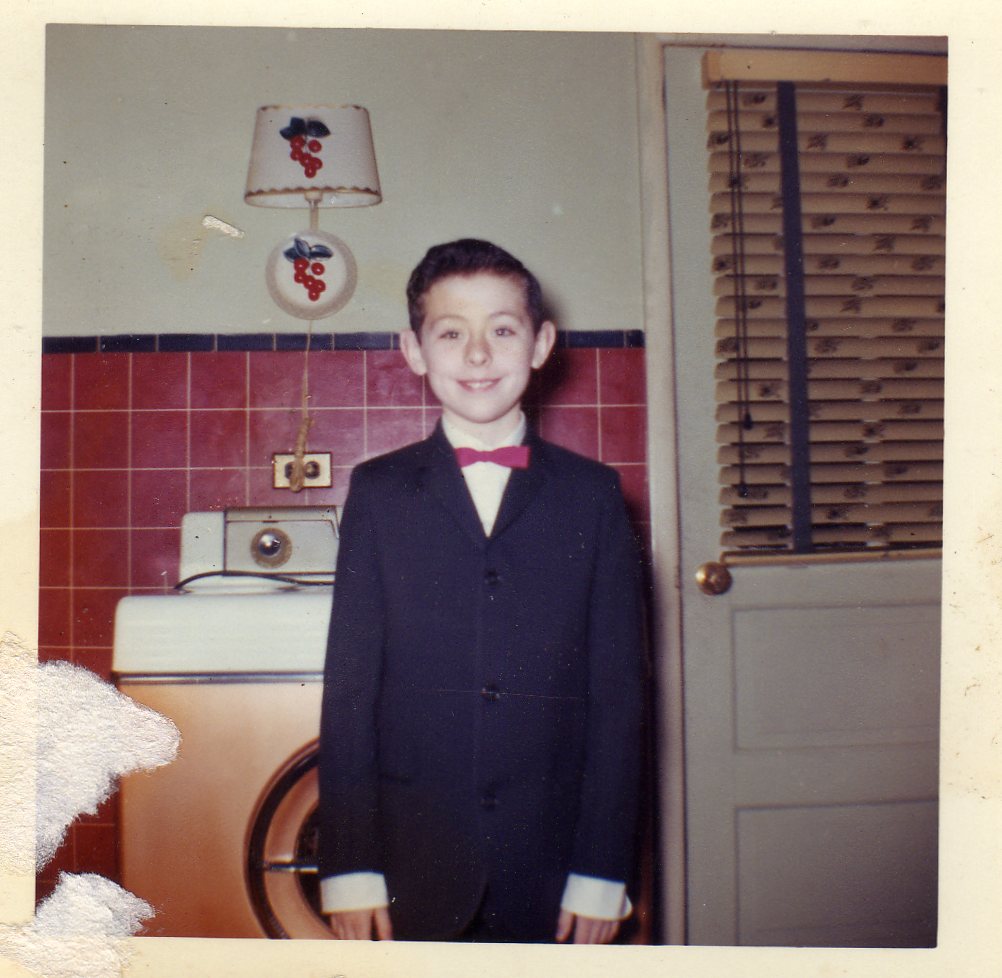
Michael Becoskie with his Alpha-Bits.
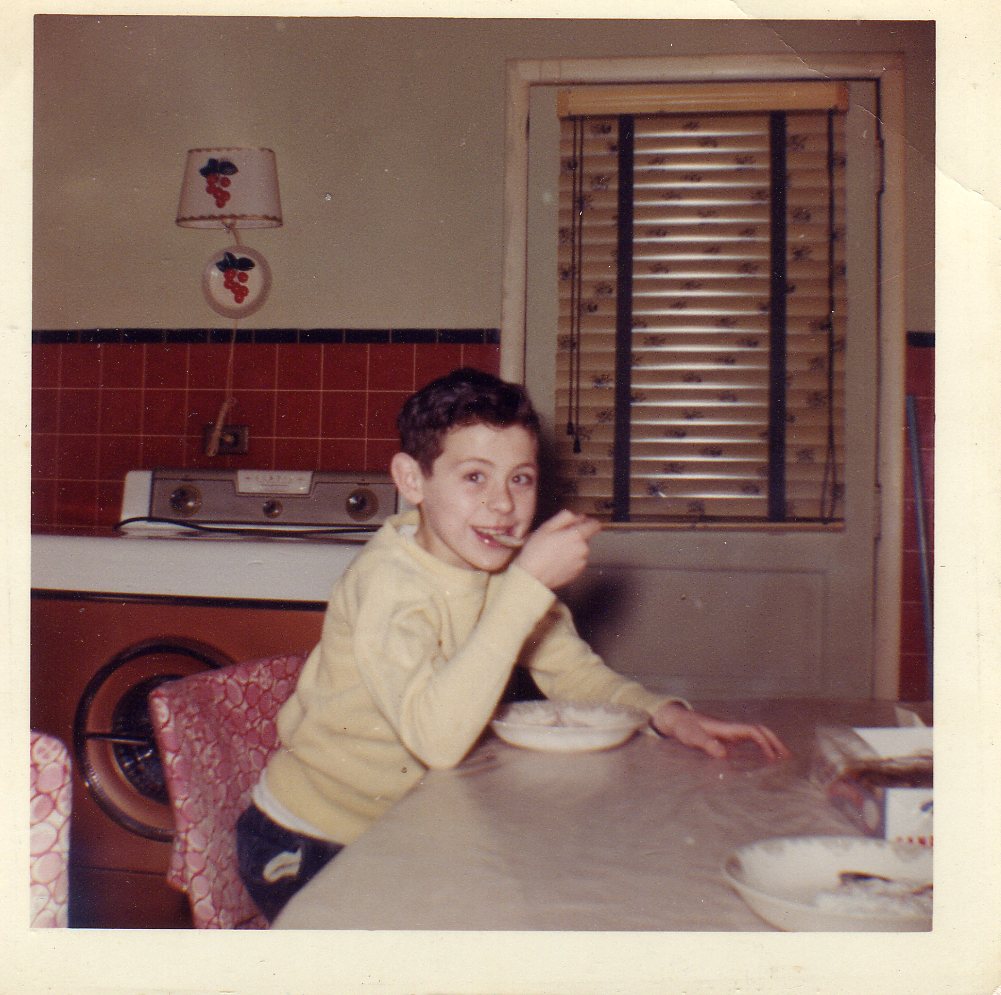
Raymond Becoskie in living room.
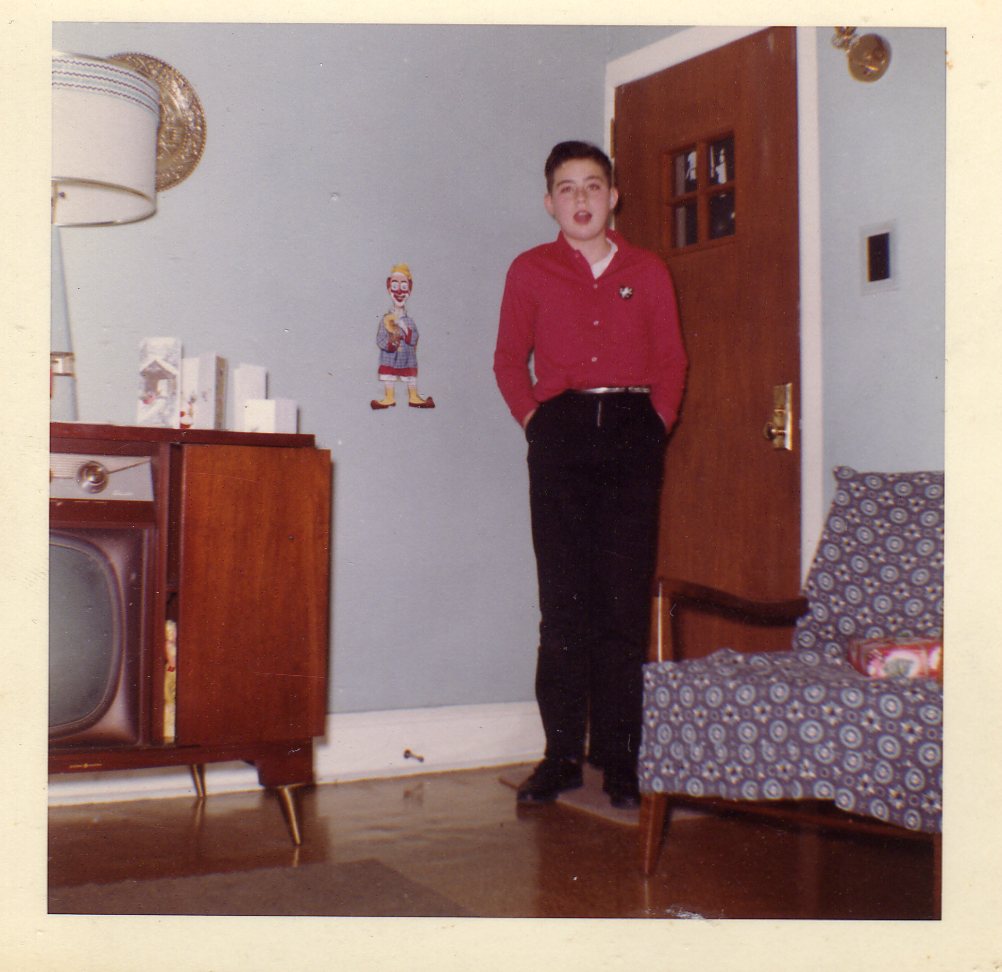
Ray Becoskie and son Michael.
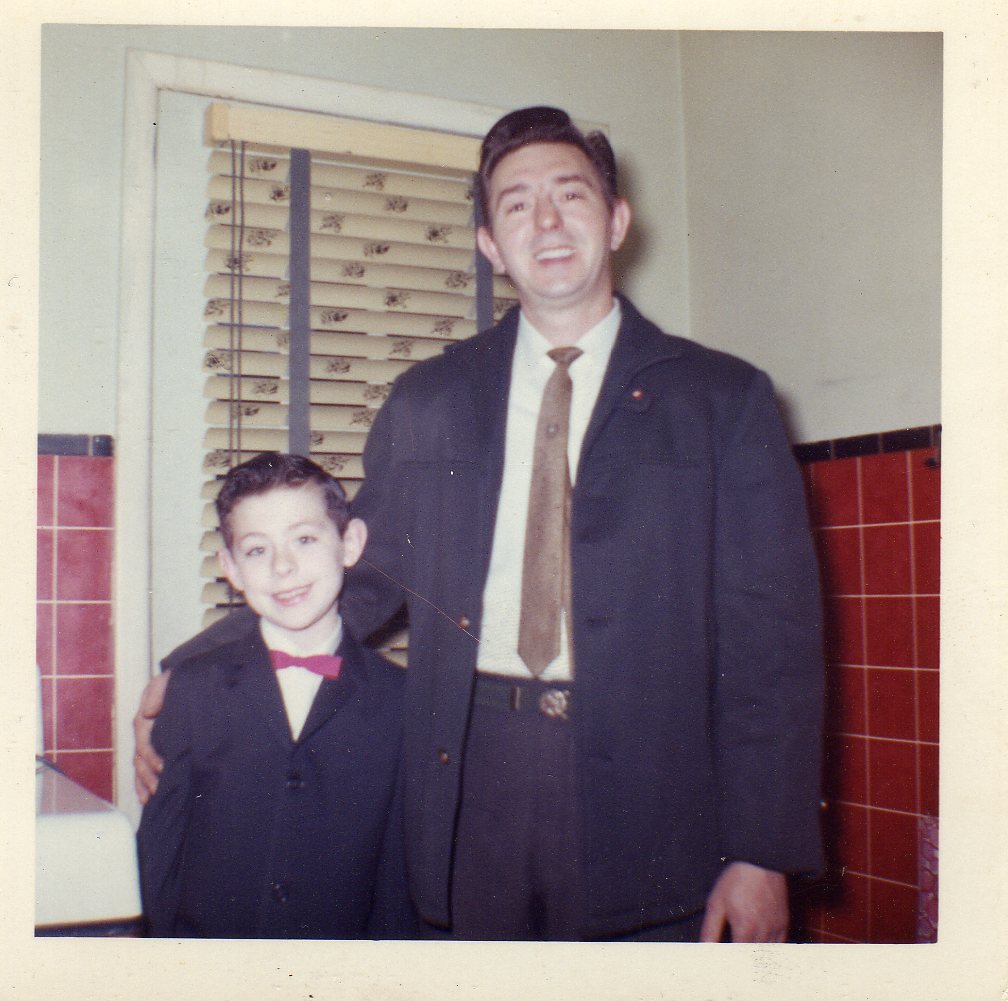
Ray & Mary Becoskie at Christmas, 1959.
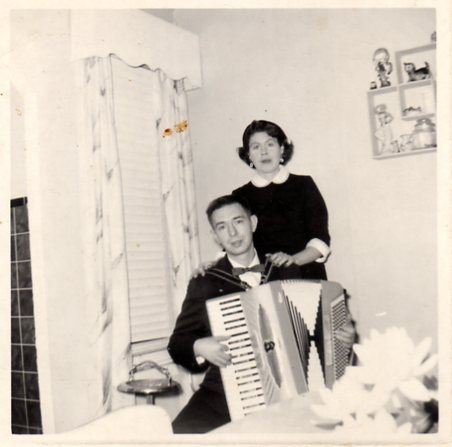
Michael & Raymond H. Becoskie.
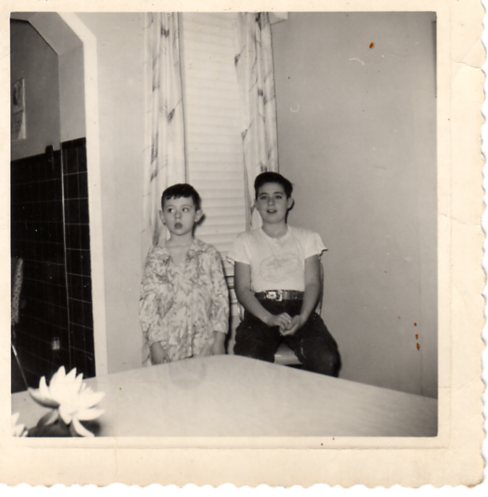
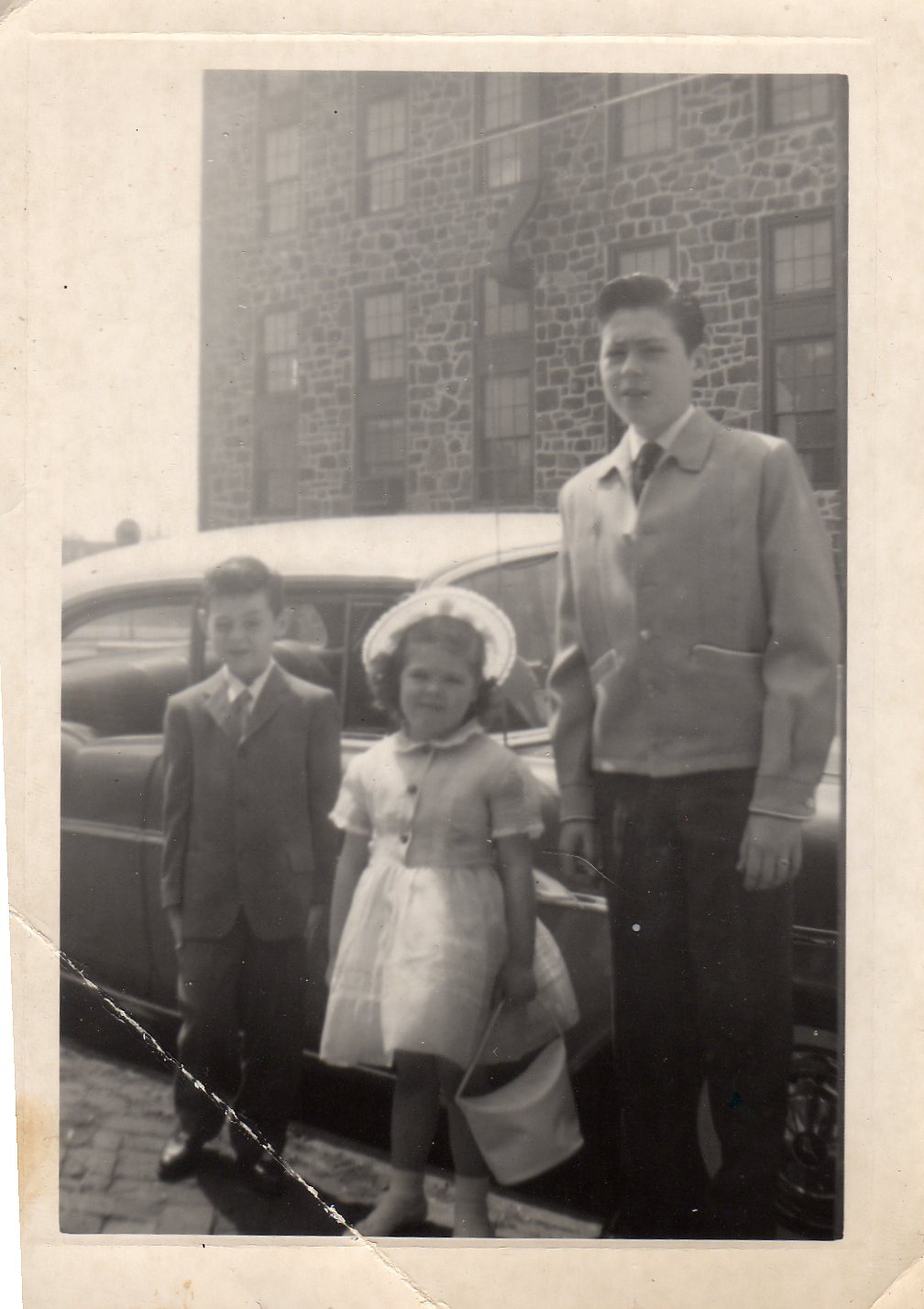
First new car for the Becoskie family, on North 7th Street near the corner of Birch Street.
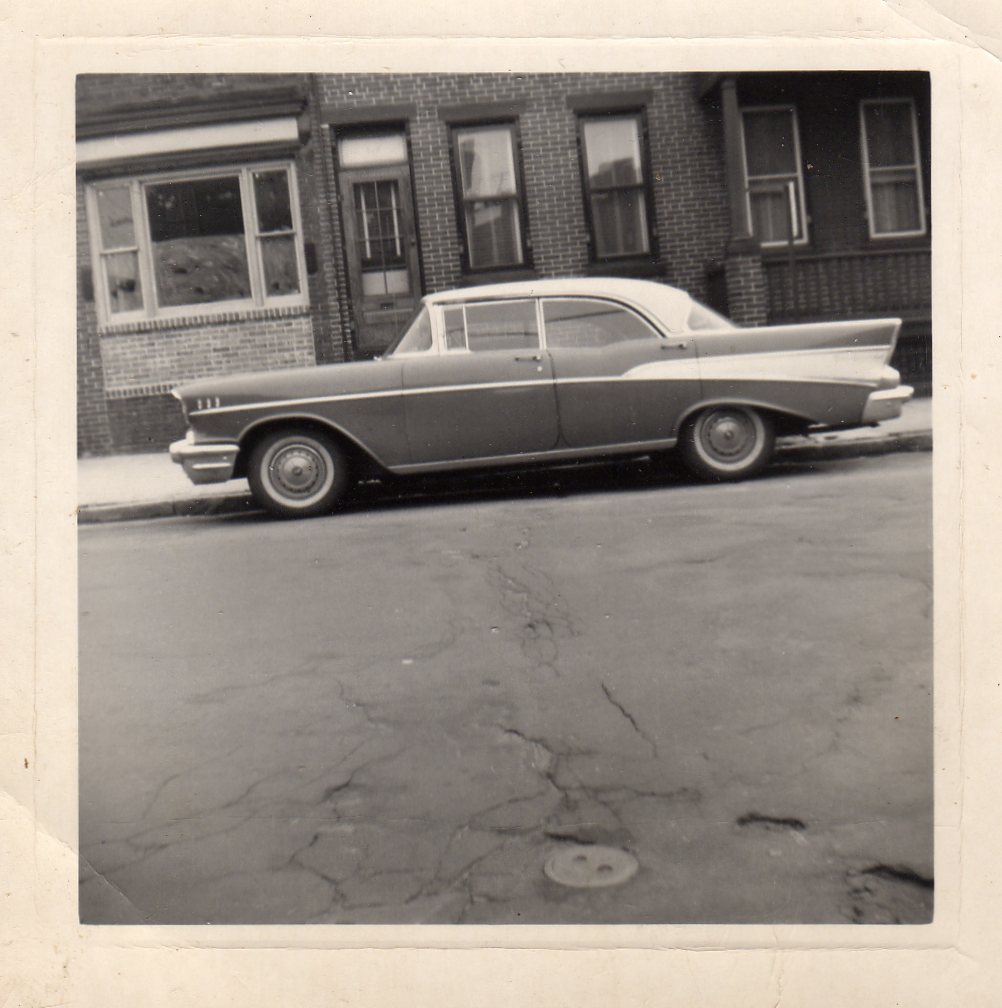
From left: Linda, Michael, Mary, and Raymond Becoskie in backyard of 510 North 7th Street.
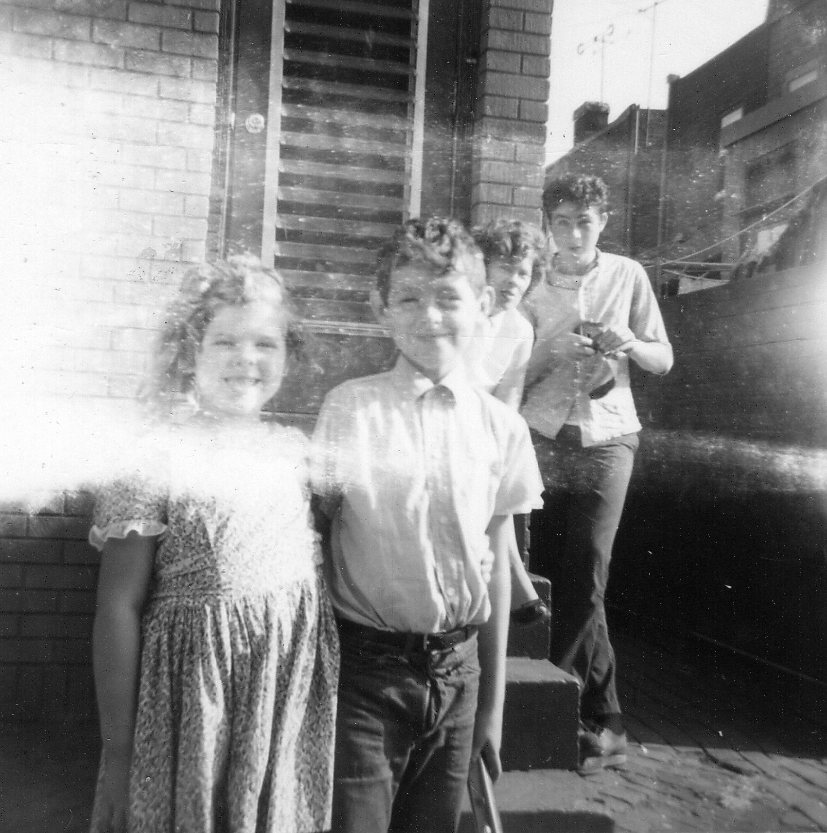
Raymond H., Michael, & Linda Becoskie. In the background, the George C. Ellis box factory.
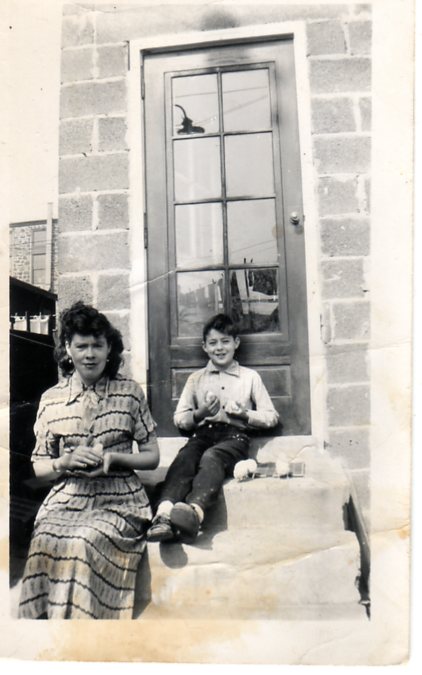
Mary and Raymond Becoskie in backyard of 510 North 7th Street with Easter chicks.
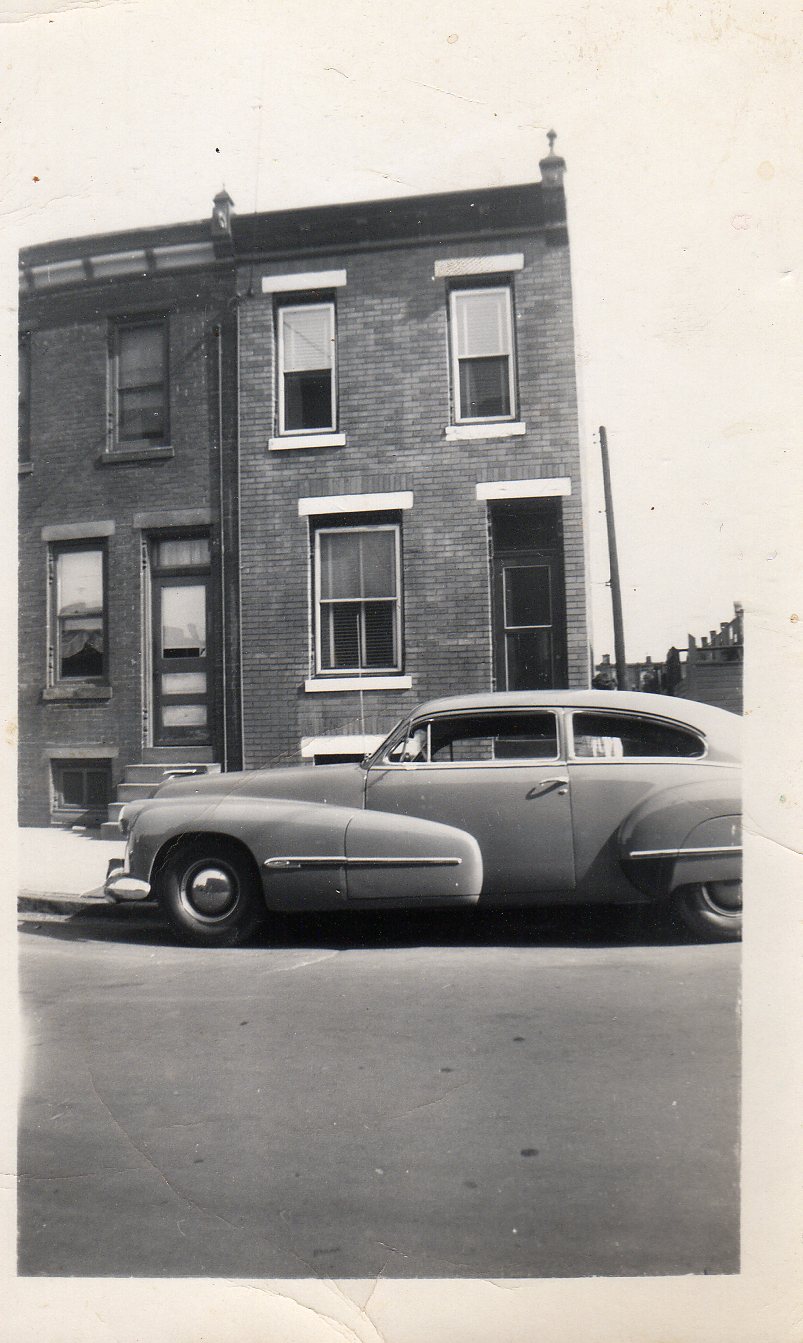
Becoskies' 1948 Oldsmobile in front of house.
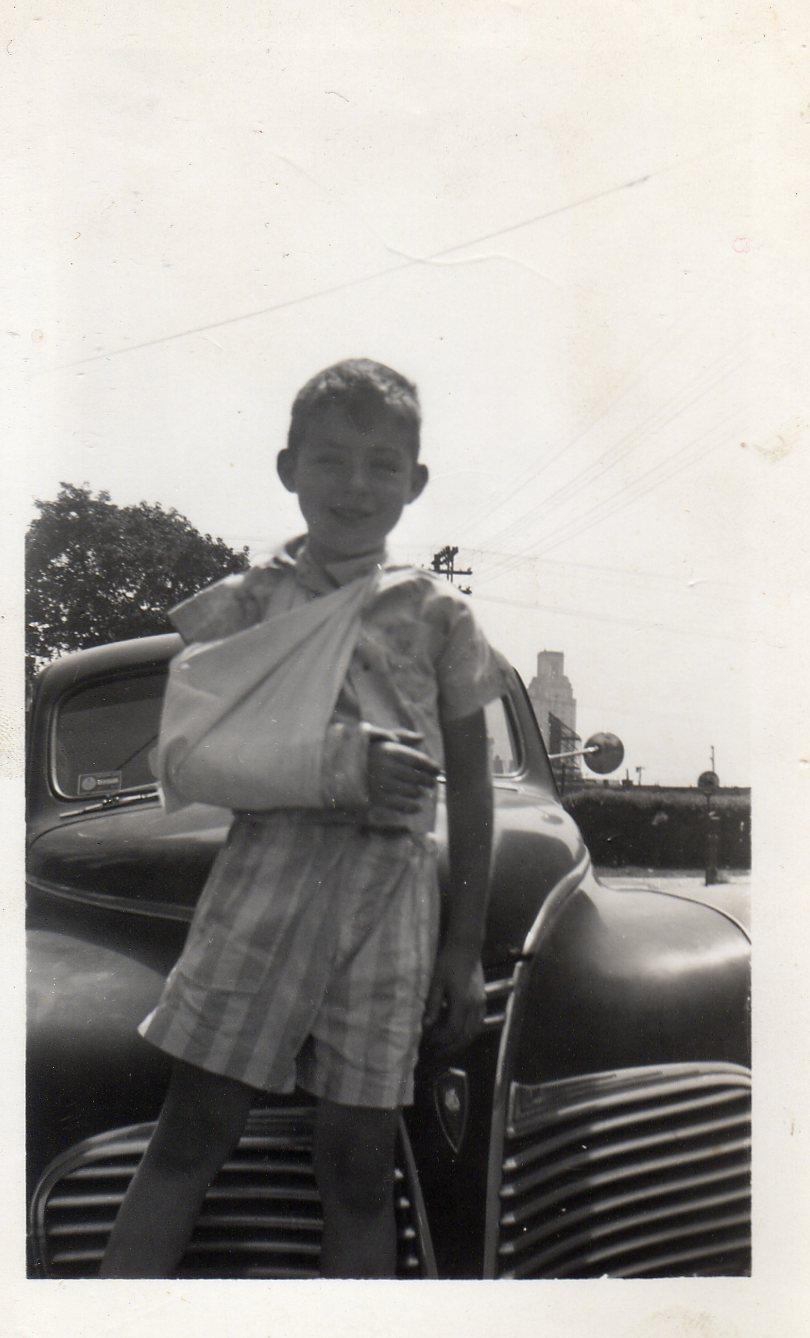
Michael Becoskie with City Hall in the background. Woodlynne Bus Stop and Fire Alarm Box at lower right.
Michael Becoskie in the backyard of 510 North 7th Street. At southwest, the rear of Buckley's barbershop.
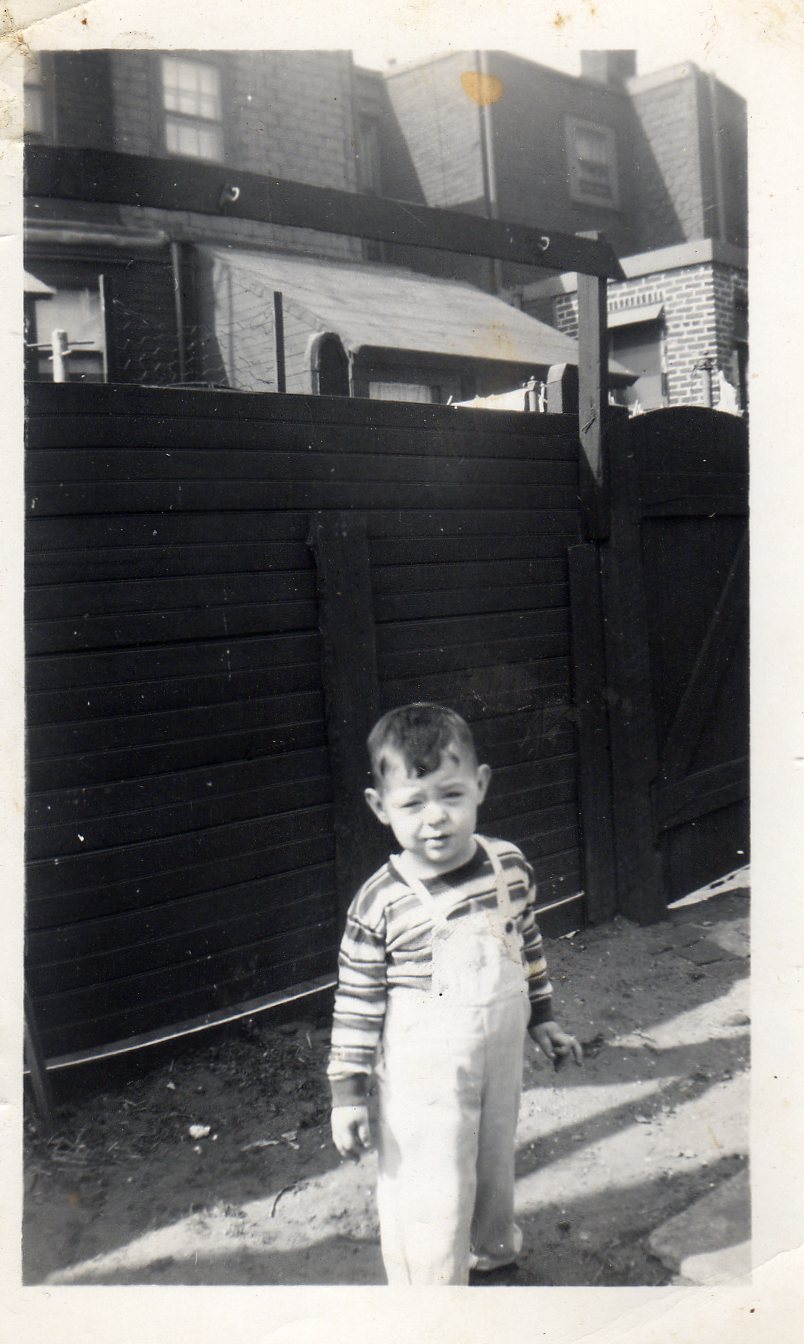
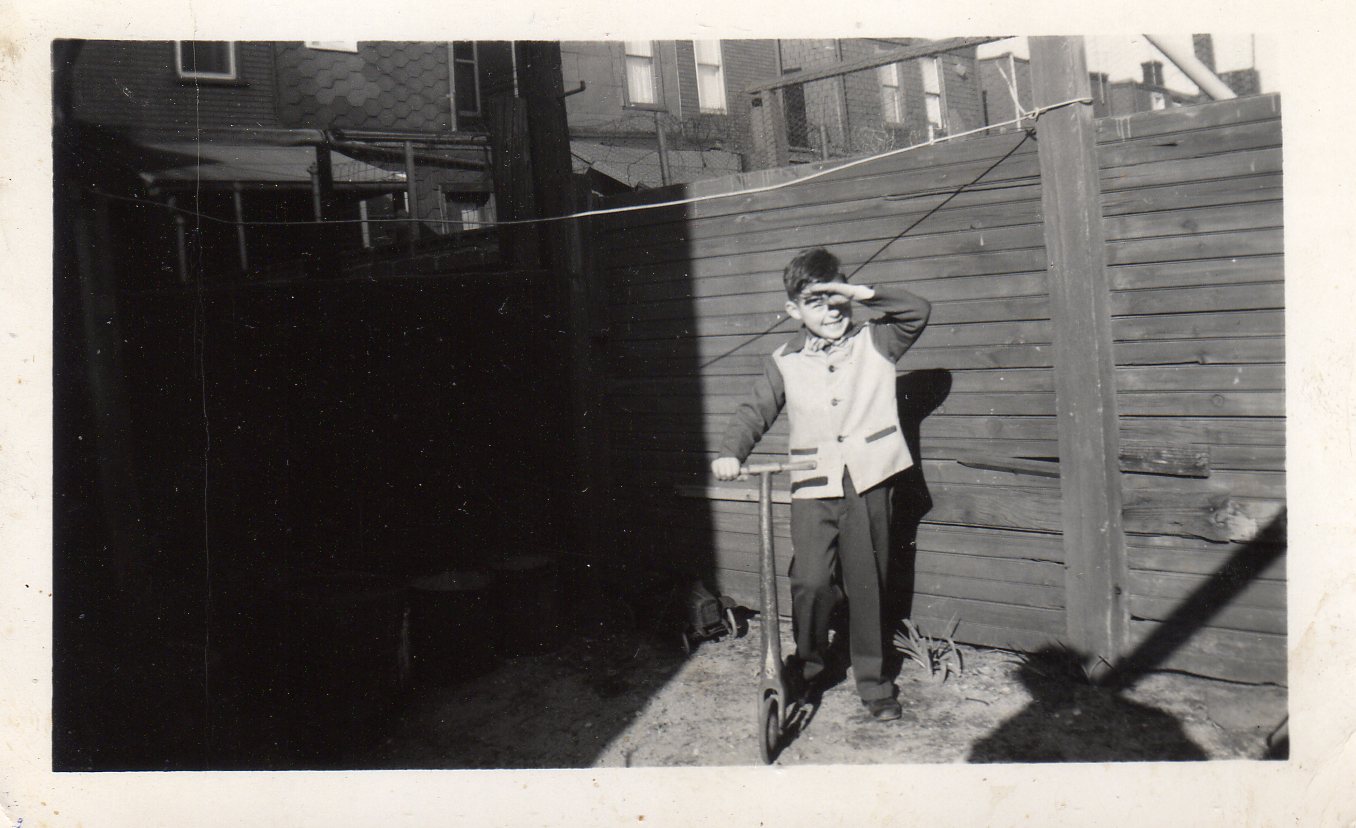
Ray Becoskie with new daughter Linda.
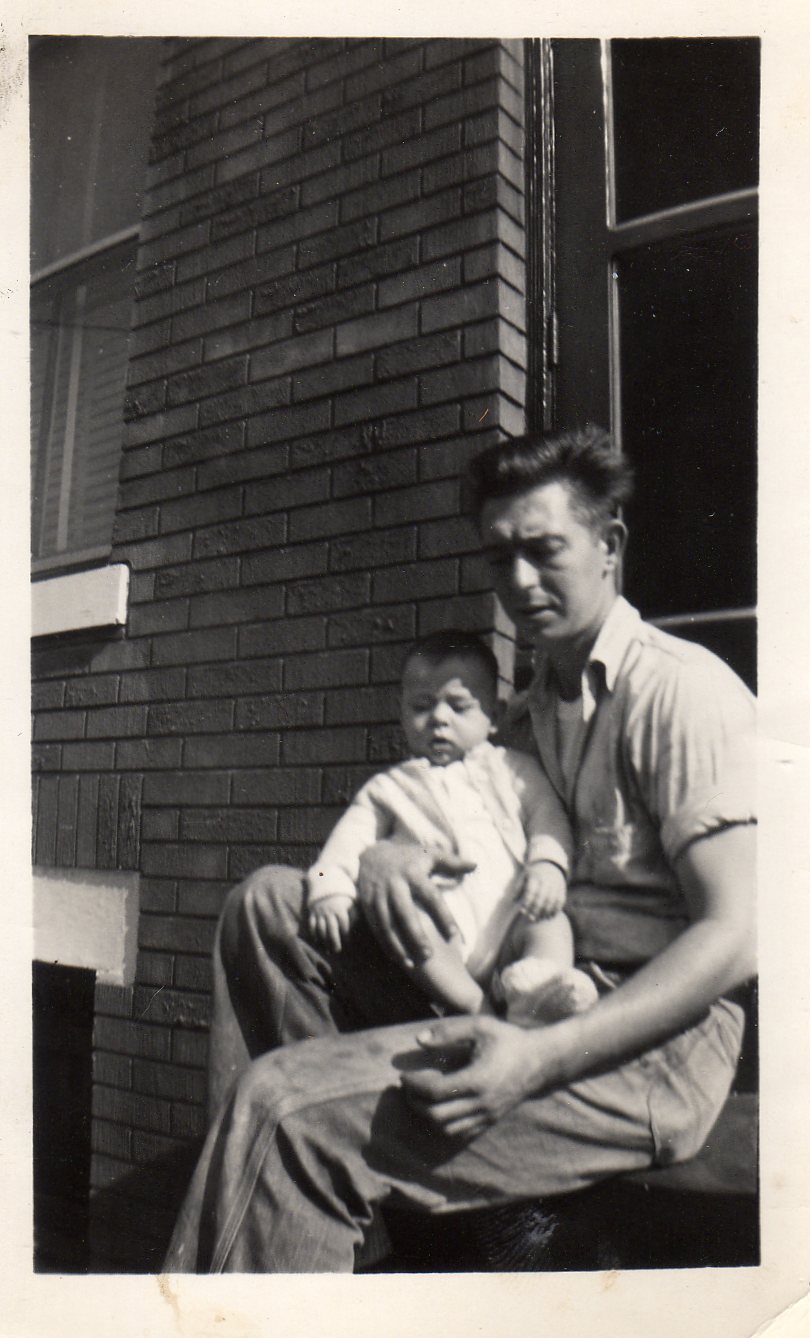
Michael Becoskie. To the northeast, back of Birch Street houses.
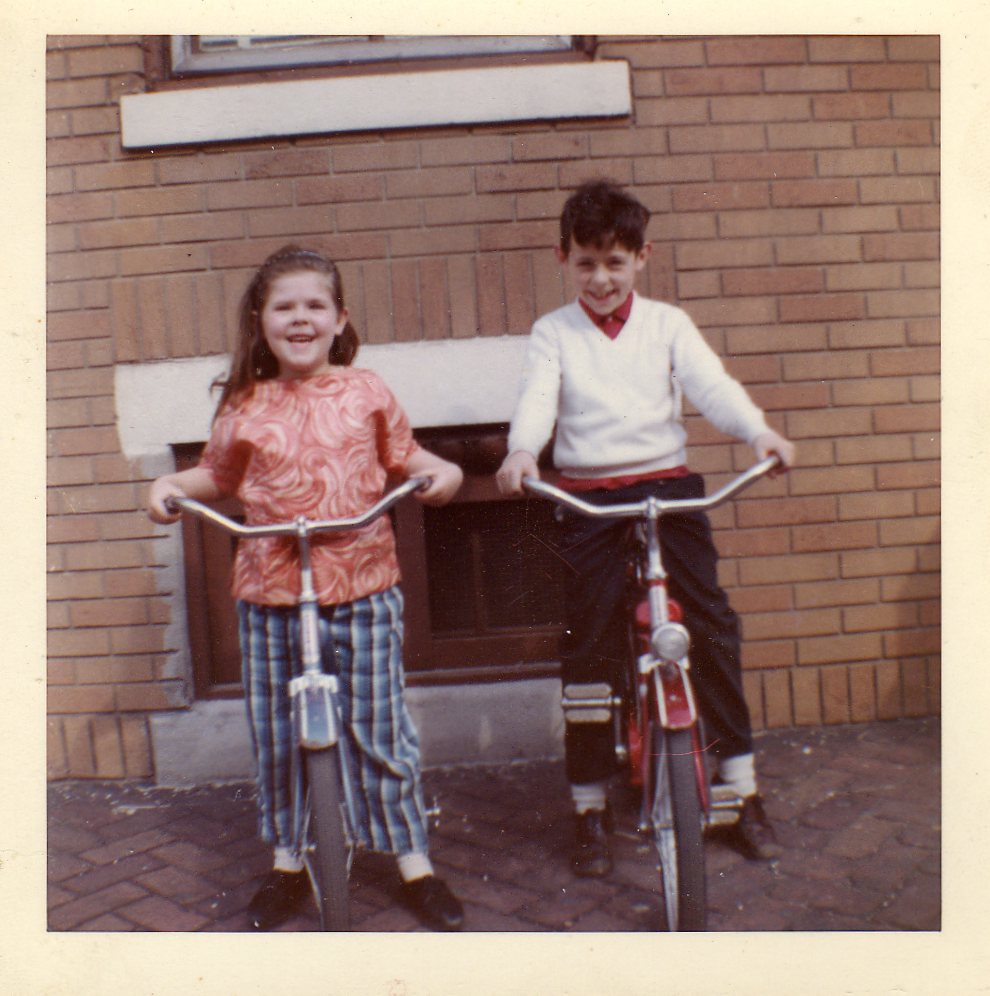
Linda & Michael Becoskie on Christmas bicycles, 1961.
Mary and Michael Becoskie, 1950s. Looking north on North 7th Street, from in front of 510. Nittinger's Tavern is in background.
View transcription
Michael Becoskie. Looking south, Buckley's/Sampona's Barber Shop and House.
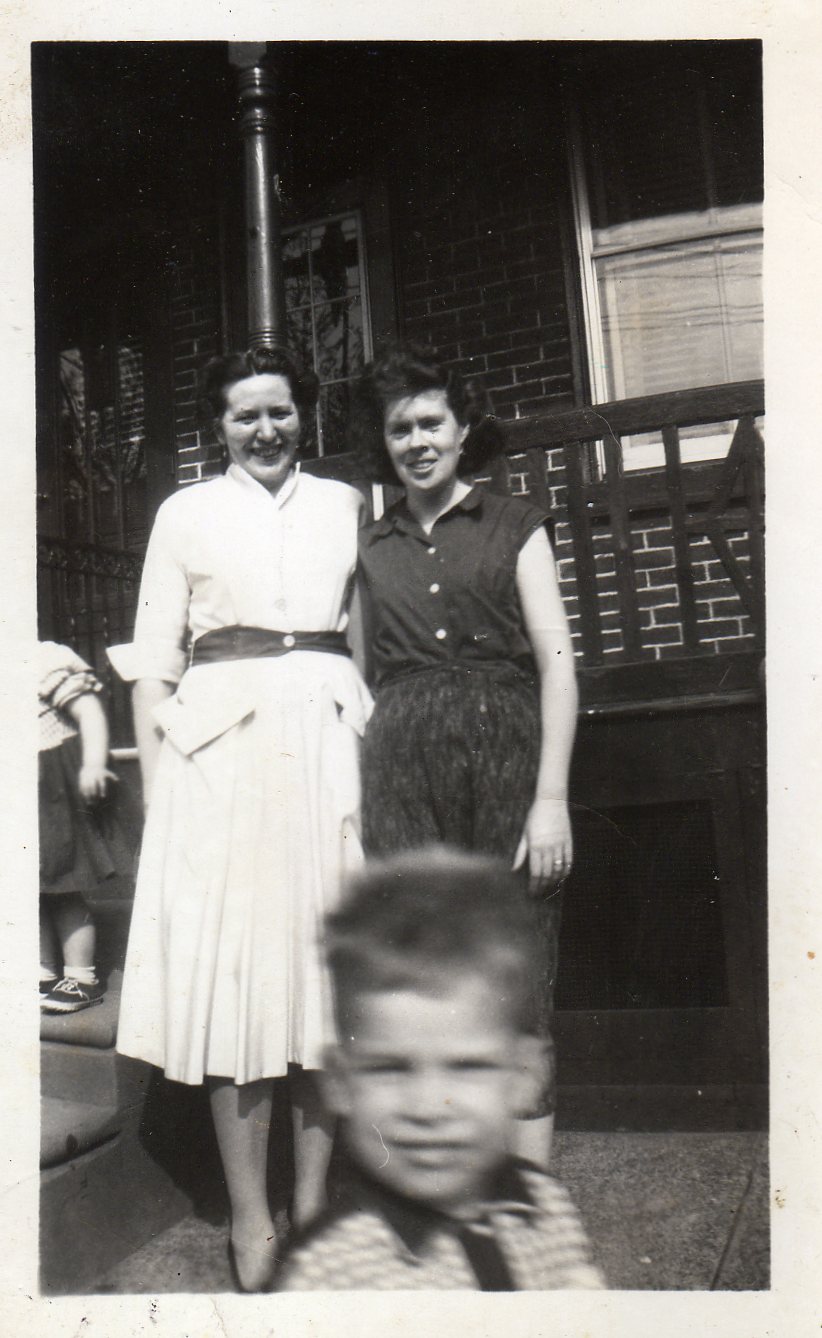
Theresa Burns and Mary Becoskie in front of the Burns house at 526 North 7th Street, next to Benny's grocery
Michael Larson, Michael Becoskie and Tommy McCullan, looking north on 7th Street at Elm Street
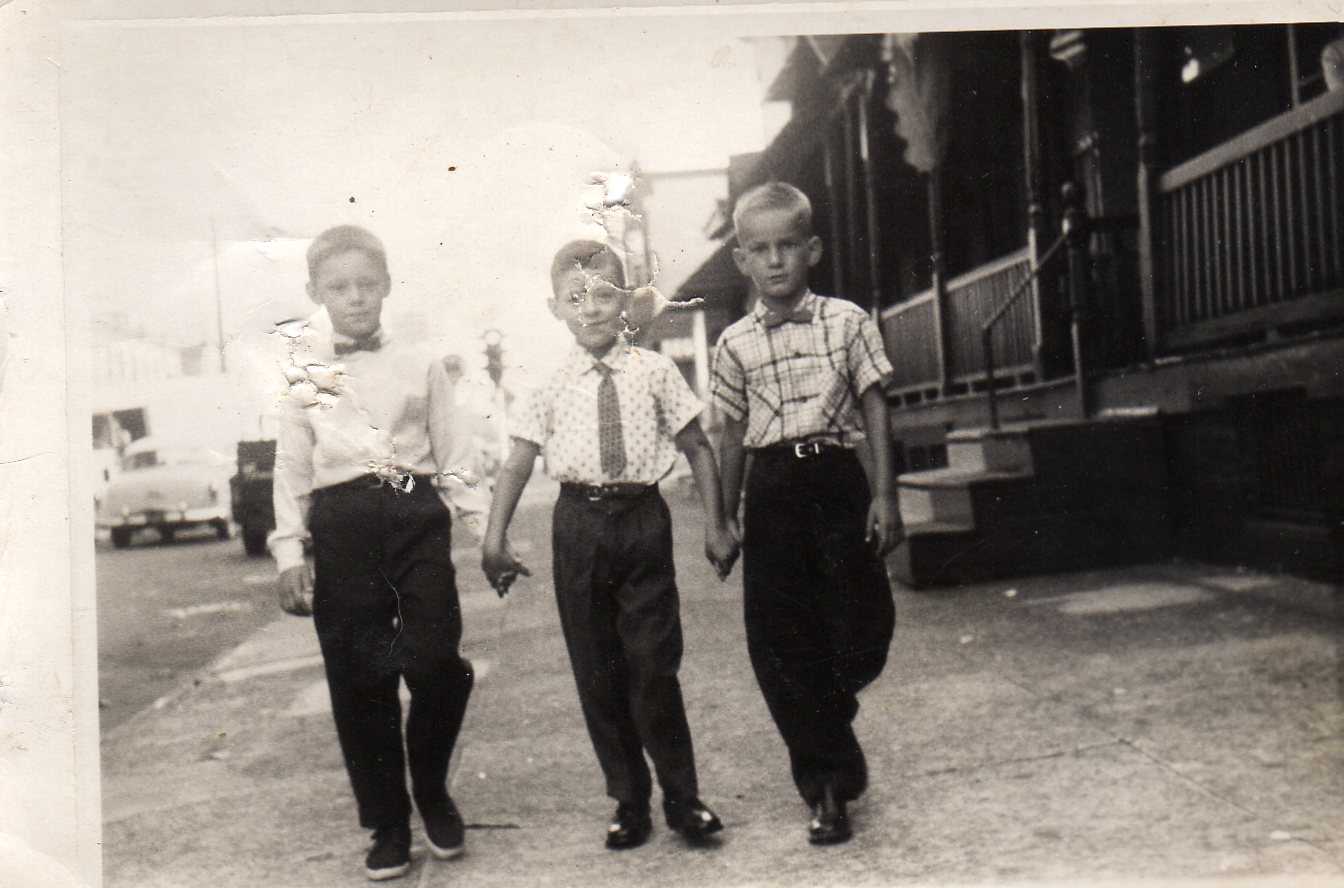
Group on North 7th Street near Benny's market, North Camden
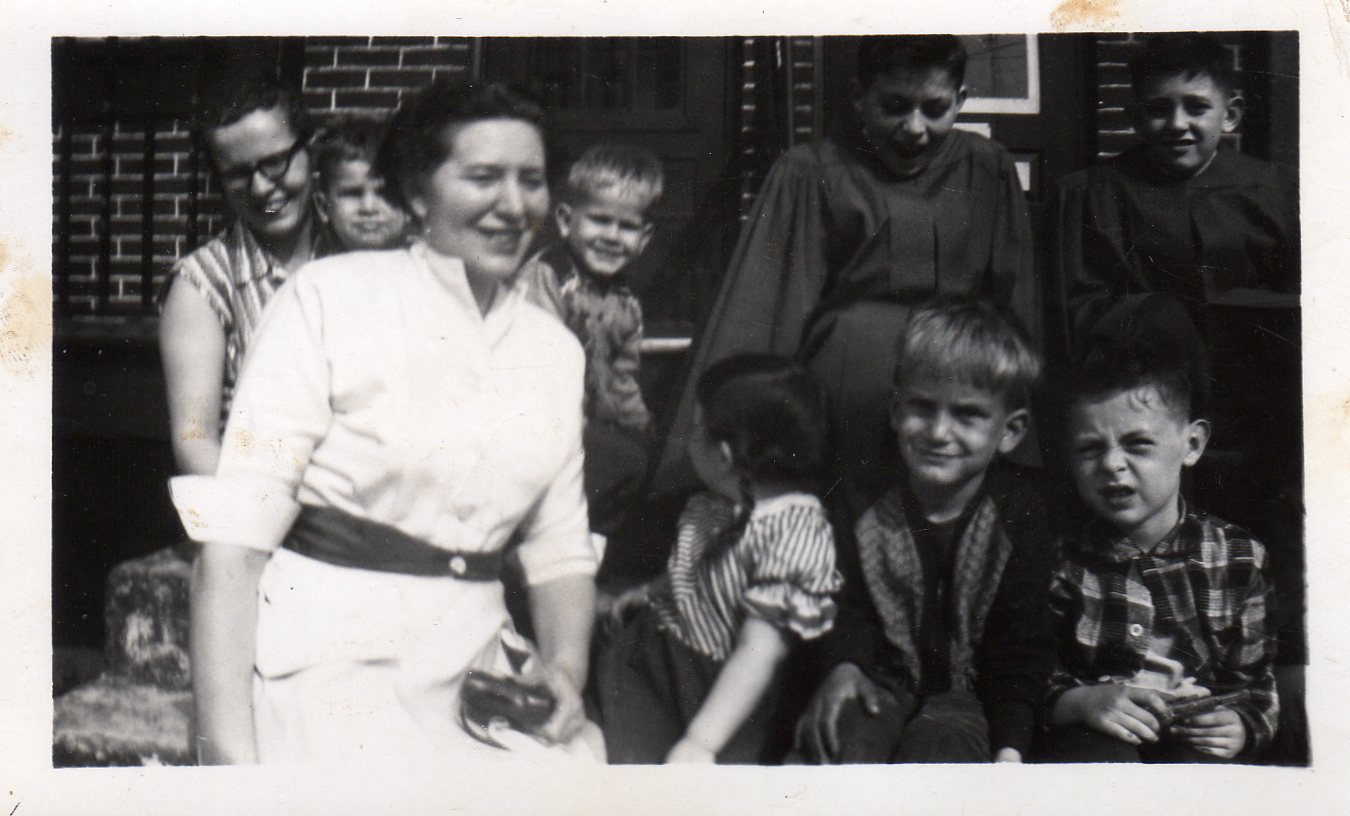
First grade at the side of Holy Name School, Vine Street
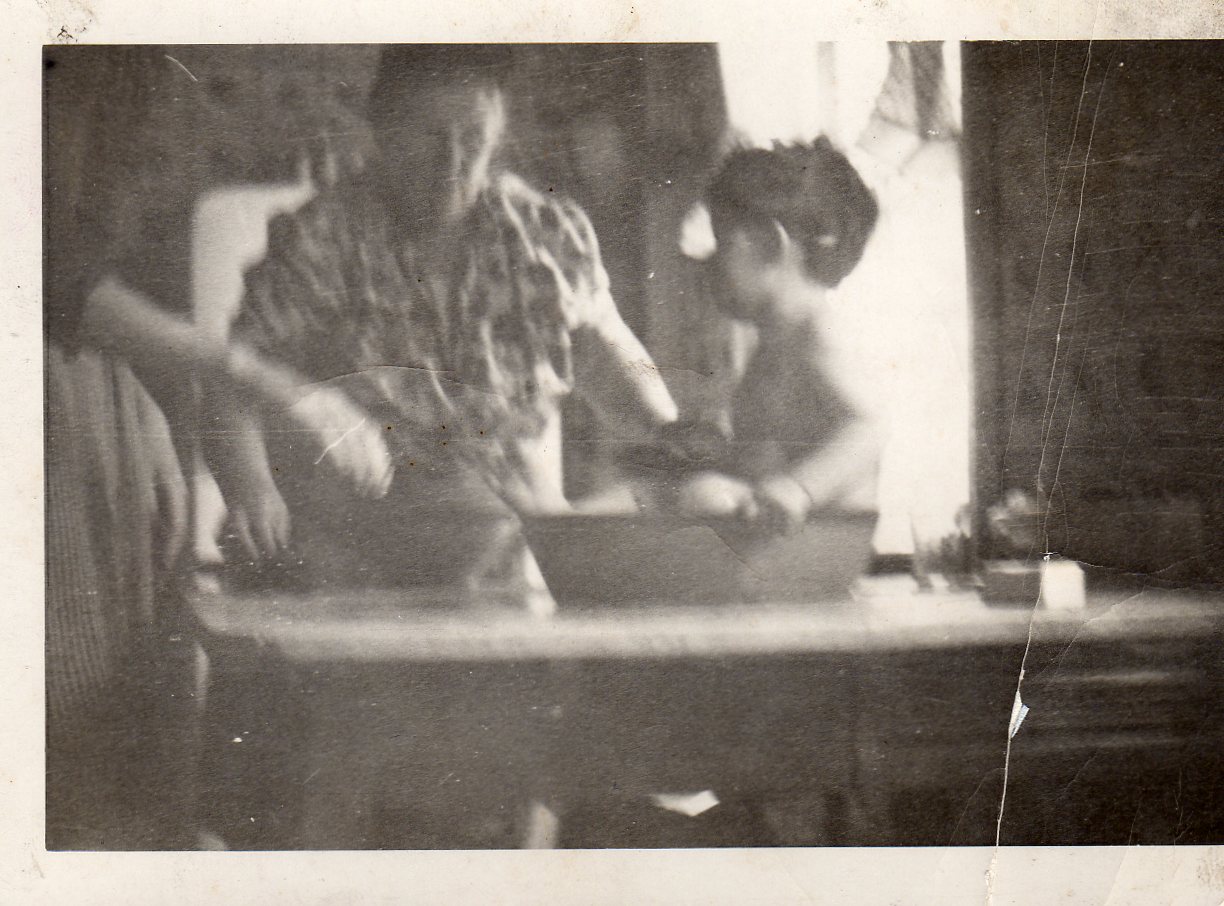
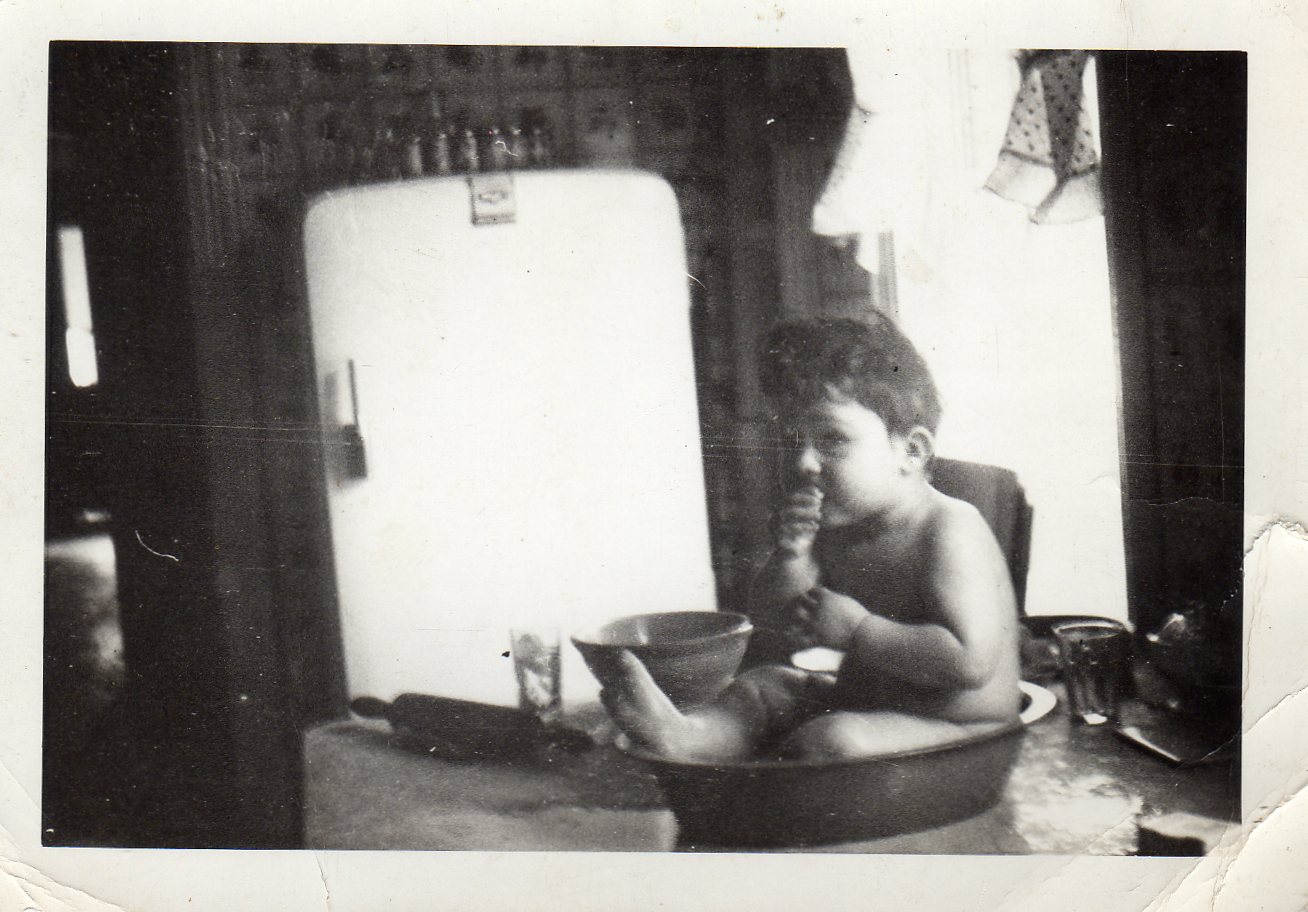
Kitchen of 625 Elm Street, 1947
625 Elm Street, 1947: eating sliced apples in Grandmother Catherine Kennedy's kitchen
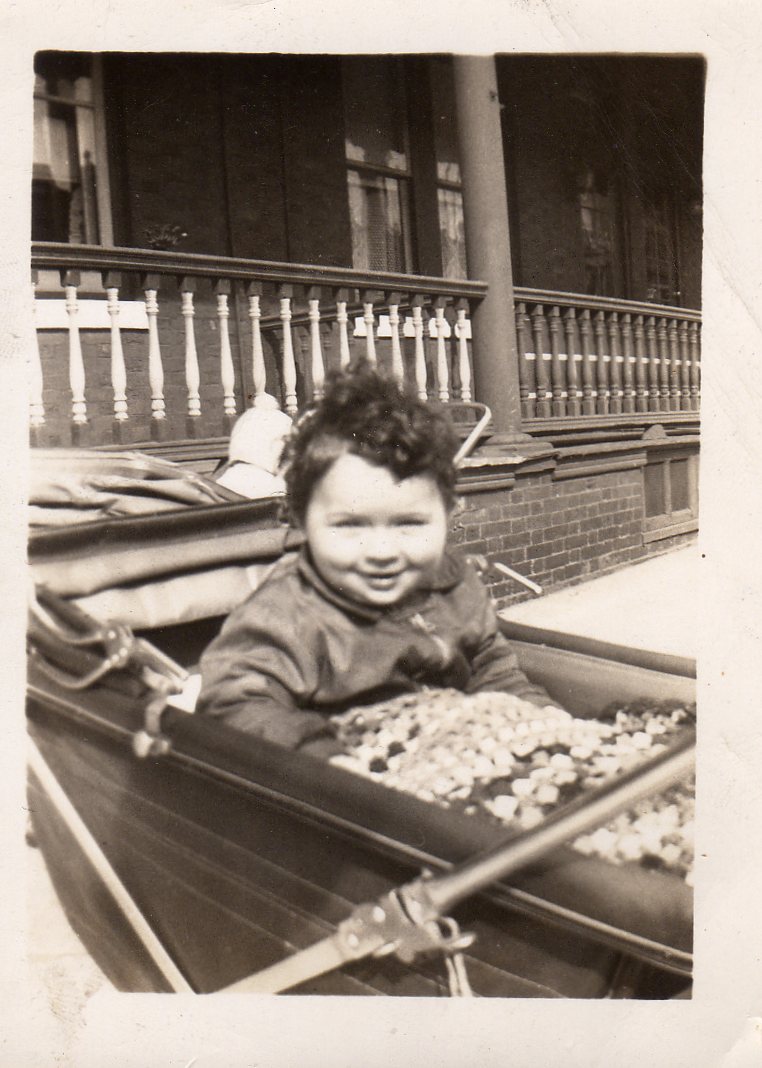
Mary Becoskie and Raymond H. Becoskie on the front porch, 625 Elm Street
Raymond H. Becoskie on the 600 block of Elm Street
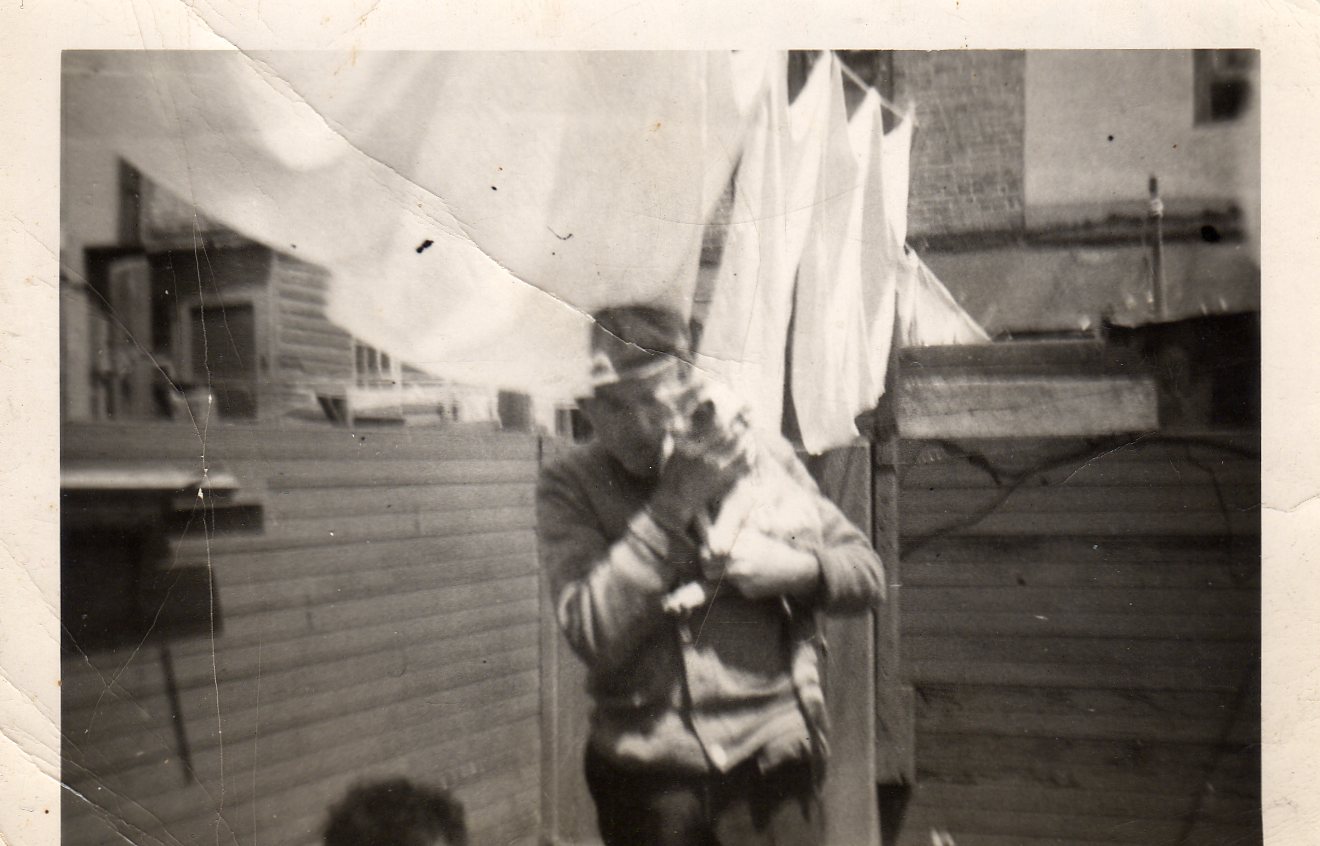
Elm Street backyard. Grandfather Hugh Kennedy, early 1950s.
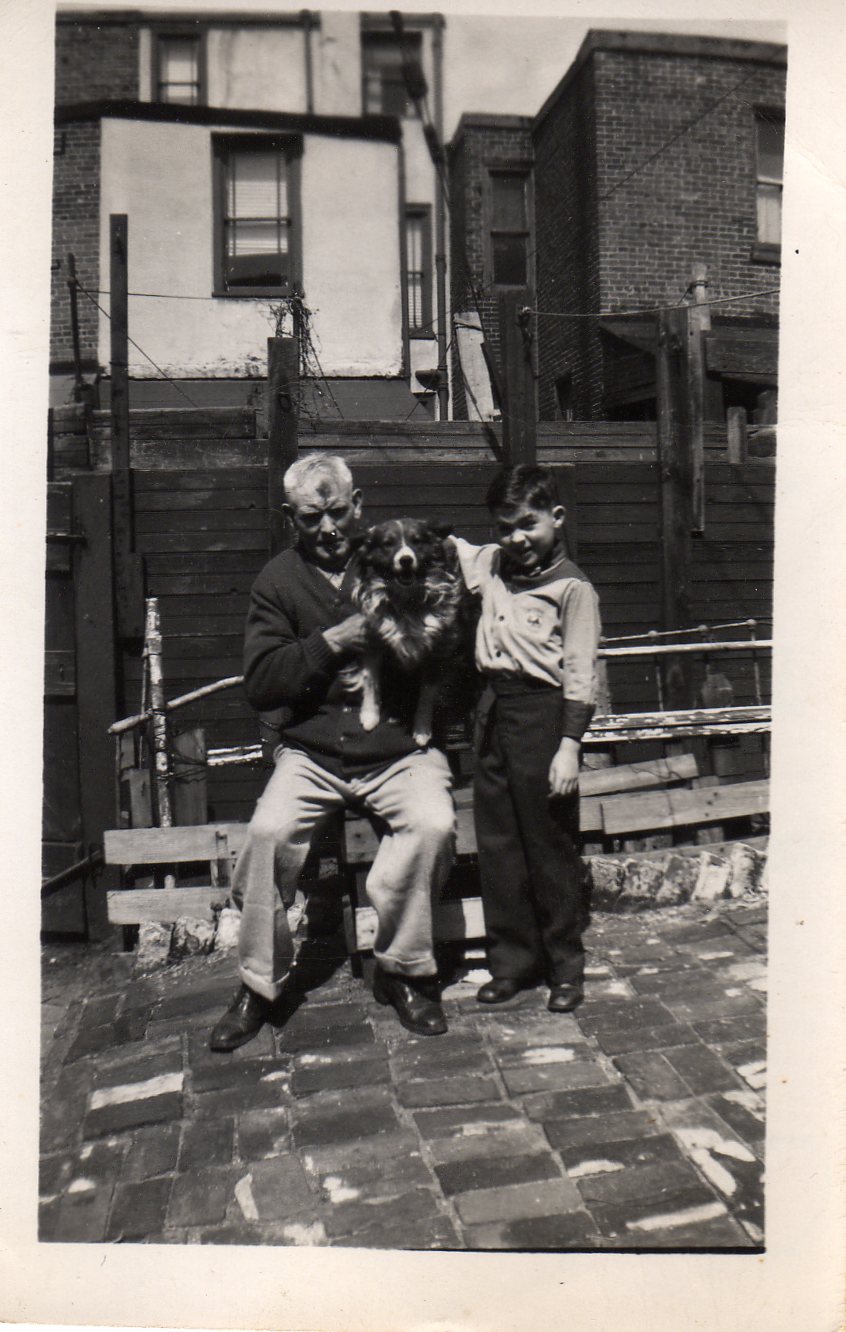
625 Elm Street backyard, early 1950s. Grandfather Hugh Kennedy, his dog "Skippy", Raymond H. Becoskie. To the north, back of the Cedar Street houses.
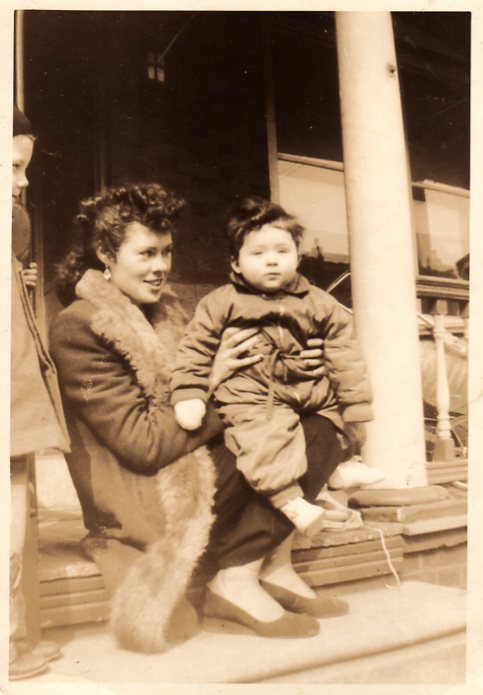
625 Elm Street porch steps — Mary Becoskie with son Michael, 1953.
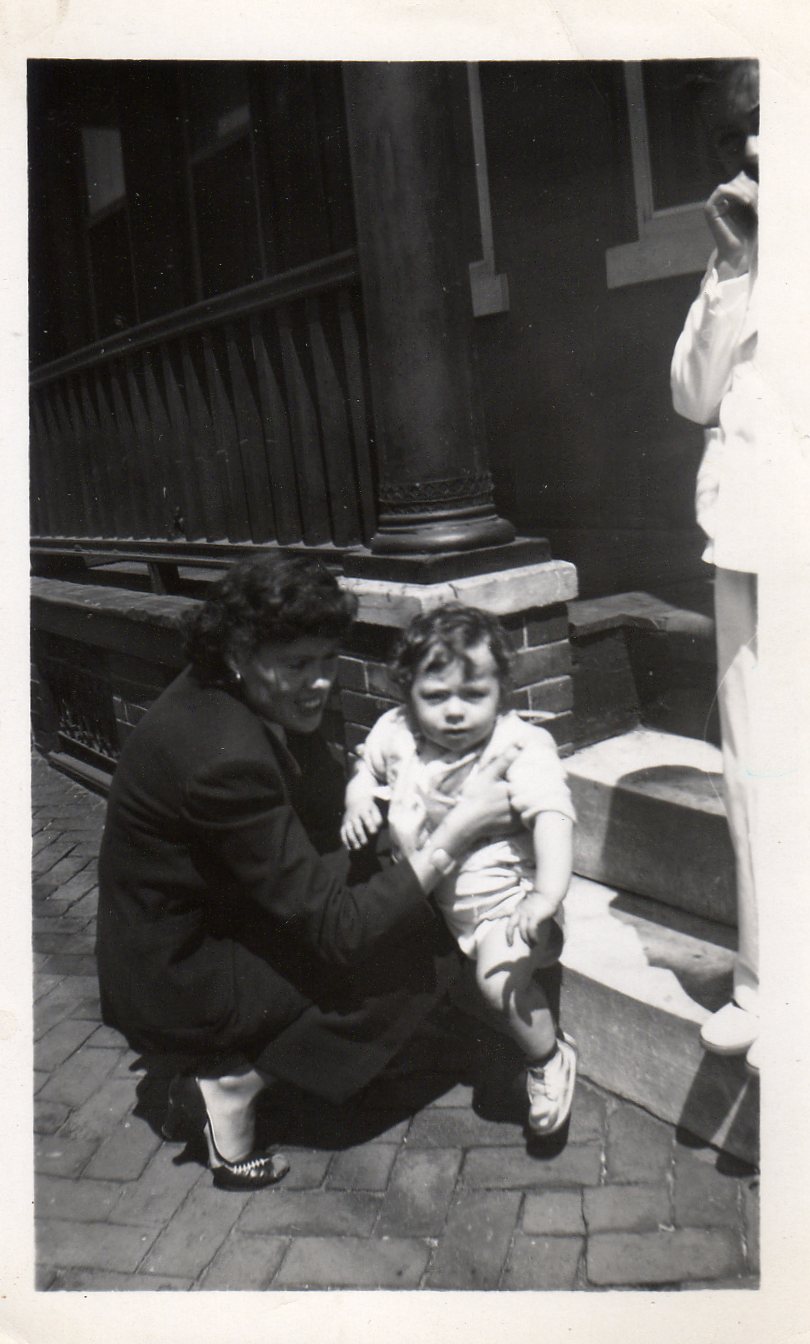
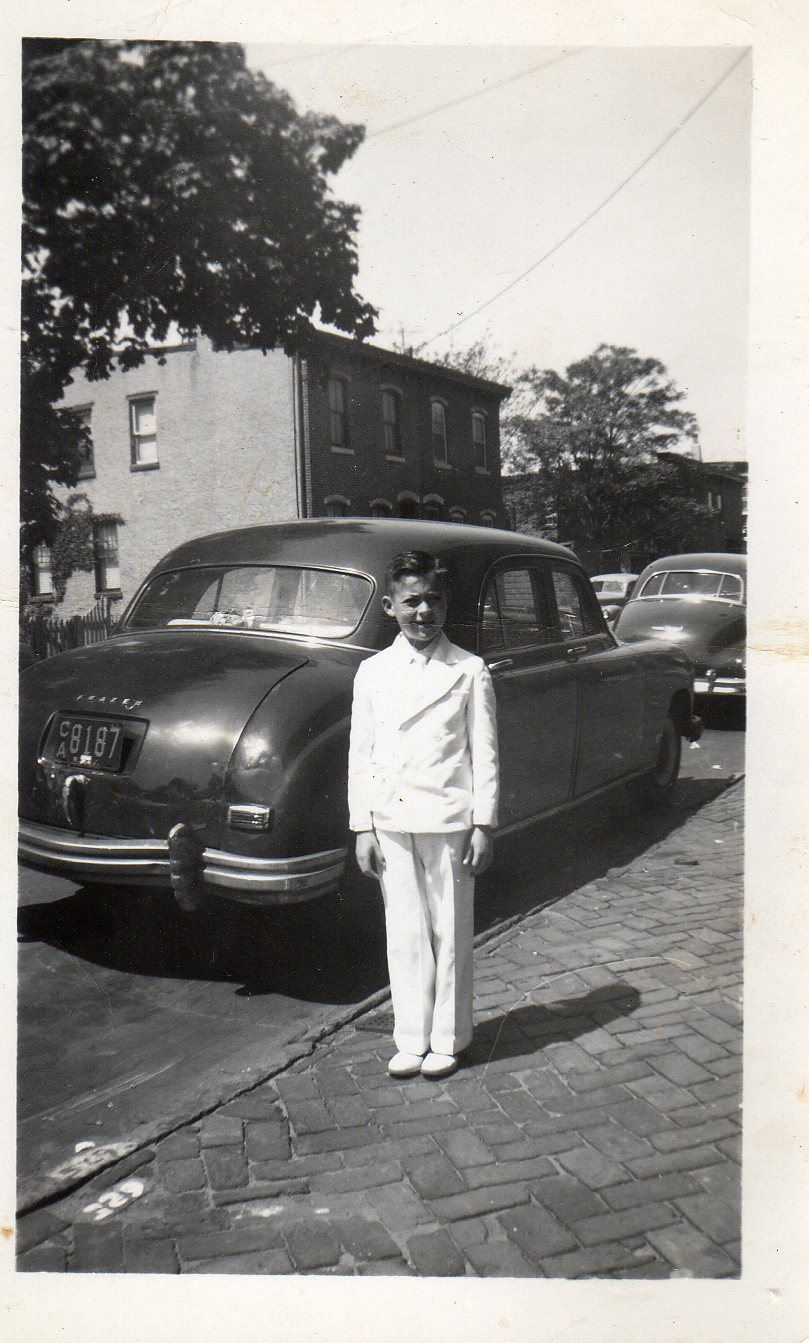
627 Elm Street steps — Mary Becoskie with son Michael 1953, Raymond Becoskie in his First Communion suit.
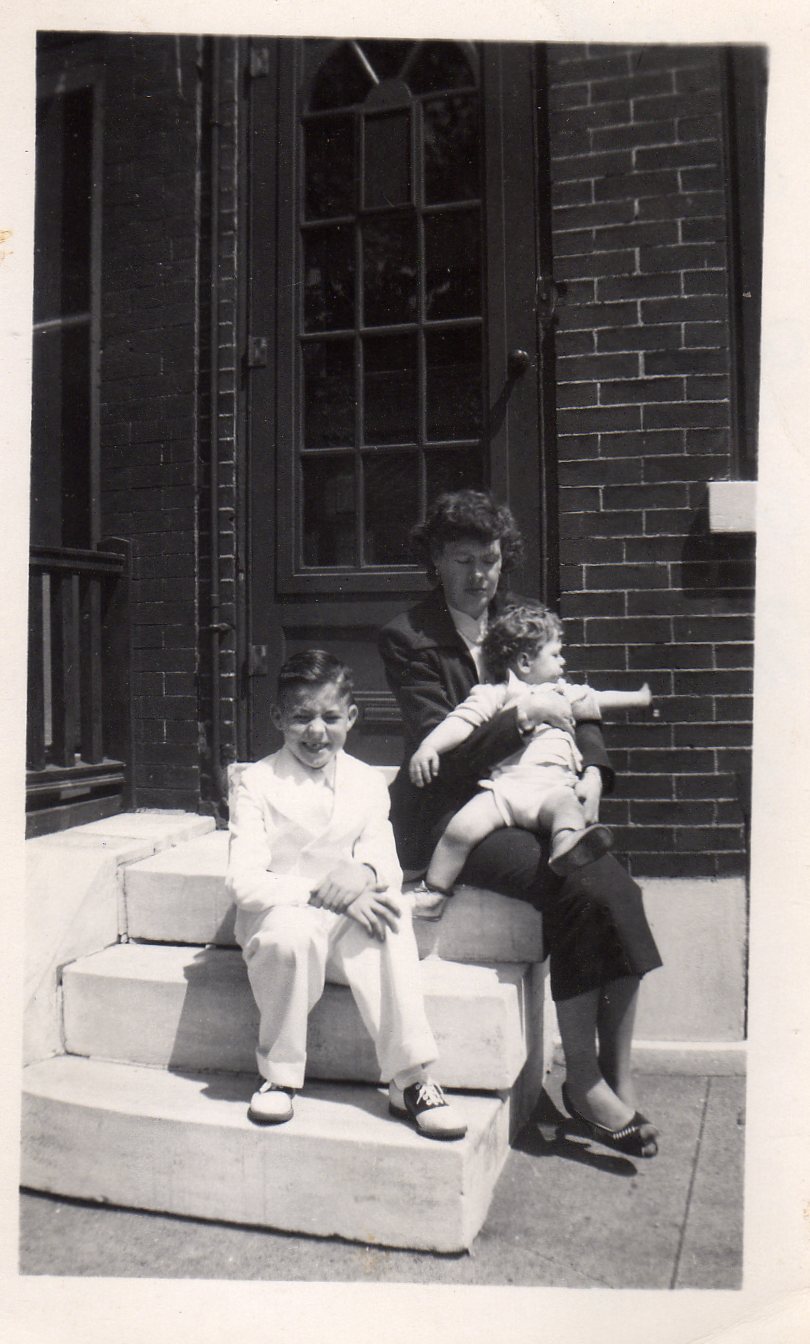
625 Elm Street backyard, 1953 — Ray Becoskie with son Michael.
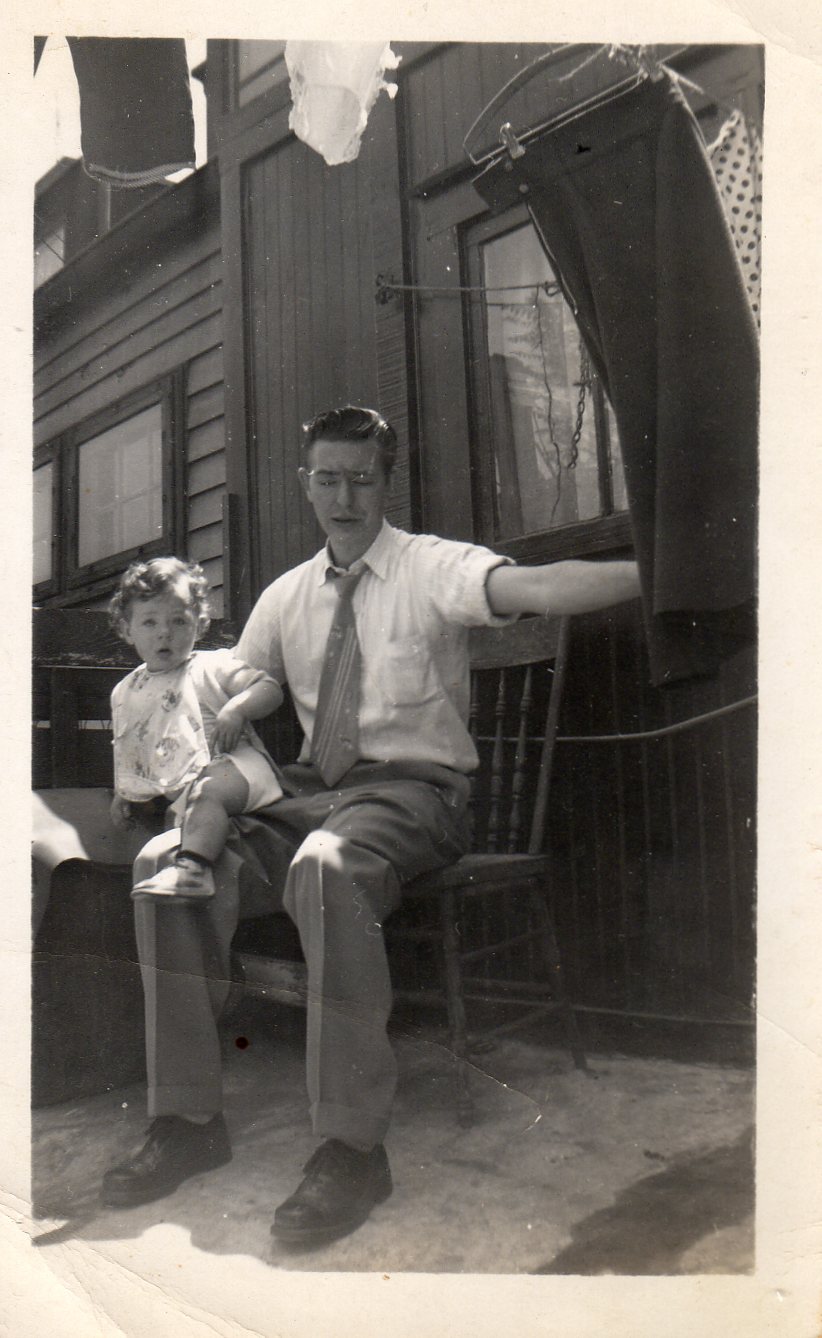
Elm Street, 1950s — Raymond Becoskie facing southwest.
View transcription
"Picture of my best friend, Jackie Brooks, of 619 Elm Street. We found an abandoned camera thrown in the weeds with other articles at the Admiral Wilson Blvd. and Forrest Hills overpass. It had two pictures left on it. I took them of Jack while he searched for more items. Mom had the film developed and gave me these two pictures. 1959–1960." — Raymond H. Becoskie, May 2010.
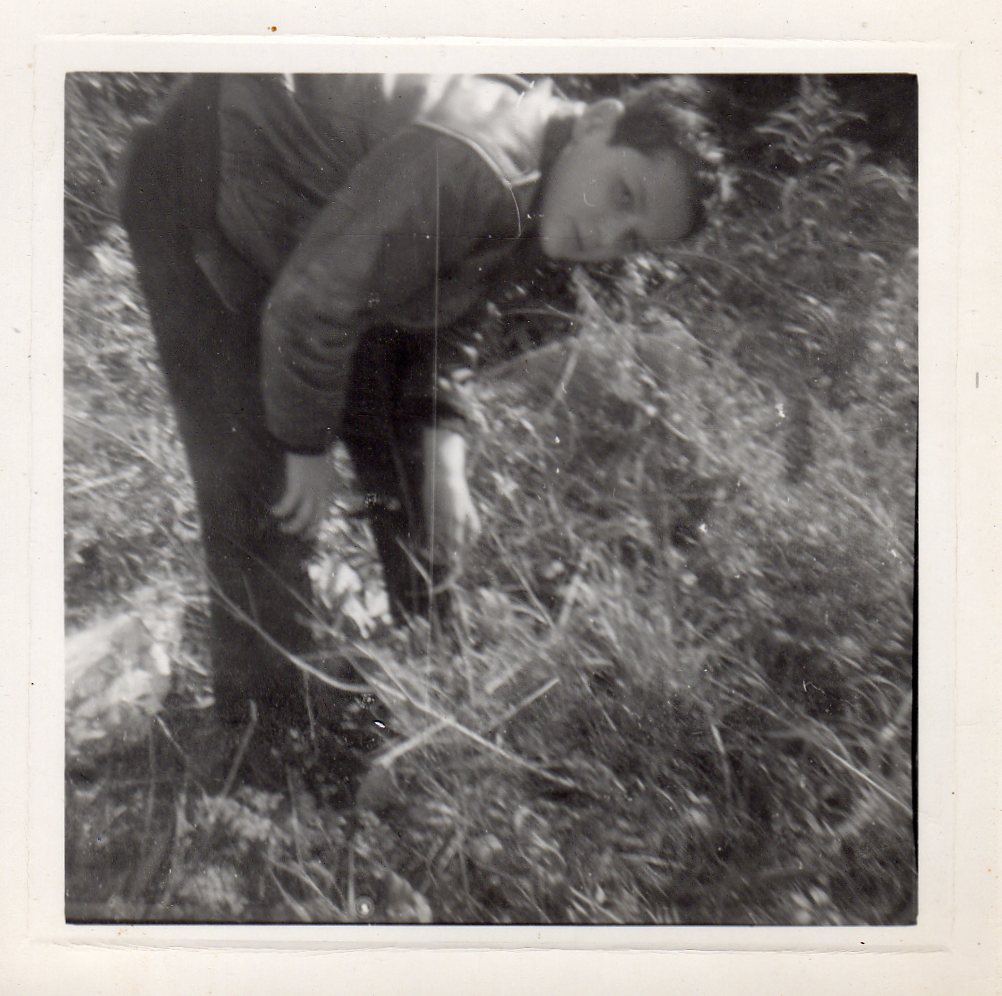
Jackie Brooks at the Admiral Wilson Blvd. and Forrest Hills overpass, 1959–1960.
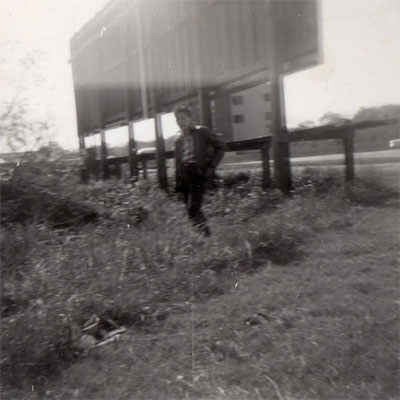
Houses for Sale — November 30, 1965
See Houses for Sale — November 30, 1965, as advertised in local newspapers that day.
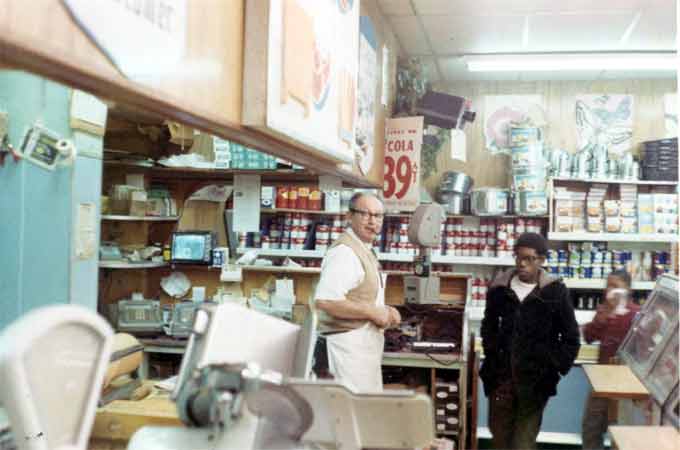
Litwin Brothers Market
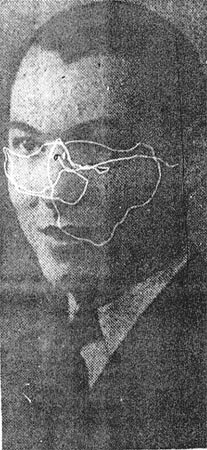
Isadore & Reba Litwin appear in the 1930 Census in Philadelphia PA, then residing at 2510 South 9th Street with their three children, Edward, Philip, and Sylvia. Isadore Litwin had emigrated from Russia prior to World War I. By the time the census was taken he already owned his own grocery store. By 1941 the Litwin family had relocated to North Camden, and Isadore Litwin had opened a grocery. Philip Litwin was driving a truck for the family business in 1941. He enlisted in the Army Air Force after Pearl Harbor, reporting for duty on January 4, 1942. After the war, the two Litwin sons married and lived nearby in North Camden. The 1947 Camden City Directory reveals that Edward Litwin had established a wholesale produce business.
Philip Litwin, 1941.
By 1959 the Litwins had moved their homes from North Camden. Isadore Litwin then lived in Parkside on Belleview Avenue, Phil Litwin moved to 3000 Stevens Street in East Camden, and Ed Litwin had moved to Pennsauken. It appears that at this time the brothers had both returned to their father’s business. Times became hard in North Camden, and by the middle 1970s there were only two groceries of any size in North Camden, the Chek-In Market at 548 State Street, and the Litwin Brothers. When the Chek-In closed its doors in the early 1980s, only Litwin’s remained.
In 2004 the Litwin Market still is in business at 8th and Elm Street, and the Litwin Brothers Check Cashing business also serves North Camden, providing a service not available in that neighborhood, as no commercial bank has done business in North Camden in over 50 years.
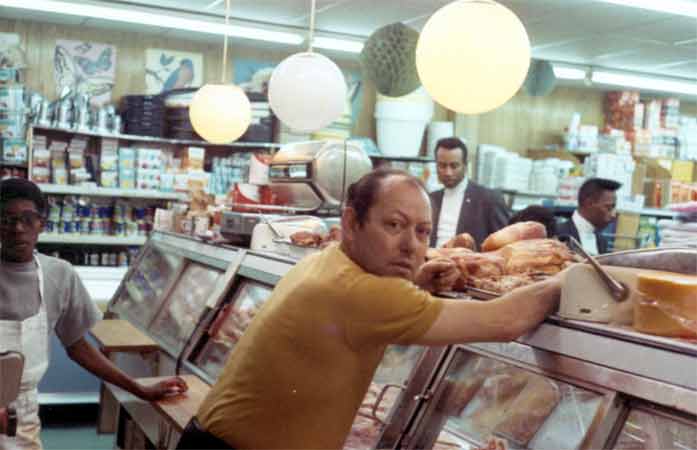
Phil Litwin, Litwin Brothers Market, 1970–1971.
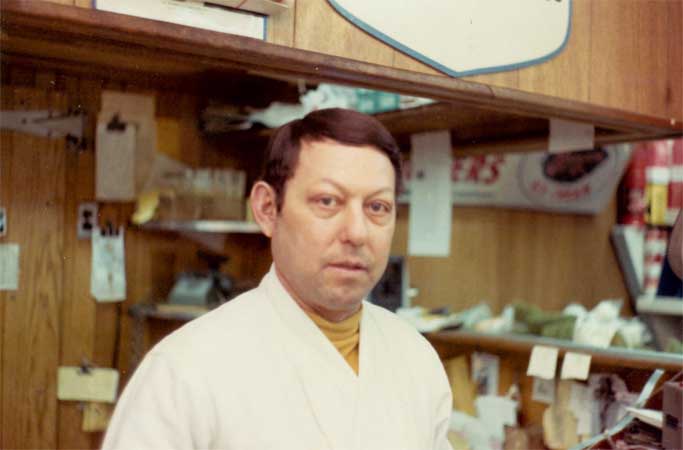
Ed Litwin and Robert Pratt at Litwin Brothers Market, circa 1970-1971. Courtesy of Earl Crim.
View transcription
Phil Litwin and Robert Pratt at Litwin Brothers Market, circa 1970-1971. Courtesy of Earl Crim.
Dave Litwin and Earl Crim at Litwin Brothers Market, circa 1970-1971. Courtesy of Earl Crim.
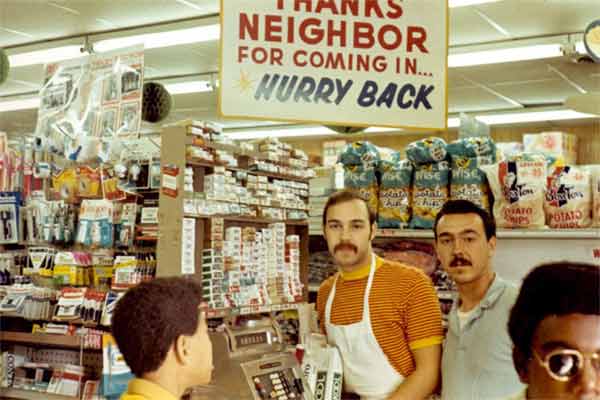
View transcription
Earl Crim at Litwin Brothers Market, circa 1970-1971. Courtesy of Earl Crim.
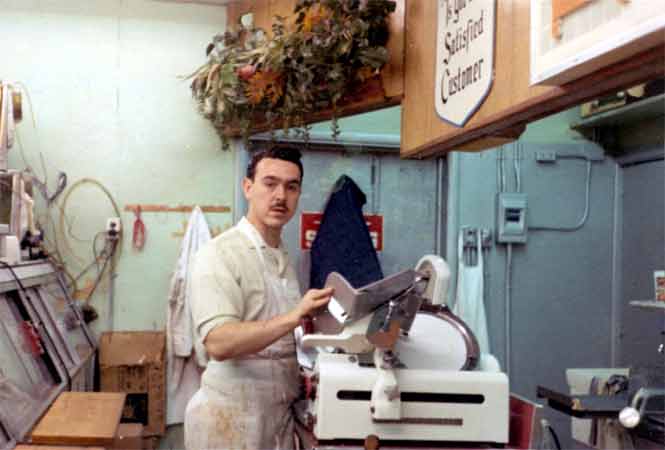
View transcription
“…late 1970 or early 71 I remember that Ed Litwin made a deal at Cherry Hill Dodge on three 1970 Dodge Swingers… I got one, Dave Litwin got one, and Eddie bought one for his daughter Eileen.” — Earl Crim, 2004
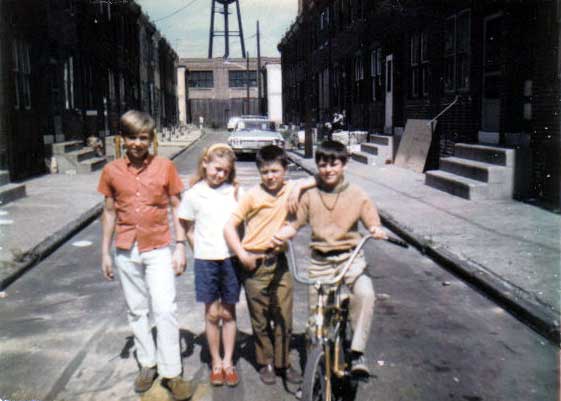
Looking North on Segal Street — Summer of 1971
Looking north on Segal Street, summer of 1971. Floyd Miller Jr., Vennie Miller, Bobby Reed, & Frank Houser Jr. John R. Evans factory at rear. Photo courtesy of Floyd L. Miller Jr.
Poets Row
See the Poets Row web page.
Bridge Board to Take 27 Properties as Safety Zone for Rail Underpass
Camden Courier-Post - February 4, 1933
Read the article: Bridge Board to Take 27 Properties as Safety Zone for Rail Underpass
Under the Bridge — July 5, 2004
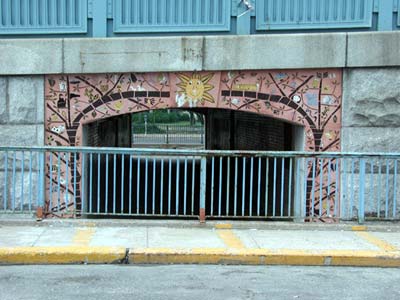
While you can drive a car under the Ben Franklin Bridge at street level from North 3rd Street east, at 4th Street there is a tunnel, closed in the early 1980s, that provided amusement for generations of local kids on bicycles, and aggravation for most adults responsible for public safety. At 5th Street there is a pedestrian tunnel, which is still in use.
4th Street tunnel under the Ben Franklin Bridge, looking south, July 5, 2004. Note the cobblestone paving and the stairway leading up to the pedestrian walkway on the bridge.
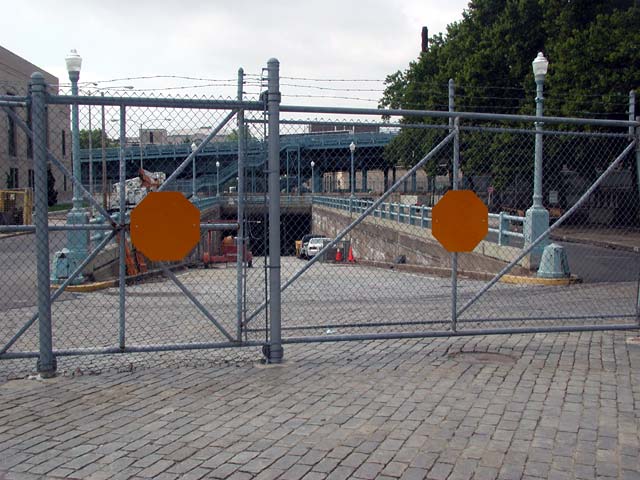
4th Street tunnel under the Ben Franklin Bridge, looking south, July 5, 2004.
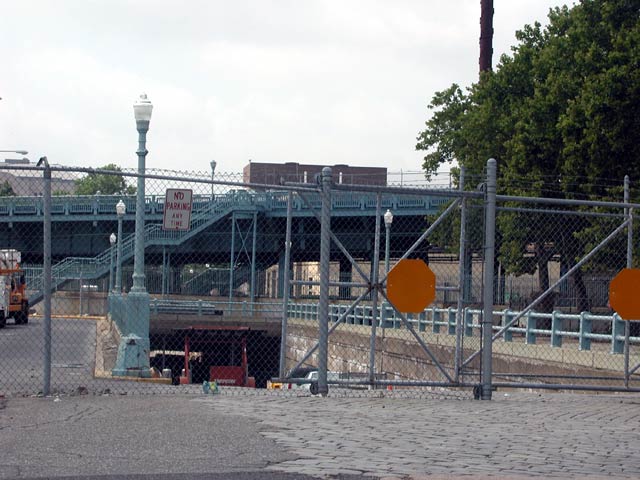
View transcription
Boys and girls from North Camden would take advantage of the tunnel ramps to roller skate and bicycle in days gone by. Thanks to Earl Crim, Jim Bessing, and John Ciafrani for telling me about the tunnel.
“You had to cross the railroad tracks on Main street to go or come from tunnel. There were no rail crossing gates, just a railroad crossing with blinking lights and a bell. A lot of guys would hop those boxcars for a short ride. That was a fun trip, but dangerous.” — John Ciafrani, October 2004
5th Street pedestrian tunnel under the Ben Franklin Bridge, looking south, July 5, 2004. Note the Rutgers University building in the background.
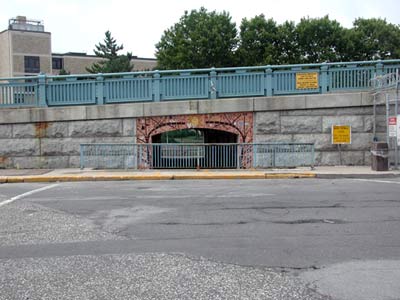
5th Street pedestrian tunnel under the Ben Franklin Bridge, looking south, July 5, 2004.
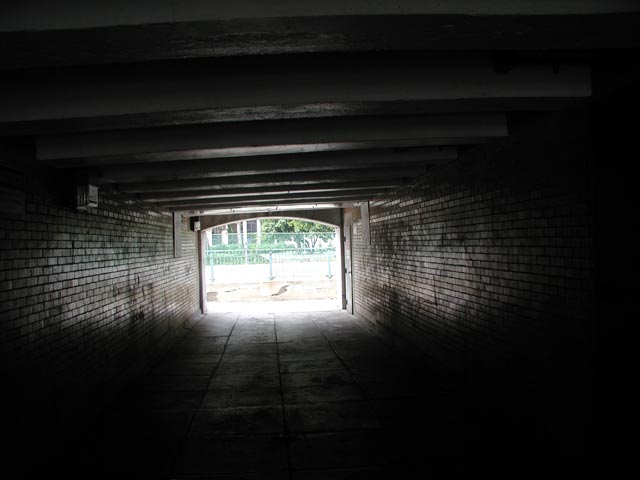
Inside the 5th Street pedestrian tunnel, looking south, July 5, 2004. Note the Rutgers University building in the background.
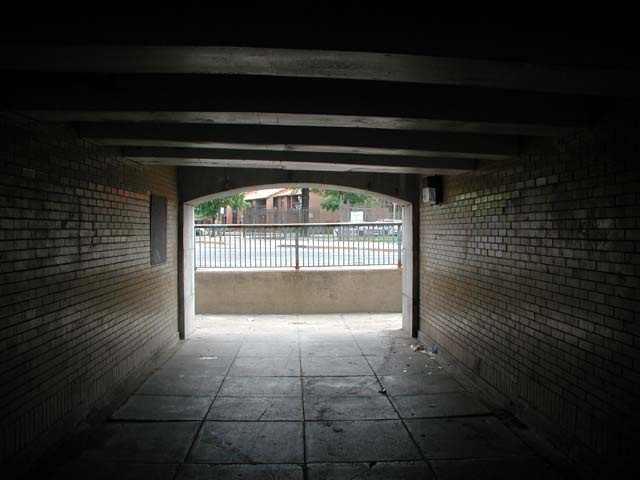
Inside the 5th Street pedestrian tunnel, looking north, July 5, 2004. Note the Northgate townhouses in the background.
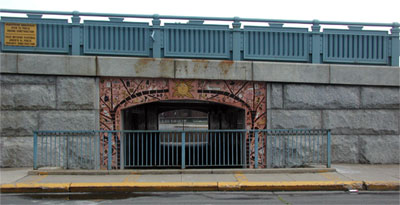
5th Street pedestrian tunnel under the Ben Franklin Bridge, looking north, July 5, 2004.
100 Block of Linden Street
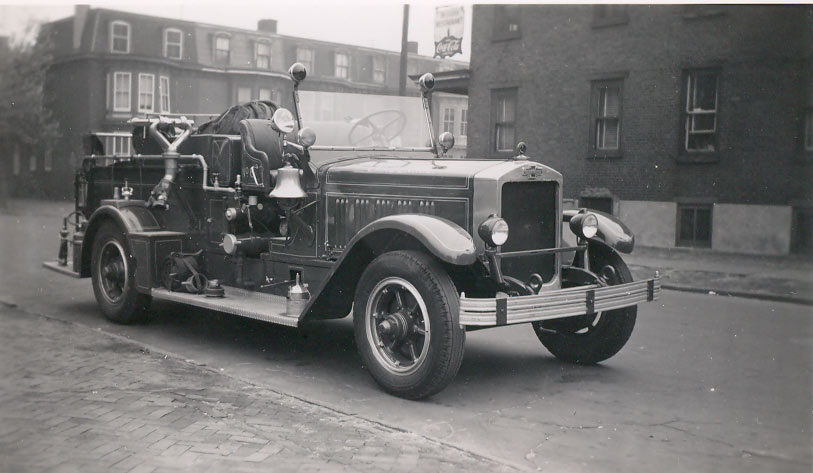
Intersection of Front and Linden Streets, circa 1950. Houses at rear are 101, 103, 105 and 107 Linden Street; 100 Linden Street is the restaurant at right. Fire truck of Engine Company 6.
View transcription
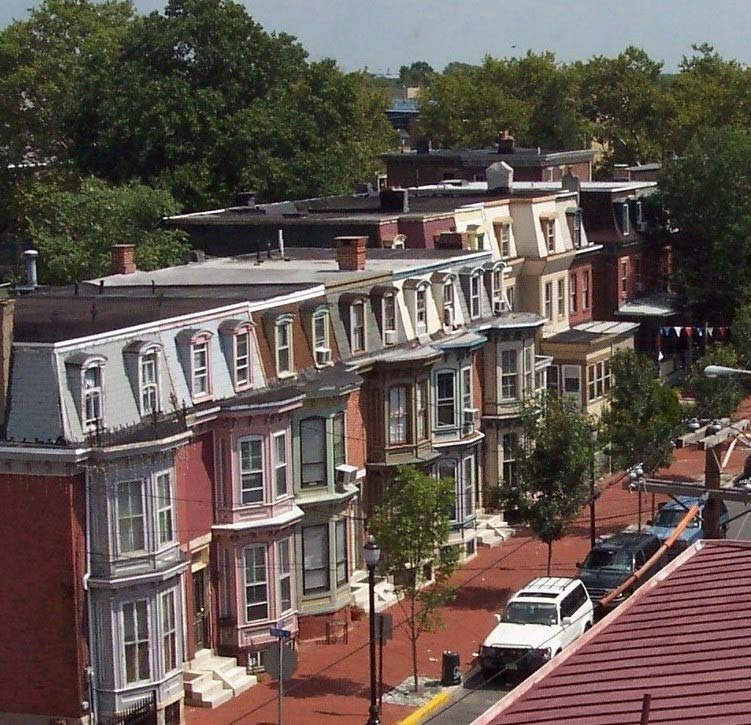
101-119 Linden Street, 2004. Photo by Craig Campbell.
A Child's Life on Grant Street: Memories of Camden
Read the article: A Child's Life on Grant Street: Memories of Camden
A Few North Camden People
| Dr. Howard F. Palm | Winfield S. Price | John F. ‘Pop’ Daly |
| Ellen D. Ryan | Frank J. Hartmann Jr. | Elsa Olah |
| Charles A. Wolverton | Charles S. Wolverton | Walter P. Wolverton |
| Samuel T.J. French Sr. | Samuel T.J. French Jr. | Nelson G. French |
| John F. Rittenhouse | Francis H. Rittenhouse | Edwin Figueroa |
| Dr. Walter Bray | Thomas Winstanley | Jacob A. Canning |
A North Camden Dilemma
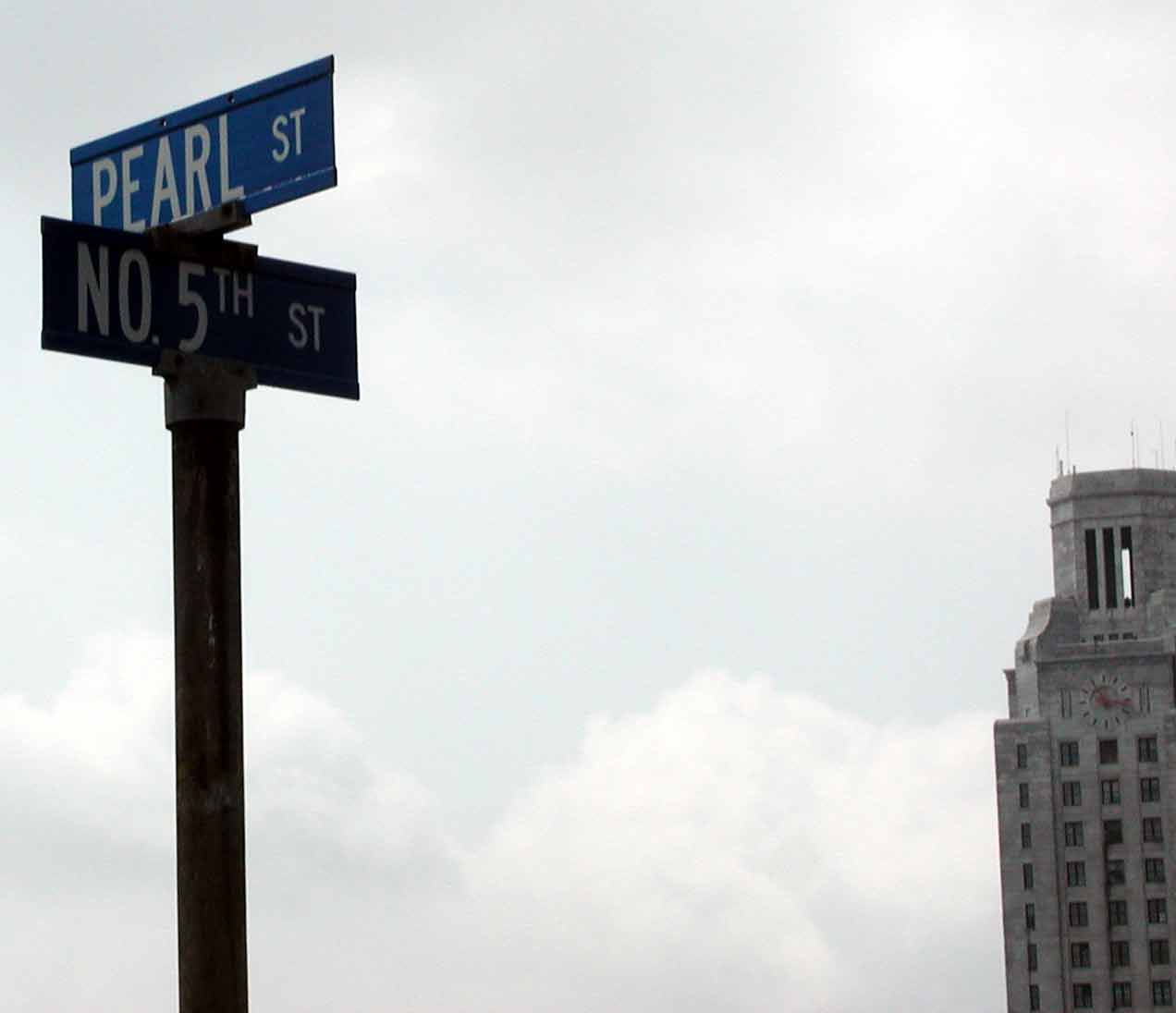
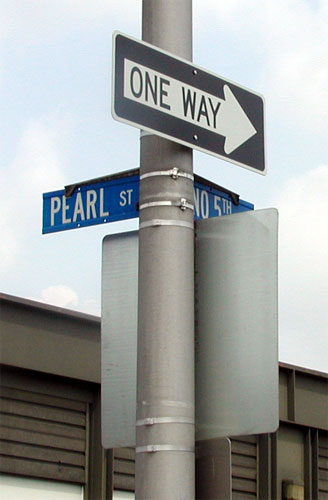
Can someone explain how the corner of 5th and Pearl can be on BOTH north and south sides of the Ben Franklin Bridge?
5th and Pearl Streets, south of the Ben Franklin Bridge, 2004.
5th and Pearl Streets, north of the Ben Franklin Bridge, 2004.
View transcription
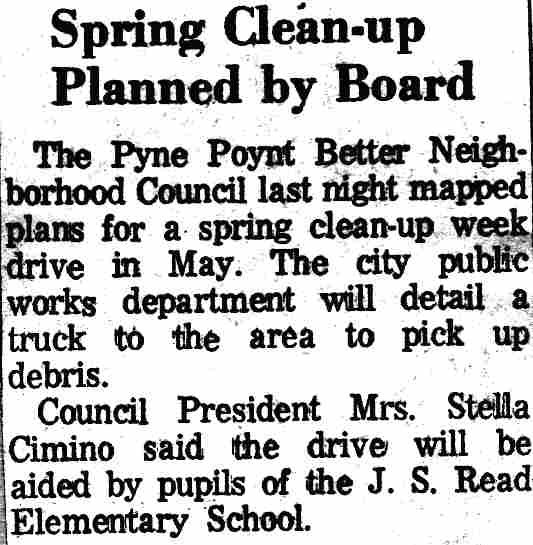
Spring Clean-up Planned by Board
Camden Courier-Post, April 1965
View transcription
Read the article: Spring Clean-up Planned by Board
State Trooper Helps Camden Children Fight Back
Camden Courier-Post - August 4, 2004
National Night Out program spotlights his achievements — By Alan Guenther
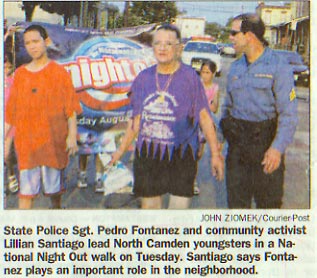
Sgt. Pedro Fontanez and Lillian Santiago lead a National Night Out walk in North Camden, Camden Courier-Post, August 4, 2004
View transcription
A few moments before a Tuesday evening rally to take back a North Camden neighborhood from criminals and vagrants for a night, Sgt. Pedro Fontanez winced as he watched 8-year-old Jahaira Miranda expertly steer her bare feet through pebbles and glittering shards of broken glass. She wanted to show her favorite place to hide. She didn’t choose the five abandoned houses near her apartment off Cedar Street. She walked past spare tires piled high against a fence. She ignored the mound of black earth Fontanez said had been illegally dumped on the land next to her home. Finally, she smiled. She showed a dented silver Plymouth Breeze parked on the grass.
“That’s my favorite,” she said. She plays there when it’s not too dark or dangerous to go outside.
As he watched Jahaira, Fontanez squinted into the setting sun. “It breaks your heart, doesn’t it?” he said.
With community activist Lillian Santiago, Fontanez helped fit about 20 neighborhood children with sparkling earrings — tiny lights provided as part of a National Night Out celebration. During the National Night Out, neighbors try to send a message to criminals that they’re fighting back.
An estimated 10,000 communities were expected to participate in 50 states on Tuesday, according to the National Association of Town Watch in Wynnewood, Pa. Sixteen South Jersey communities were scheduled to celebrate.
Because of the recent rash of crime in Camden, Santiago said the National Night Out celebration was especially important. Thirty-four people have been murdered so far in Camden this year. The record was set in 1995 when 58 people were killed.
Santiago calls her community group the North Camden Stars. She tries to get as many children as possible involved to show them that “the drug life is no good for them,” she said. Fontanez plays an important role with the children in North Camden, she said.
“He’s good with the kids,” she said. “He knows how to talk to them.”
He reads to local children in the schools, he said. He’s working with children to rebuild bicycles and distribute them for Christmas this year. He’s working with the local high school and elementary schools, trying to build a program where the older children tutor and act as mentors to the younger kids. City school officials will meet to discuss the proposed mentoring program today, he said.
Fontanez said he tries to restore goodwill toward state troopers in a city where they have not always been welcomed.
A high school dropout at age 17, Fontanez later became a pilot, a licensed practical nurse and a state trooper. He returned from military service in Iraq last year.
“I guess I’m an overachiever,” he said. He wants children — and adults — to know that “if given the opportunity, every child has the chance to succeed.”
As they walked through their North Camden streets, the children carried a “National Night Out” banner. From behind, they were small silhouettes in the setting sun, surrounded by graffiti, potholes and boarded up homes.
Ray Becoskie's Memories of North Camden
I was familiar with most of the streets of N. Camden as I was a paperboy for the Philadelphia Bulletin. My daily and Sunday route spanned from East/West 5th Street to 10th Street and North/South from Pearl Street all the way down to the only house next to the river in Pyne Point Park, I think it was a dredge owner’s house. I used to pick up my papers at the store on 7th & Vine across the street from the Sewell School. As I remember it was owned by two sisters at the time.
At times when we were playing on 10th Street, we would cross the State Street Bridge when it used to rotate to let the tug boats through. Sometimes the bridge operator would allow us to stand on its walkway while he rotated it, if we promised to behave and stand still.
Seeing the caretaker’s house at Pyne Point brought back memories also. Smith… Smitty as we used to call him would frequently chase us out of the park, we were usually mischievous and I guess we deserved it.
The Ben Franklin Bridge was one of our favorite playgrounds, walking or riding our bikes across. Loading up our pockets with stones to throw them in the river from the middle of the bridge. My Grandfather would walk that bridge to Snellenberg’s in Philly where he worked as a window washer (he didn’t want to spend the dimes for carfare.) My mother told me that he also walked that bridge on its grand opening in 1927.
One last memory for now is the City Hall. From our front steps my mother taught me how to tell time from the glowing hands of the clock.
In the pony picture there is a bag of laundry on the porch (on Elm Street). All laundry was sent out or done by hand on Mondays, if I remember correctly. That’s the day the “Clothes Prop Man” would walk the alleyways of Camden carrying homemade clothes props, clothes pins & clothes lines on his shoulders singing out “CLOTHSSSEEE PRROOPPS” very loudly. (Everyone in Camden was enterprising!) More stories later about the “Knife Sharpening Man”, Window Washer Man, vendors etc.
There was one more article by a lady, I forget the street. But she talked of buried treasure on Petty’s Island. We were all “River Rats, Bridge Brats, and Alley Cats!” On more than one occasion we would lash crates, skids, pallets together to paddle our way over there, or to the ran-aground barge from Pyne Point. It must have been the Huckleberry Finn, Tom Sawyer Stories. I’m now glad we always flipped over in shallow water, or I wouldn’t be typing this today!
Warren Ash Jr.'s Memories of North Camden
My name is Warren Ash Jr. I now live in Tacoma, Washington. I used to live at 718 N. 8th Street in Camden. My father, Warren Ash, bought the house in the 50’s from a Mr. Welch. I was born in 1955. My mother’s name was Georgia Ash and I have one younger sister, Diana. We lived there until 1967, I believe.
I have seen pictures of 718 on the web and it isn’t pretty. I can see through the old bathroom window and see light, which means the walls between the bathroom, the back bedroom and the outside wall are open or missing. Looks like a fire may have burned out the place. I was by there in the seventies and someone was still living there.
I remember Mr. Austermuhl of 740 State Street and Mr. Dalton of Dalton’s Pharmacy on the northwest corner of 8th and State. The store on the northeast corner of 8th and State used to be a milk store.
On the southwest corner of 8th and Vine Street was another drugstore, complete with soda fountain. It was the old typical green metal exterior with the big Coca-Cola circle emblems. I used to get my candy there.
I went to school at both schools a little further up Vine Street. The older school was called Sewell School. The school on the southwest corner of 7th and Vine was called Northeast School. My father attended Sewell school also. Northeast used to be an all girl school when he was a kid. Of course, the old building has been replaced by a newer structure. I was in class in the second grade at Northeast School when President Kennedy was assassinated.
Another childhood memory was watching the Mummers parade marching from State Street, down North 8th Street. I can also remember watching a large fire in an abandoned factory located on the northeast corner of North 9th Street. It lasted most of the day and was something a kid will always remember watching. If you travel south on North 8th Street and turn left on Vine Street, you will come to Willard Street on the right. That is where most of the gang members of my youth used to live.
I also remember that bridge on State Street being stuck in the open position because it was so hot outside when they opened it, it expanded and wouldn’t shut. The fire department had to hose it down for a while so it would close. Anyway, just before that bridge, on the North side of the street, there used to be businesses and stores. My Mom saw a doctor for her thyroid there and there used to be a pizzeria and deli and another drugstore where I got my first Cherry Coke, handmade at the soda fountain.
My dad would also take me to the bridge over the rail yard on East State Street. We were both train nuts. As a matter of fact, I got my first train ride down in that yard. We were walking around and an engine crew wanted to know if we wanted a ride.
My Grandfather, Warren S. Ash, bought and owned the Matlack & Sons hardware store at 701 North 8th Street. 703 North 8th Street was also a part of the hardware store. Downstairs at 703 was the business office and my Grandfather lived upstairs of both 701 and 703.
My Grandfather moved the hardware business further downtown to an old Packard dealership. He stopped selling to the public and dealt with schools and businesses. This was before the riots in 68. I forget the town he moved his home to and my family moved to Collingswood. We didn’t stay there long. My dad worked for IBM and we started to move fairly regularly after 1969. Never lived in New Jersey again after that. He was an IBM customer engineer for all of South Jersey, fixing those giant computers that now fit in a laptop.